Recognize that the expression is a product of two cubes: \((0.25)^3\) and \((400)^3\).
Use the property of exponents that states \((a^m)(b^m) = (ab)^m\) to combine the terms: \((0.25 imes 400)^3\).
Calculate the product inside the parentheses: \$0.25 imes 400$.
Rewrite the expression as a single cube: \((\text{result from step 3})^3\).
Evaluate the cube by multiplying the base by itself three times: \((\text{result})^3 = \text{result} \times \text{result} \times \text{result}\).
Verified video answer for a similar problem:
This video solution was recommended by our tutors as helpful for the problem above
Video duration:
2m
Play a video:
Was this helpful?
Key Concepts
Here are the essential concepts you must grasp in order to answer the question correctly.
Exponentiation and Powers
Exponentiation involves raising a base number to a power, indicating repeated multiplication. For example, 0.25^3 means multiplying 0.25 by itself three times. Understanding how to compute powers is essential for simplifying expressions like (0.25^3)(400^3).
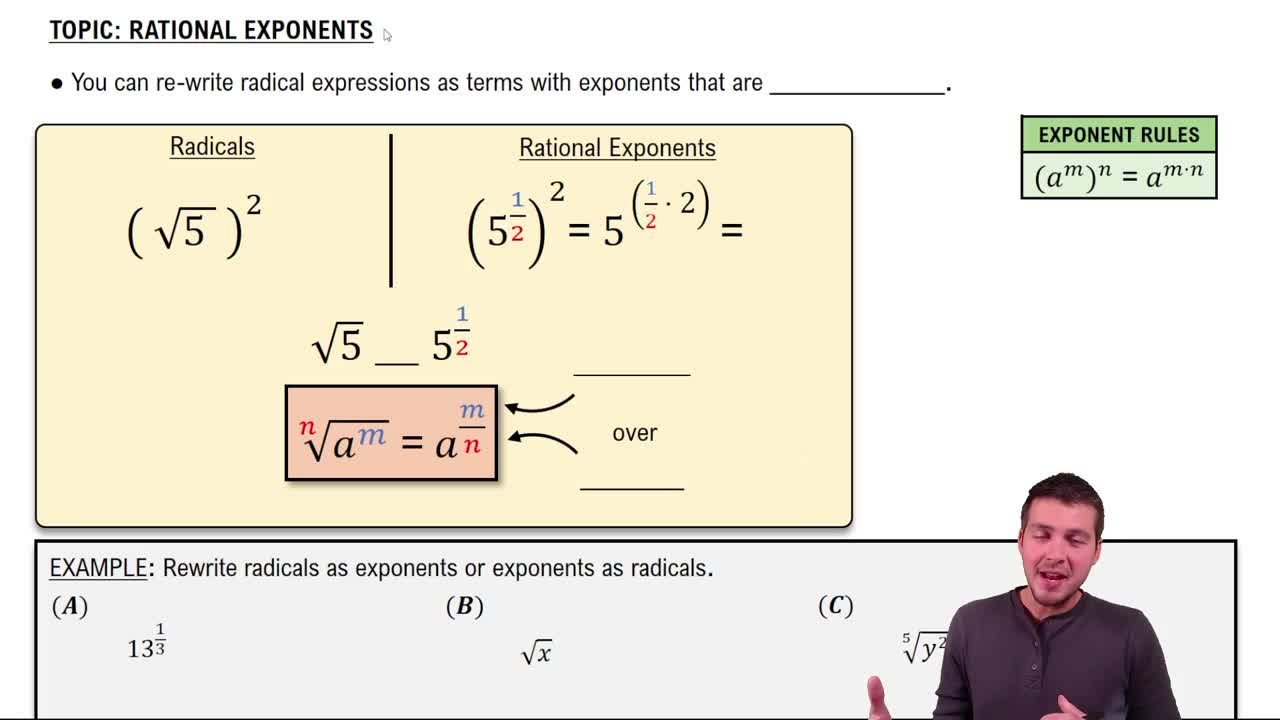
Properties of exponents, such as the product of powers rule, state that (a^m)(b^m) = (ab)^m when the exponents are the same. This allows simplification of expressions like (0.25^3)(400^3) into (0.25 × 400)^3, making mental calculation easier.
Mental math strategies involve simplifying calculations by recognizing patterns or using properties like factoring. Here, rewriting the expression using exponent rules helps reduce complexity, enabling quick mental computation without a calculator.