Perform the indicated operations. Assume all variables represent positive real numbers. ∛64xy² + ∛27x⁴y⁵
Verified step by step guidance
1
Identify the cube roots: \( \sqrt[3]{64xy^2} \) and \( \sqrt[3]{27x^4y^5} \).
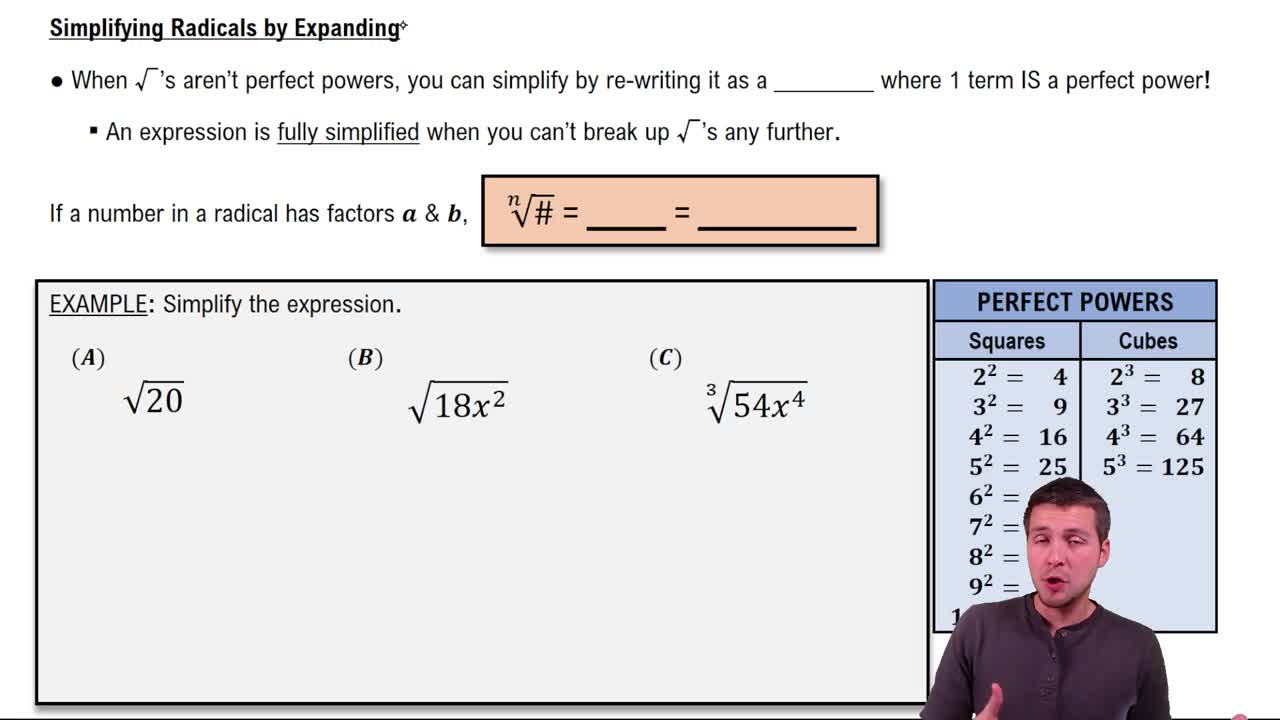
Break down each term into its prime factors: \( 64 = 2^6 \), \( 27 = 3^3 \), and express the variables with exponents.
Rewrite the cube roots using these factors: \( \sqrt[3]{2^6x^1y^2} \) and \( \sqrt[3]{3^3x^4y^5} \).
Simplify each cube root by taking the cube root of each factor: \( \sqrt[3]{2^6} = 2^2 \), \( \sqrt[3]{3^3} = 3 \), and apply the cube root to the variables.
Combine the simplified terms to express the result of the operation.
Verified video answer for a similar problem:
This video solution was recommended by our tutors as helpful for the problem above
Video duration:
5m
Play a video:
Was this helpful?
Key Concepts
Here are the essential concepts you must grasp in order to answer the question correctly.
Radical Expressions
Radical expressions involve roots, such as square roots or cube roots. In this question, we are dealing with cube roots, denoted as ∛. Understanding how to simplify and manipulate these expressions is crucial, as it allows us to combine like terms and perform operations effectively.
The properties of exponents govern how to handle expressions involving powers. For instance, when multiplying like bases, you add the exponents. This concept is essential for simplifying the terms within the radical expressions, especially when dealing with variables raised to different powers.
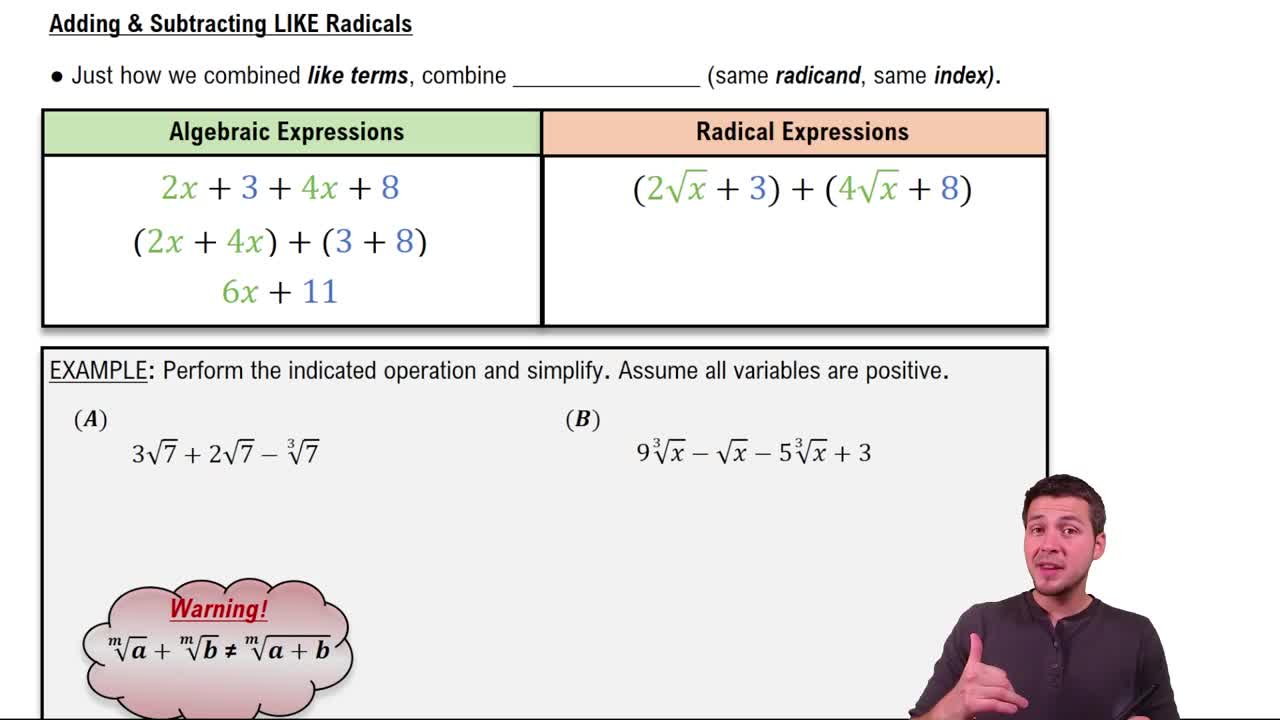
Combining like terms is a fundamental algebraic skill that involves adding or subtracting terms that have the same variable components. In the context of radical expressions, this means identifying terms that can be simplified together, which is necessary for arriving at a final simplified form of the expression.