In Exercises 59–76, find the indicated root, or state that the expression is not a real number.___⁶√−1
Verified step by step guidance
1
Identify the expression: \( \sqrt[6]{-1} \).
Recognize that you are looking for the sixth root of \(-1\).
Recall that an even root of a negative number is not a real number.
Understand that the sixth root of \(-1\) involves finding a number that, when raised to the sixth power, equals \(-1\).
Conclude that since no real number raised to an even power can be negative, \( \sqrt[6]{-1} \) is not a real number.
Verified video answer for a similar problem:
This video solution was recommended by our tutors as helpful for the problem above
Video duration:
4m
Play a video:
Was this helpful?
Key Concepts
Here are the essential concepts you must grasp in order to answer the question correctly.
Roots of Numbers
Roots are mathematical operations that determine a number which, when raised to a specific power, yields the original number. For example, the square root of 9 is 3, since 3² = 9. In this case, we are dealing with a sixth root, which means we are looking for a number that, when raised to the sixth power, equals -1.
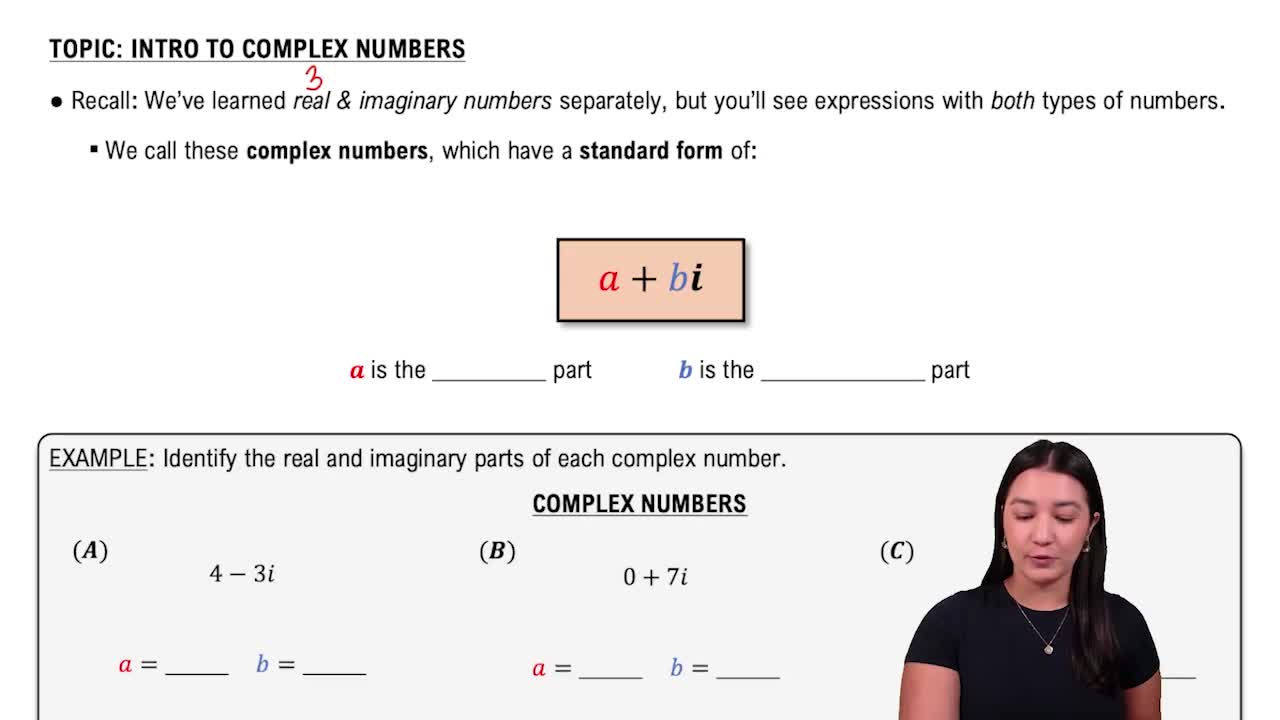
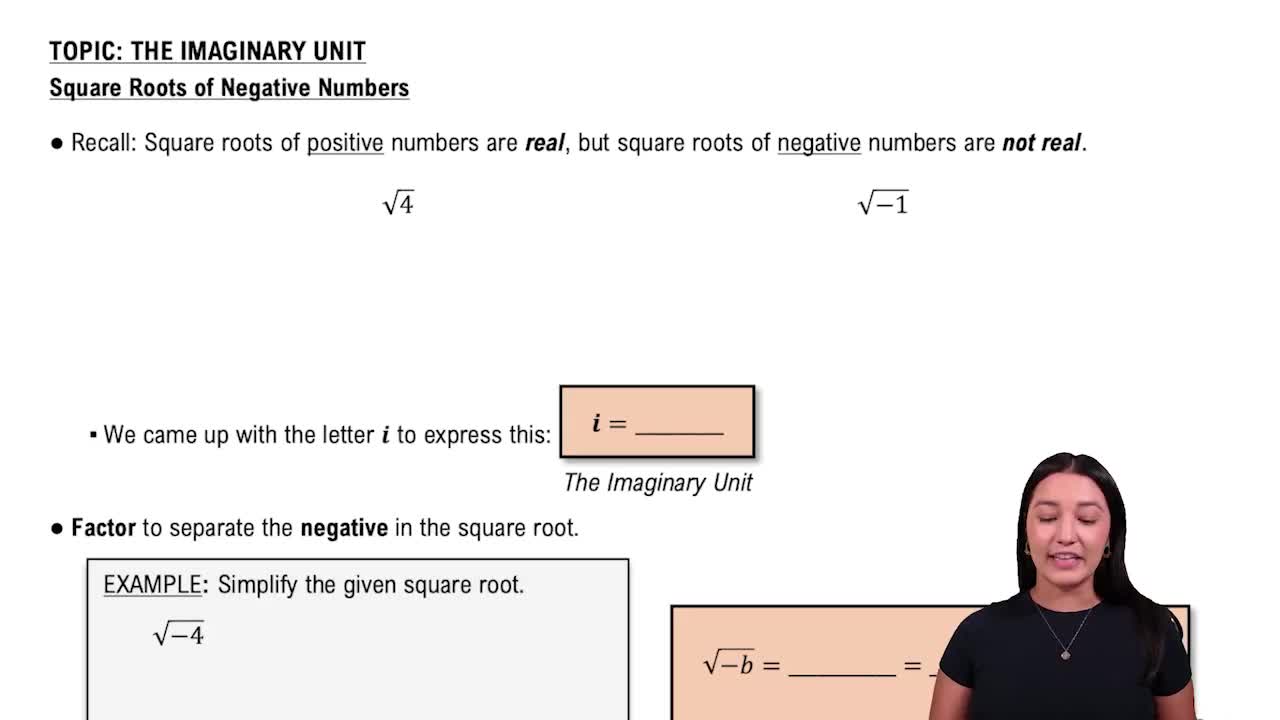
Real numbers include all the numbers on the number line, encompassing both positive and negative values, as well as zero. However, certain roots, such as the sixth root of -1, do not yield real numbers. Instead, they fall into the category of complex numbers, which include imaginary units represented as 'i', where i² = -1.
When taking even roots (like square roots, fourth roots, etc.) of negative numbers, the result is not a real number. This is because no real number squared or raised to an even power can produce a negative result. Therefore, the sixth root of -1 is not a real number, but can be expressed in terms of complex numbers.