In Exercises 55–78, use properties of rational exponents to simplify each expression. Assume that all variables represent positive numbers.(2x^⅕)⁵
Verified step by step guidance
1
Identify the expression: \((2x^{\frac{1}{5}})^5\).
Apply the power of a product property: \((ab)^n = a^n b^n\).
Distribute the exponent 5 to both 2 and \(x^{\frac{1}{5}}\): \(2^5 \cdot (x^{\frac{1}{5}})^5\).
Simplify \(2^5\) to get 32.
Use the power of a power property: \((a^m)^n = a^{m \cdot n}\), so \((x^{\frac{1}{5}})^5 = x^{\frac{1}{5} \cdot 5} = x^1 = x\).
Verified video answer for a similar problem:
This video solution was recommended by our tutors as helpful for the problem above
Video duration:
4m
Play a video:
Was this helpful?
Key Concepts
Here are the essential concepts you must grasp in order to answer the question correctly.
Rational Exponents
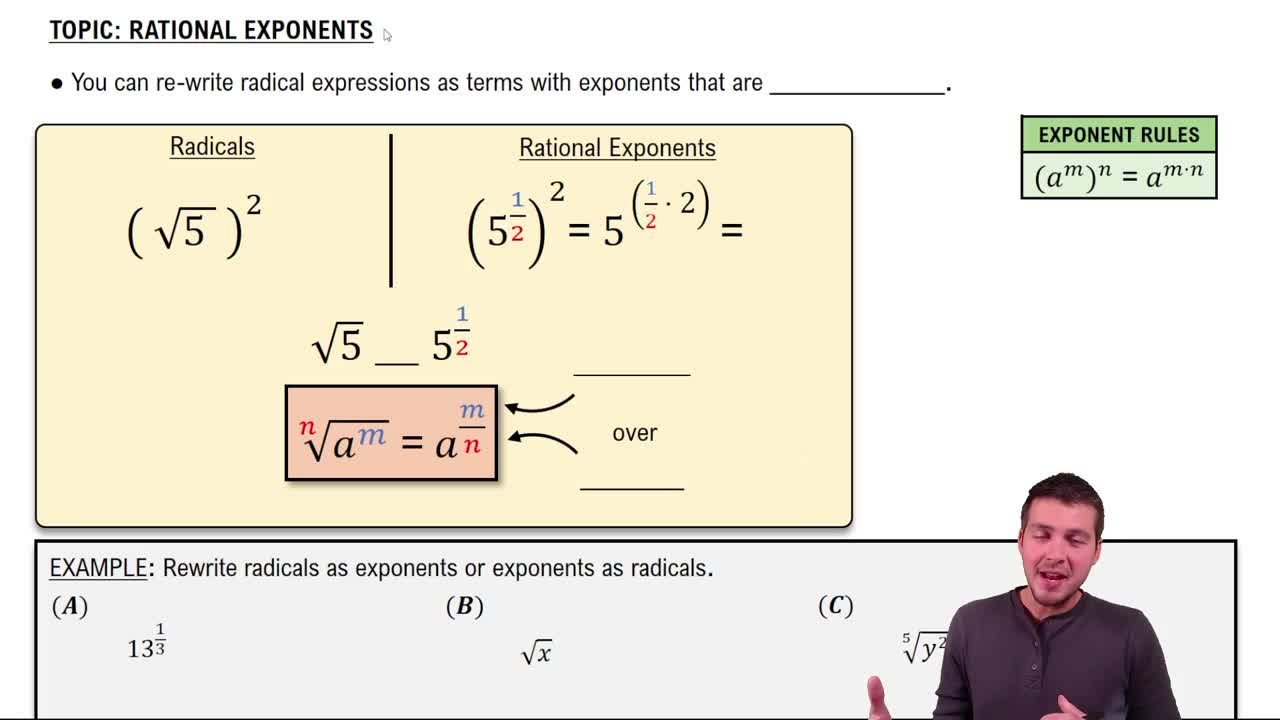
Rational exponents are a way to express roots and powers using fractions. For example, an exponent of 1/n indicates the n-th root of a number, while a numerator indicates the power. Thus, x^(1/n) = n√x, and x^(m/n) = n√(x^m). Understanding this concept is crucial for simplifying expressions involving roots and powers.
The properties of exponents include rules that govern how to manipulate expressions with exponents. Key properties include the product of powers (a^m * a^n = a^(m+n)), the power of a power ( (a^m)^n = a^(m*n)), and the power of a product ( (ab)^n = a^n * b^n). These rules are essential for simplifying expressions with rational exponents.
Simplification involves rewriting an expression in a more manageable or standard form. This often includes combining like terms, reducing fractions, and applying exponent rules. In the context of rational exponents, simplification may involve converting between radical and exponential forms, which helps in making calculations easier and clearer.