Solve each equation in Exercises 96–102 by the method of your choice. 2√(x-1) = x
Table of contents
- 0. Review of Algebra4h 18m
- 1. Equations & Inequalities3h 18m
- 2. Graphs of Equations1h 43m
- 3. Functions2h 17m
- 4. Polynomial Functions1h 44m
- 5. Rational Functions1h 23m
- 6. Exponential & Logarithmic Functions2h 28m
- 7. Systems of Equations & Matrices4h 5m
- 8. Conic Sections2h 23m
- 9. Sequences, Series, & Induction1h 22m
- 10. Combinatorics & Probability1h 45m
1. Equations & Inequalities
Choosing a Method to Solve Quadratics
Problem 88
Textbook Question
Solve each radical equation in Exercises 88–89. √ (2x-3) + x = 3
Verified step by step guidance1
Step 1: Isolate the radical expression on one side of the equation. Subtract x from both sides to get: √(2x - 3) = 3 - x.
Step 2: Eliminate the square root by squaring both sides of the equation. This gives: (√(2x - 3))² = (3 - x)². Simplify to get: 2x - 3 = (3 - x)(3 - x).
Step 3: Expand the right-hand side of the equation. Use the distributive property to expand (3 - x)(3 - x), which results in: 2x - 3 = 9 - 6x + x².
Step 4: Rearrange the equation into standard quadratic form. Combine all terms on one side of the equation to get: x² - 8x + 12 = 0.
Step 5: Solve the quadratic equation using factoring, the quadratic formula, or completing the square. After finding the solutions, substitute them back into the original equation to check for extraneous solutions introduced by squaring.
Verified video answer for a similar problem:This video solution was recommended by our tutors as helpful for the problem above
Video duration:
5mPlay a video:
Was this helpful?
Key Concepts
Here are the essential concepts you must grasp in order to answer the question correctly.
Radical Equations
Radical equations are equations that involve a variable within a radical (square root, cube root, etc.). To solve these equations, one typically isolates the radical on one side and then squares both sides to eliminate the radical. This process may introduce extraneous solutions, so it's essential to check all potential solutions in the original equation.
Recommended video:
Guided course
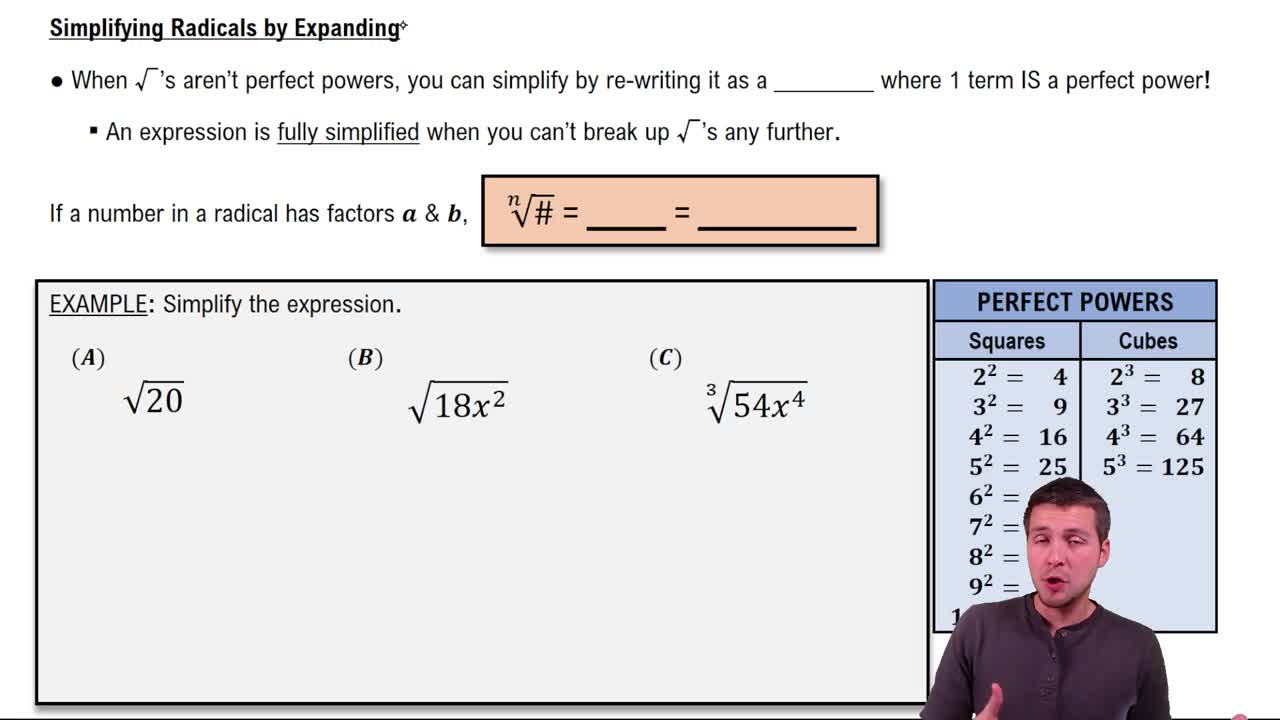
Expanding Radicals
Isolating the Variable
Isolating the variable is a fundamental algebraic technique used to solve equations. This involves rearranging the equation to get the variable on one side and all other terms on the opposite side. In the context of radical equations, isolating the radical before squaring both sides is crucial for correctly solving the equation.
Recommended video:
Guided course
Equations with Two Variables
Extraneous Solutions
Extraneous solutions are solutions that emerge from the process of solving an equation but do not satisfy the original equation. This is particularly common in radical equations, where squaring both sides can introduce solutions that are not valid. Therefore, it is important to substitute any found solutions back into the original equation to verify their validity.
Recommended video:
Categorizing Linear Equations
Watch next
Master Choosing a Method to Solve Quadratics with a bite sized video explanation from Patrick
Start learningRelated Videos
Related Practice
Textbook Question
398
views
