Express each sum using summation notation. Use as the lower limit of summation and for the index of summation.
Table of contents
- 0. Review of Algebra4h 18m
- 1. Equations & Inequalities3h 18m
- 2. Graphs of Equations1h 43m
- 3. Functions2h 17m
- 4. Polynomial Functions1h 44m
- 5. Rational Functions1h 23m
- 6. Exponential & Logarithmic Functions2h 28m
- 7. Systems of Equations & Matrices4h 5m
- 8. Conic Sections2h 23m
- 9. Sequences, Series, & Induction1h 22m
- 10. Combinatorics & Probability1h 45m
9. Sequences, Series, & Induction
Sequences
Problem 59
Textbook Question
In Exercises 55–60, express each sum using summation notation. Use a lower limit of summation of your choice and k for the index of summation.
Verified step by step guidance1
Identify the pattern in the sum: the terms are a, (a + d), (a + 2d), ..., (a + nd), which shows an arithmetic sequence where each term increases by d.
Choose the index of summation as k, starting from 0 to n, because the first term corresponds to k = 0 and the last term corresponds to k = n.
Express the general term of the sequence using k: the k-th term is .
Write the summation notation by summing the general term from k = 0 to k = n: .
This summation notation compactly represents the entire sum .
Verified video answer for a similar problem:This video solution was recommended by our tutors as helpful for the problem above
Video duration:
3mPlay a video:
Was this helpful?
Key Concepts
Here are the essential concepts you must grasp in order to answer the question correctly.
Arithmetic Sequence
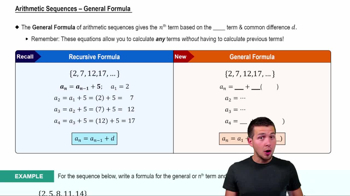
An arithmetic sequence is a list of numbers where each term after the first is found by adding a constant difference, d, to the previous term. In the given sum, the terms follow this pattern: a, a+d, a+2d, ..., a+nd, which is the foundation for expressing the sum in summation notation.
Recommended video:
Guided course
Arithmetic Sequences - General Formula
Summation Notation
Summation notation uses the sigma symbol (∑) to represent the sum of a sequence of terms. It includes an index of summation, a lower limit, and an upper limit, allowing a compact expression of long sums like the arithmetic sequence given in the problem.
Recommended video:
Interval Notation
Index of Summation and Limits
The index of summation, often denoted by k, is a variable that represents each term's position in the sequence. The lower and upper limits define the range of terms to be summed. Choosing appropriate limits and expressing each term in terms of k is essential to correctly write the sum in summation notation.
Recommended video:
Guided course
Adding & Subtracting Like Radicals
Watch next
Master Introduction to Sequences with a bite sized video explanation from Patrick
Start learningRelated Videos
Related Practice
Textbook Question
740
views