Determine whether each statement is true or false. If false, explain why. A polynomial function having degree 6 and only real coefficients may have no real zeros.
Table of contents
- 0. Review of Algebra4h 18m
- 1. Equations & Inequalities3h 18m
- 2. Graphs of Equations1h 43m
- 3. Functions2h 17m
- 4. Polynomial Functions1h 44m
- 5. Rational Functions1h 23m
- 6. Exponential & Logarithmic Functions2h 28m
- 7. Systems of Equations & Matrices4h 5m
- 8. Conic Sections2h 23m
- 9. Sequences, Series, & Induction1h 22m
- 10. Combinatorics & Probability1h 45m
4. Polynomial Functions
Zeros of Polynomial Functions
Problem 22
Textbook Question
Factor ƒ(x) into linear factors given that k is a zero.
Verified step by step guidance1
Since k = 1 is a zero of the polynomial ƒ(x) = 2x^3 - 3x^2 - 5x + 6, use synthetic division or polynomial division to divide ƒ(x) by (x - 1).
Set up synthetic division with the coefficients of ƒ(x): 2, -3, -5, and 6, and use 1 as the divisor.
Perform the synthetic division step-by-step to find the quotient polynomial, which will be a quadratic expression.
Write ƒ(x) as the product of (x - 1) and the quotient polynomial obtained from the division.
Factor the quadratic quotient further, if possible, into linear factors to express ƒ(x) completely as a product of linear factors.
Verified video answer for a similar problem:This video solution was recommended by our tutors as helpful for the problem above
Video duration:
10mPlay a video:
Was this helpful?
Key Concepts
Here are the essential concepts you must grasp in order to answer the question correctly.
Polynomial Zeros and the Factor Theorem
A zero of a polynomial is a value of x that makes the polynomial equal to zero. The Factor Theorem states that if k is a zero of ƒ(x), then (x - k) is a factor of ƒ(x). This allows us to factor the polynomial by dividing it by (x - k).
Recommended video:
Guided course
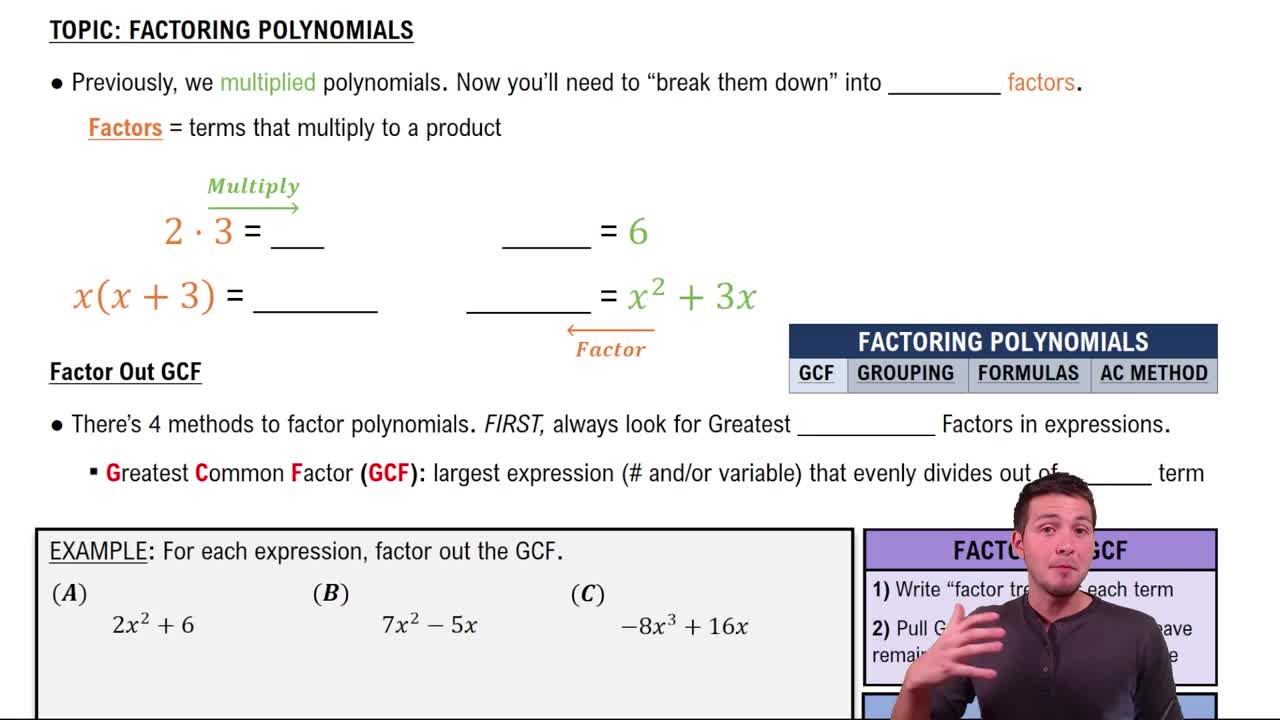
Introduction to Factoring Polynomials
Polynomial Division (Synthetic or Long Division)
Polynomial division is used to divide a polynomial by a linear factor like (x - k). Synthetic division is a shortcut method for dividing by linear factors and helps find the quotient polynomial after factoring out (x - k). This simplifies the polynomial into lower-degree factors.
Recommended video:
Guided course
Introduction to Factoring Polynomials
Factoring Polynomials into Linear Factors
After dividing out a known factor, the resulting polynomial can often be factored further into linear factors by finding its zeros. Factoring completely into linear factors means expressing the polynomial as a product of first-degree polynomials, which corresponds to all its roots.
Recommended video:
Guided course
Introduction to Factoring Polynomials
Related Videos
Related Practice
Textbook Question
564
views