
Textbook Question
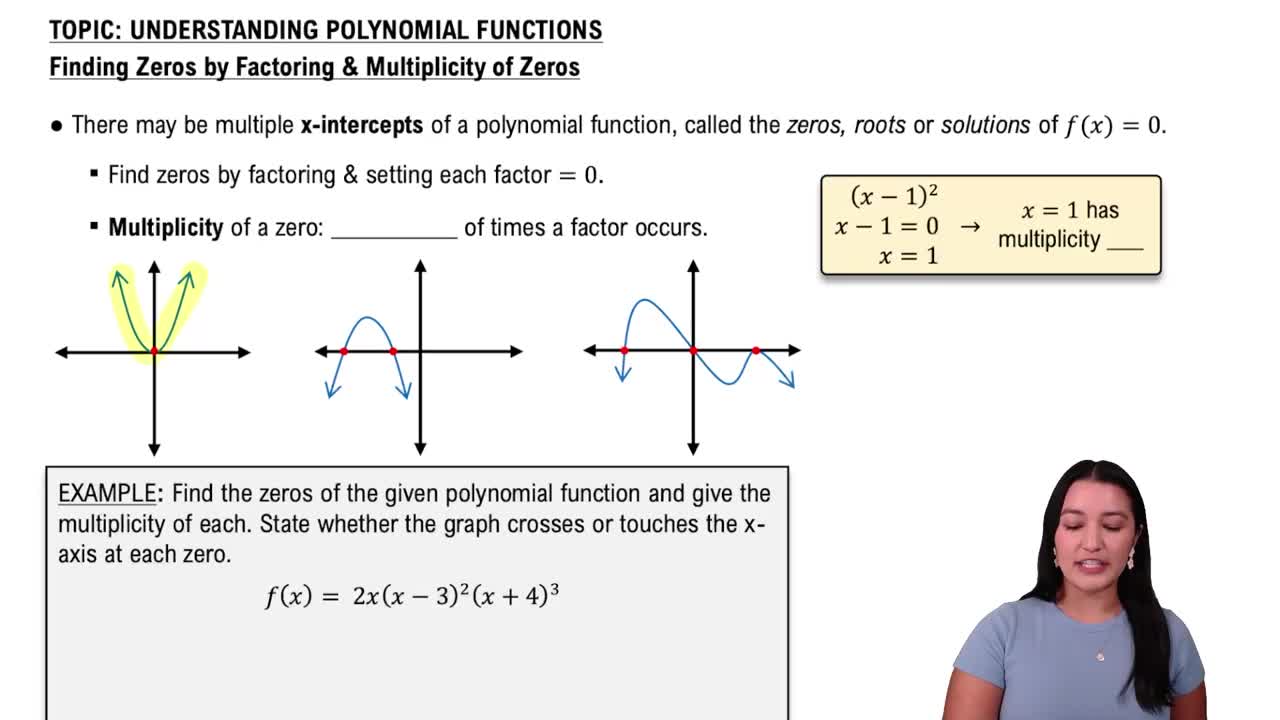
Solve each polynomial inequality in Exercises 1–42 and graph the solution set on a real number line. Express each solution set in interval notation. (x+1)(x+2)(x+3)≥0
526
views

 Verified step by step guidance
 03:42
03:42
 05:33
05:33 04:27
04:27Solve each polynomial inequality in Exercises 1–42 and graph the solution set on a real number line. Express each solution set in interval notation. (x+1)(x+2)(x+3)≥0
Find an nth-degree polynomial function with real coefficients satisfying the given conditions. If you are using a graphing utility, use it to graph the function and verify the real zeros and the given function value. n=4; i and 3i are zeros; f(-1) = 20
Find the vertical asymptotes, if any, and the values of x corresponding to holes, if any, of the graph of each rational function. g(x)=(x−3)/(x2−9)
Divide using synthetic division. (x4−256)/(x−4)
Solve each polynomial inequality in Exercises 1–42 and graph the solution set on a real number line. Express each solution set in interval notation. x(3−x)(x−5)≤0
Find the zeros for each polynomial function and give the multiplicity for each zero. State whether the graph crosses the x-axis, or touches the x-axis and turns around, at each zero.