Find all complex zeros of each polynomial function. Give exact values. List multiple zeros as necessary.* ƒ(x)=4x3+3x2+8x+6
Table of contents
- 0. Review of Algebra4h 18m
- 1. Equations & Inequalities3h 18m
- 2. Graphs of Equations1h 43m
- 3. Functions2h 17m
- 4. Polynomial Functions1h 44m
- 5. Rational Functions1h 23m
- 6. Exponential & Logarithmic Functions2h 28m
- 7. Systems of Equations & Matrices4h 5m
- 8. Conic Sections2h 23m
- 9. Sequences, Series, & Induction1h 22m
- 10. Combinatorics & Probability1h 45m
4. Polynomial Functions
Zeros of Polynomial Functions
Problem 17
Textbook Question
Use the factor theorem and synthetic division to determine whether the second polynomial is a factor of the first. x3+2x2+3; x-1
Verified step by step guidance1
Identify the polynomials involved: the first polynomial is \(x^3 + 2x^2 + 3\) and the second polynomial is \(x - 1\).
Recall the Factor Theorem: a polynomial \(f(x)\) has a factor \((x - c)\) if and only if \(f(c) = 0\). Here, \(c = 1\) because the factor is \(x - 1\).
Evaluate the first polynomial at \(x = 1\) by substituting 1 into \(x^3 + 2x^2 + 3\), which means calculating \$1^3 + 2(1)^2 + 3$.
Use synthetic division to divide the first polynomial by \(x - 1\): set up synthetic division with 1 as the divisor and the coefficients of the first polynomial (1, 2, 0, 3) as the dividend. Note that the coefficient of \(x\) is 0 since it is missing.
Perform the synthetic division steps: bring down the first coefficient, multiply by 1, add to the next coefficient, and continue until all coefficients are processed. The remainder will tell you if \(x - 1\) is a factor (remainder 0 means it is a factor).
Verified video answer for a similar problem:This video solution was recommended by our tutors as helpful for the problem above
Video duration:
3mPlay a video:
Was this helpful?
Key Concepts
Here are the essential concepts you must grasp in order to answer the question correctly.
Factor Theorem
The Factor Theorem states that a polynomial f(x) has (x - c) as a factor if and only if f(c) = 0. This means that substituting c into the polynomial yields zero, confirming that (x - c) divides the polynomial exactly without remainder.
Recommended video:
Guided course
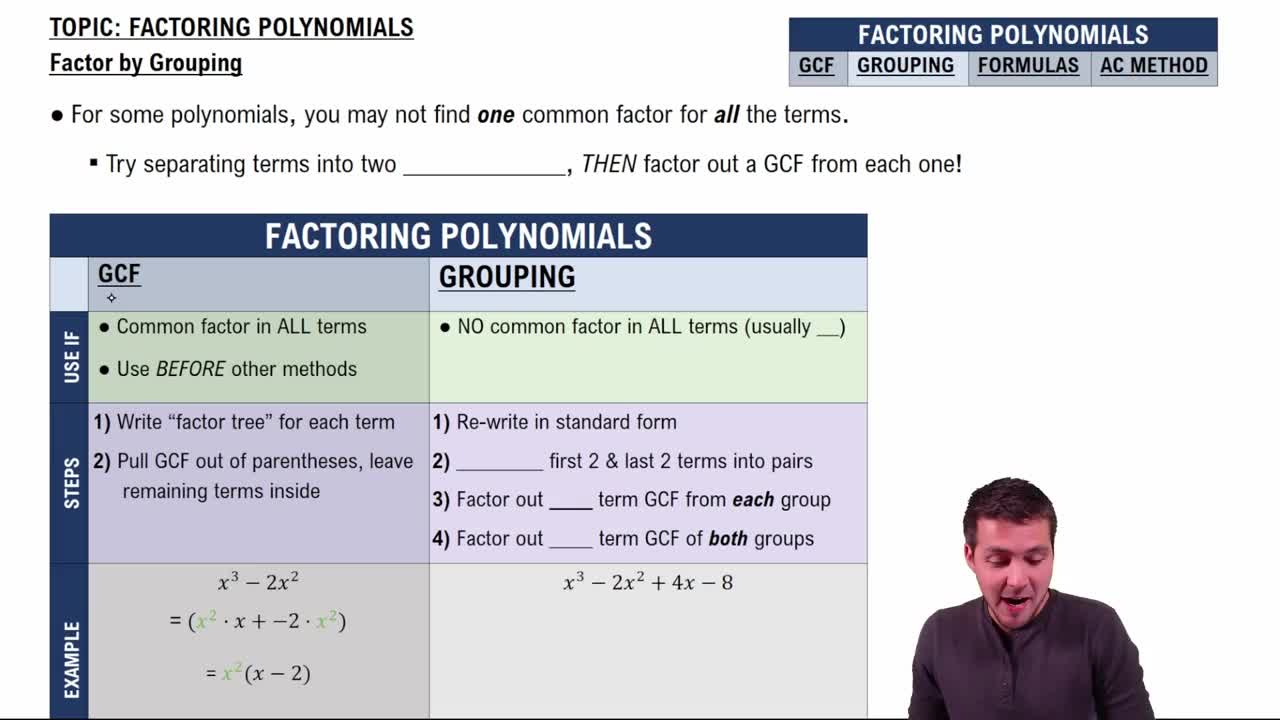
Factor by Grouping
Synthetic Division
Synthetic division is a shortcut method for dividing a polynomial by a linear binomial of the form (x - c). It simplifies the long division process by using only the coefficients, making it faster to find the quotient and remainder.
Recommended video:
Higher Powers of i
Polynomial Factorization
Polynomial factorization involves expressing a polynomial as a product of its factors. Determining if one polynomial is a factor of another helps simplify expressions and solve polynomial equations by breaking them into simpler components.
Recommended video:
Guided course
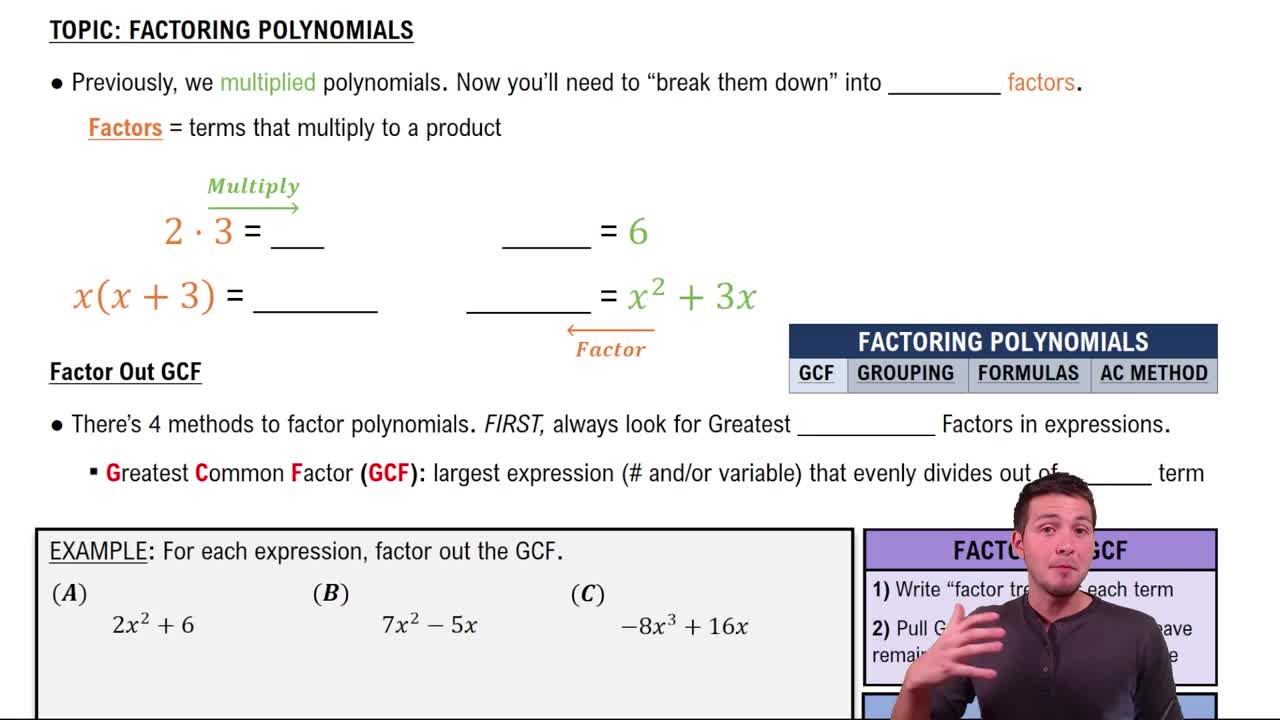
Introduction to Factoring Polynomials
Related Videos
Related Practice
Textbook Question
275
views