Determine whether each statement is true or false. If false, correct the right side of the equation. (2/3)2 = (3/2)2
Verified step by step guidance
1
Recall the property of exponents for negative powers: \(a^{-n} = \frac{1}{a^n}\), where \(a \neq 0\) and \(n\) is a positive integer.
Apply this property to the expression \((\frac{2}{3})^{-2}\), which becomes \(\frac{1}{(\frac{2}{3})^2}\).
Simplify the denominator by squaring the fraction: \((\frac{2}{3})^2 = \frac{2^2}{3^2} = \frac{4}{9}\).
Rewrite the expression as \(\frac{1}{\frac{4}{9}}\), which is equivalent to multiplying by the reciprocal: \$1 \times \frac{9}{4} = \frac{9}{4}$.
Compare this result to the right side of the original equation \((\frac{3}{2})^2 = \frac{3^2}{2^2} = \frac{9}{4}\). Since both sides simplify to \(\frac{9}{4}\), the original statement is true.
Verified video answer for a similar problem:
This video solution was recommended by our tutors as helpful for the problem above
Video duration:
1m
Play a video:
Was this helpful?
Key Concepts
Here are the essential concepts you must grasp in order to answer the question correctly.
Negative Exponents
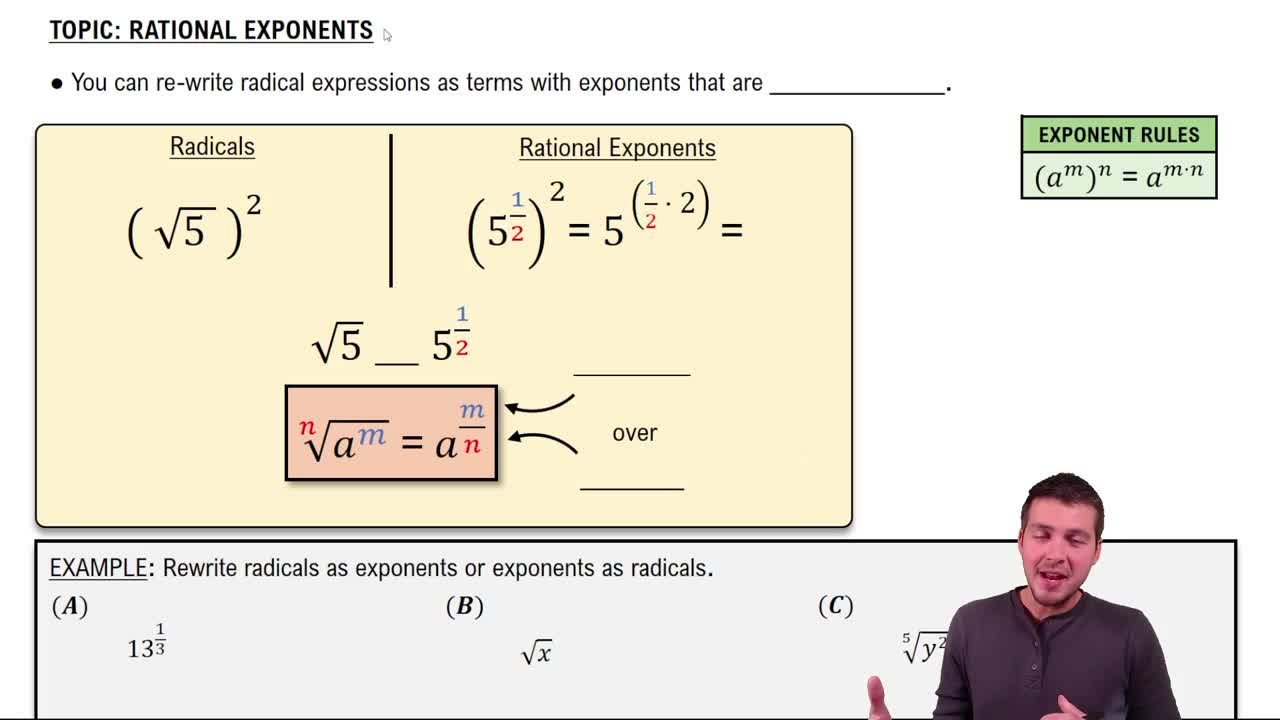
A negative exponent indicates the reciprocal of the base raised to the corresponding positive exponent. For example, a^(-n) = 1/(a^n). This rule allows us to rewrite expressions with negative exponents into more manageable forms.
The reciprocal of a fraction is obtained by swapping its numerator and denominator. For instance, the reciprocal of (2/3) is (3/2). This concept is essential when dealing with negative exponents applied to fractions.
Raising a fraction to a power means raising both the numerator and denominator to that power separately. For example, (a/b)^n = (a^n)/(b^n). This rule helps simplify expressions involving powers of fractions.