Ch. 8 - Sequences, Induction, and Probability
Blitzer - College Algebra 8th Edition
Blitzer8th EditionCollege AlgebraISBN: 9780136970514Not the one you use?Change textbook
Chapter 9, Problem 14

In Exercises 12–15, write the first six terms of each arithmetic sequence. a1 = 3/2, d = -1/2

Verified step by step guidance
1
Step 1: Recall the formula for the nth term of an arithmetic sequence: a_n = a_1 + (n - 1) imes d , where a_1 is the first term, d is the common difference, and n is the term number.
Step 2: Identify the given values: a_1 = \(\frac{3}{2}\) (the first term) and d = -\(\frac{1}{2}\) (the common difference).
Step 3: Calculate the second term (a_2) using the formula: a_2 = a_1 + d = \(\frac{3}{2}\) + (-\(\frac{1}{2}\)). Simplify the expression to find a_2.
Step 4: Calculate the third term (a_3) using the formula: a_3 = a_1 + 2d = \(\frac{3}{2}\) + 2(-\(\frac{1}{2}\)). Simplify the expression to find a_3. Repeat this process for a_4, a_5, and a_6.
Step 5: Write the first six terms of the sequence in order: a_1, a_2, a_3, a_4, a_5, a_6, based on the calculations from the previous steps.

Verified video answer for a similar problem:

This video solution was recommended by our tutors as helpful for the problem above.
Video duration:
2m
Was this helpful?

Key Concepts

Here are the essential concepts you must grasp in order to answer the question correctly.

Arithmetic Sequence

An arithmetic sequence is a sequence of numbers in which the difference between consecutive terms is constant. This difference is known as the common difference (d). In this case, the first term (a1) is given, and the common difference allows us to generate subsequent terms by adding d to the previous term.
Recommended video:
Guided course
5:17
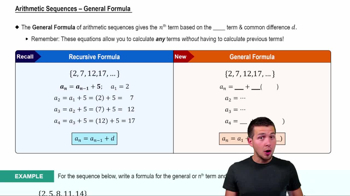
Arithmetic Sequences - General Formula

First Term and Common Difference

The first term of an arithmetic sequence is the initial value from which the sequence starts, denoted as a1. The common difference (d) is the fixed amount that is added to each term to obtain the next term. For the given sequence, a1 = 3/2 and d = -1/2, indicating that each term will decrease by 1/2 from the previous term.
Recommended video:
5:57
Graphs of Common Functions

Generating Terms of the Sequence

To find the terms of an arithmetic sequence, start with the first term and repeatedly add the common difference. For example, to find the first six terms, calculate each term by applying the formula: a_n = a1 + (n-1)d, where n is the term number. This process allows for systematic generation of the sequence's terms.
Recommended video:
Guided course
4:45
Geometric Sequences - General Formula