Use the vertical line test to identify graphs in which y is a function of x.
Table of contents
- 0. Review of Algebra4h 18m
- 1. Equations & Inequalities3h 18m
- 2. Graphs of Equations1h 43m
- 3. Functions2h 17m
- 4. Polynomial Functions1h 44m
- 5. Rational Functions1h 23m
- 6. Exponential & Logarithmic Functions2h 28m
- 7. Systems of Equations & Matrices4h 5m
- 8. Conic Sections2h 23m
- 9. Sequences, Series, & Induction1h 22m
- 10. Combinatorics & Probability1h 45m
2. Graphs of Equations
Graphs and Coordinates
Problem 72
Textbook Question
Graph each function.
Verified step by step guidance1
Identify the base function to graph, which is the square root function \(f(x) = \sqrt{x}\). This function is defined for \(x \geq 0\) and its graph starts at the origin \((0,0)\), increasing slowly to the right.
Apply the negative sign in front of the square root, changing the function to \(f(x) = -\sqrt{x}\). This reflects the graph of \(\sqrt{x}\) across the x-axis, so the graph will start at \((0,0)\) and decrease as \(x\) increases.
Apply the vertical shift by subtracting 2, resulting in \(f(x) = -\sqrt{x} - 2\). This moves the entire graph down by 2 units, so the starting point moves from \((0,0)\) to \((0,-2)\).
Determine the domain and range of the function. The domain remains \(x \geq 0\) because the square root is only defined for non-negative \(x\). The range shifts to \(y \leq -2\) because the graph is reflected and shifted down.
Plot key points such as \((0,-2)\), \((1,-3)\), and \((4,-4)\) by substituting values of \(x\) into the function, then sketch the curve starting at \((0,-2)\) and decreasing gently to the right.
Verified video answer for a similar problem:This video solution was recommended by our tutors as helpful for the problem above
Video duration:
2mPlay a video:
Was this helpful?
Key Concepts
Here are the essential concepts you must grasp in order to answer the question correctly.
Square Root Function
The square root function, denoted as √x, outputs the non-negative value whose square is x. Its domain is all non-negative real numbers (x ≥ 0), and its graph starts at the origin (0,0) and increases slowly to the right. Understanding this base function is essential before applying transformations.
Recommended video:
Imaginary Roots with the Square Root Property
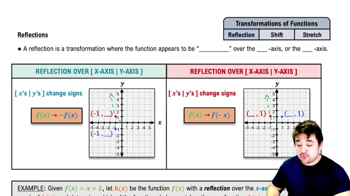
Vertical Reflection and Translation
Multiplying the square root function by -1 reflects its graph across the x-axis, flipping it upside down. The '-2' outside the square root shifts the entire graph downward by 2 units. Recognizing these transformations helps in accurately sketching the modified function.
Recommended video:
Reflections of Functions
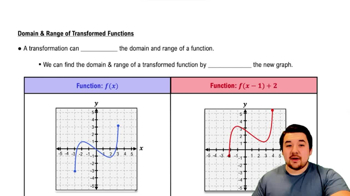
Domain and Range of Transformed Functions
The domain of ƒ(x) = -√x - 2 remains x ≥ 0 since the square root is undefined for negative inputs. The range changes due to reflection and translation; here, it becomes y ≤ -2 because the graph is flipped and shifted down. Identifying domain and range ensures the graph is correctly bounded.
Recommended video:
Domain & Range of Transformed Functions
Watch next
Master Graphs & the Rectangular Coordinate System with a bite sized video explanation from Patrick
Start learningRelated Videos
Related Practice
Textbook Question
815
views