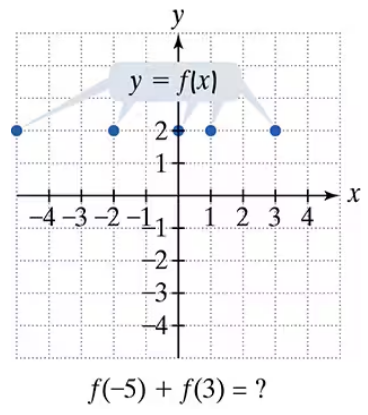
In Exercises 77–92, use the graph to determine a. the function's domain; b. the function's range; c. the x-intercepts, if any; d. the y-intercept, if any; and e. the missing function values, indicated by question marks, below each graph.
Verified step by step guidance
1
Identify the points on the graph: (-5, -4), (-3, 1), (1, -2), (3, 3), and (4, 5).
Determine the domain by listing all the x-values from the points: {-5, -3, 1, 3, 4}.
Determine the range by listing all the y-values from the points: {-4, 1, -2, 3, 5}.
Check for x-intercepts by finding points where y = 0. There are no such points, so there are no x-intercepts.
Check for a y-intercept by finding a point where x = 0. There is no such point, so there is no y-intercept.
Verified video answer for a similar problem:
This video solution was recommended by our tutors as helpful for the problem above
Video duration:
3m
Play a video:
Was this helpful?
Key Concepts
Here are the essential concepts you must grasp in order to answer the question correctly.
Domain
The domain of a function refers to the set of all possible input values (x-values) for which the function is defined. In the context of a graph, the domain can be determined by identifying the horizontal extent of the graph, including all x-values that have corresponding y-values. For the given graph, the domain includes all x-coordinates of the plotted points.
The range of a function is the set of all possible output values (y-values) that the function can produce. To find the range from a graph, one must look at the vertical extent of the graph, noting all y-values that correspond to the x-values in the domain. In this case, the range is determined by the y-coordinates of the points plotted on the graph.
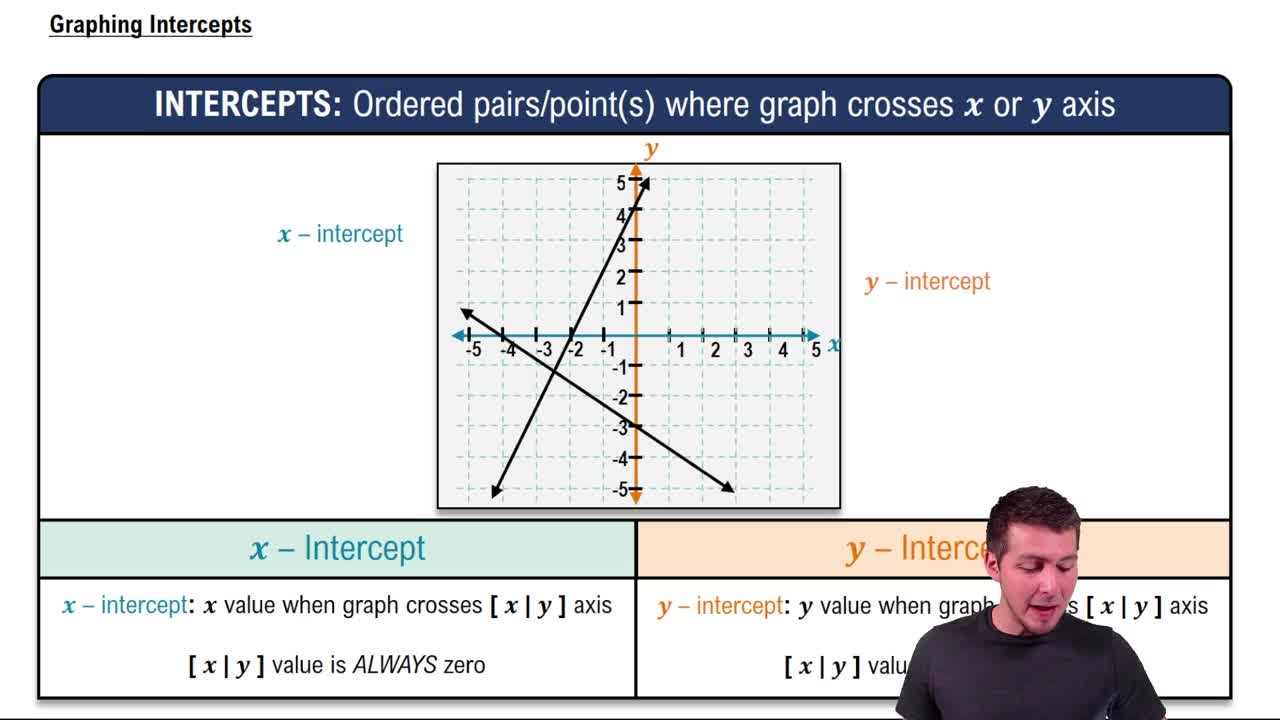
Intercepts are points where the graph of a function crosses the axes. The x-intercepts occur where the graph intersects the x-axis (y=0), while the y-intercept occurs where the graph intersects the y-axis (x=0). Identifying these intercepts is crucial for understanding the behavior of the function, and they can be found by analyzing the coordinates of the plotted points in relation to the axes.