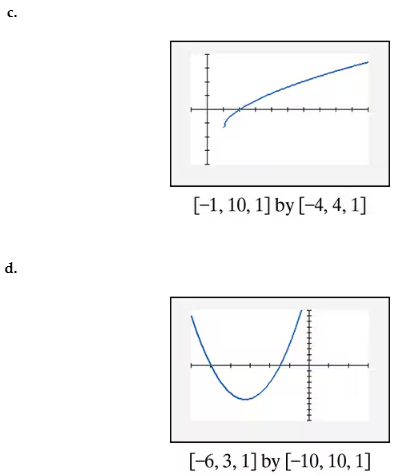
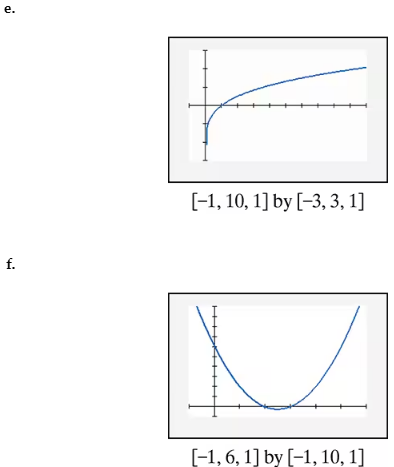
In Exercises 85–90, find the x-intercepts of the graph of each equation. Then use the x-intercepts to match the equation with its graph. [The graphs are labeled (a) through (f).] y = 2(x + 2)^2 + 5(x + 2) - 3
Verified step by step guidance
1
Rewrite the equation in standard form by expanding and combining like terms. Start by expanding \( 2(x + 2)^2 \) and \( 5(x + 2) \).
Combine all terms to form a quadratic equation in the standard form \( ax^2 + bx + c = 0 \).
Set \( y = 0 \) to find the x-intercepts, as the x-intercepts occur where the graph crosses the x-axis (i.e., where \( y = 0 \)).
Solve the resulting quadratic equation using the quadratic formula \( x = \frac{-b \pm \sqrt{b^2 - 4ac}}{2a} \), where \( a \), \( b \), and \( c \) are the coefficients from the standard form.
Simplify the solutions to find the x-intercepts, which are the values of \( x \) where the graph crosses the x-axis.
Verified video answer for a similar problem:
This video solution was recommended by our tutors as helpful for the problem above
Video duration:
1m
Play a video:
Was this helpful?
Key Concepts
Here are the essential concepts you must grasp in order to answer the question correctly.
X-Intercepts
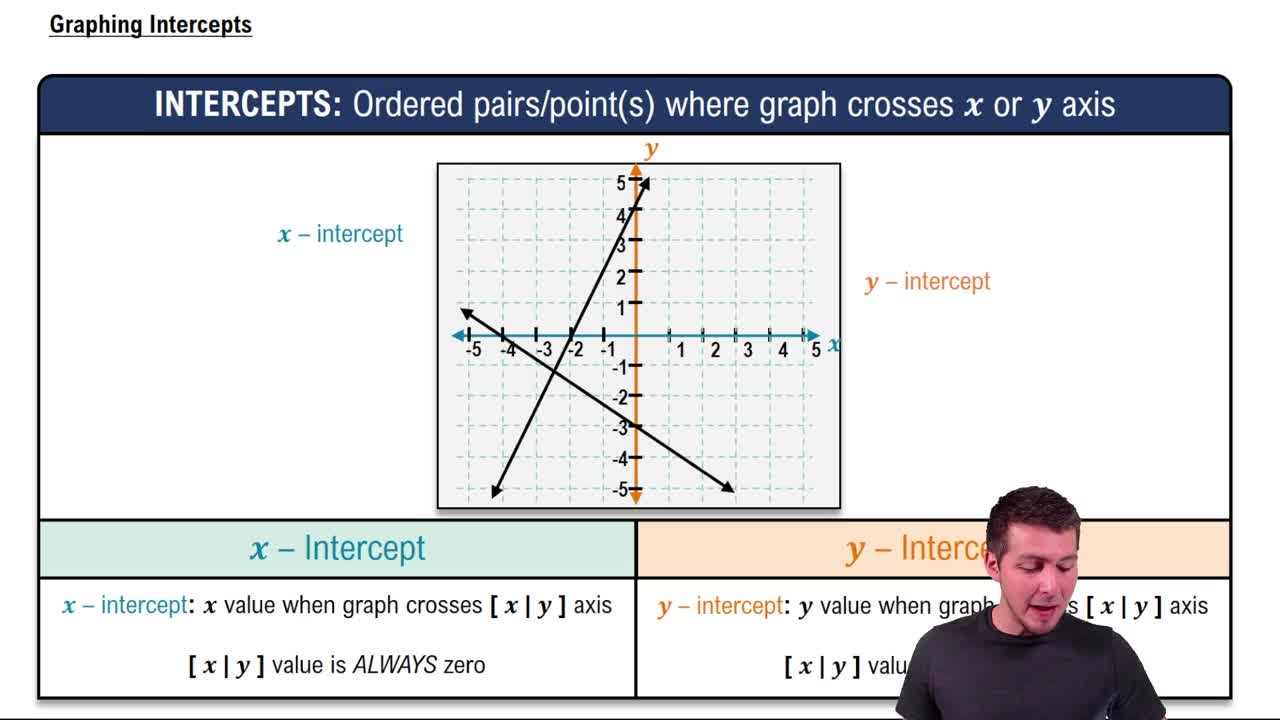
X-intercepts are the points where a graph crosses the x-axis, which occur when the output value (y) is zero. To find the x-intercepts of an equation, you set y equal to zero and solve for x. This is crucial for understanding the behavior of the graph and identifying key points that help in graphing the function.
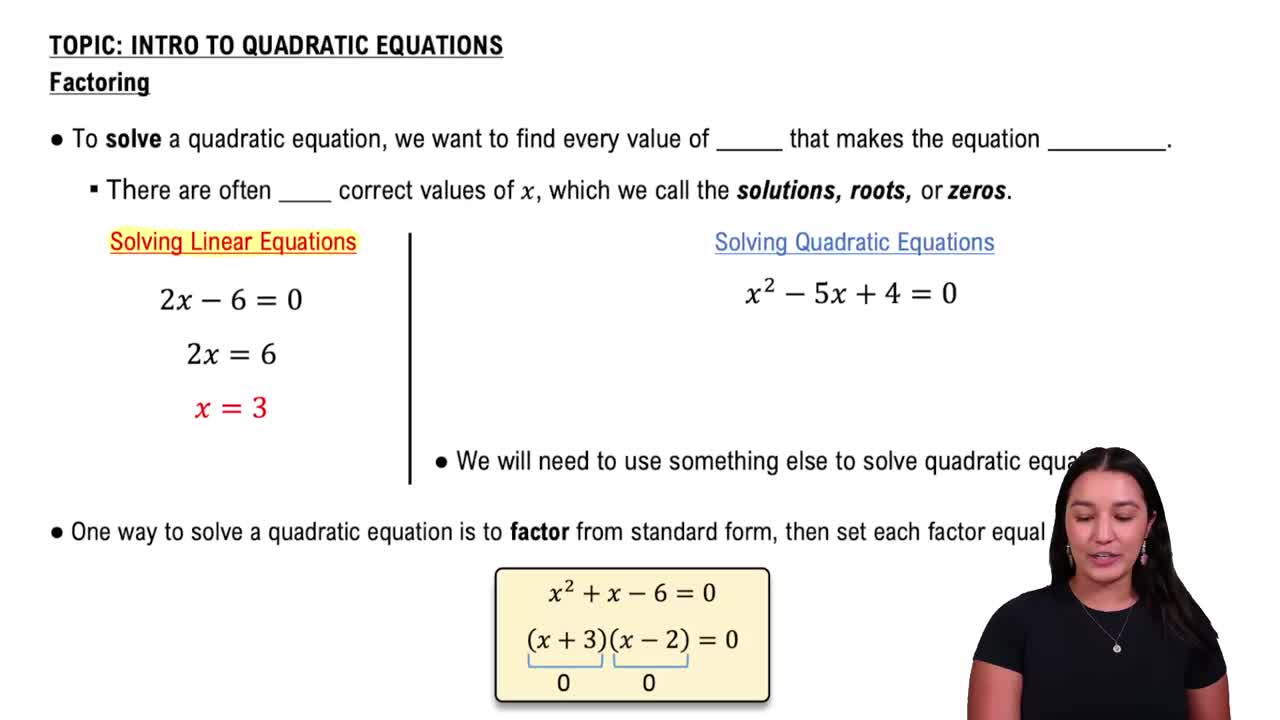
Factoring is a method used to simplify quadratic equations, which are polynomials of degree two. The given equation can be expressed in standard form, and factoring allows us to find the roots or solutions more easily. Understanding how to factor quadratics is essential for solving for x-intercepts effectively.
Graphing functions involves plotting points on a coordinate plane to visualize the relationship between variables. Once the x-intercepts are determined, they can be used to match the equation with its corresponding graph. Familiarity with the shape and characteristics of quadratic graphs, such as their vertex and direction, aids in accurately interpreting the graph.