Divide using synthetic division. (x5+4x4−3x2+2x+3)÷(x−3)
Table of contents
- 0. Review of Algebra4h 18m
- 1. Equations & Inequalities3h 18m
- 2. Graphs of Equations1h 43m
- 3. Functions2h 17m
- 4. Polynomial Functions1h 44m
- 5. Rational Functions1h 23m
- 6. Exponential & Logarithmic Functions2h 28m
- 7. Systems of Equations & Matrices4h 5m
- 8. Conic Sections2h 23m
- 9. Sequences, Series, & Induction1h 22m
- 10. Combinatorics & Probability1h 45m
4. Polynomial Functions
Dividing Polynomials
Problem 37
Textbook Question
For each polynomial function, use the remainder theorem to find ƒ(k). ƒ(x) = x3 - 4x2 + 2x+1; k = -1
Verified step by step guidance1
Recall the Remainder Theorem, which states that the remainder when a polynomial ƒ(x) is divided by (x - k) is equal to ƒ(k). So, to find ƒ(k), we simply evaluate the polynomial at x = k.
Substitute k = -1 into the polynomial ƒ(x) = x^3 - 4x^2 + 2x + 1. This means replacing every x in the polynomial with -1.
Write the expression after substitution: ƒ(-1) = (-1)^3 - 4(-1)^2 + 2(-1) + 1.
Simplify each term step-by-step: calculate (-1)^3, (-1)^2, multiply by coefficients, and then combine all terms.
Sum all the simplified terms to find the value of ƒ(-1), which is the remainder when ƒ(x) is divided by (x + 1).
Verified video answer for a similar problem:This video solution was recommended by our tutors as helpful for the problem above
Video duration:
2mPlay a video:
Was this helpful?
Key Concepts
Here are the essential concepts you must grasp in order to answer the question correctly.
Polynomial Functions
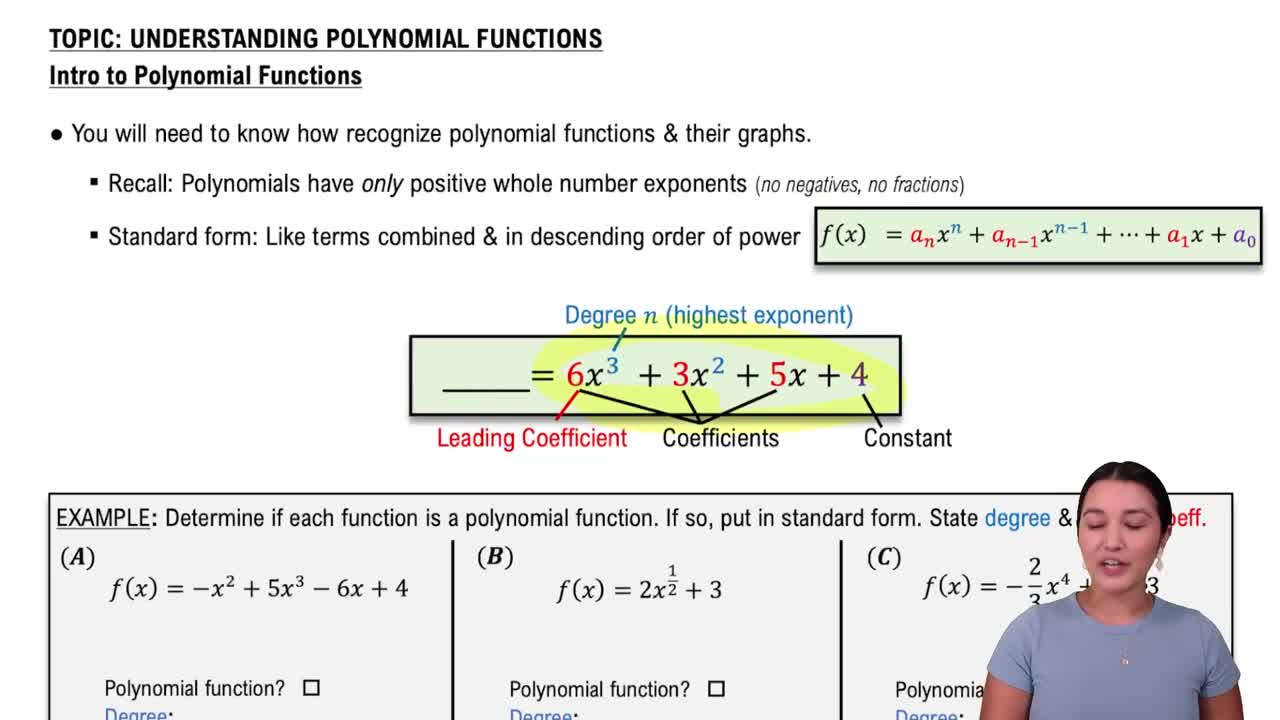
A polynomial function is an expression consisting of variables and coefficients combined using addition, subtraction, multiplication, and non-negative integer exponents. Understanding the structure of polynomials, such as terms and degrees, is essential for evaluating and manipulating these functions.
Recommended video:
Introduction to Polynomial Functions
Remainder Theorem
The Remainder Theorem states that the remainder when a polynomial f(x) is divided by (x - k) is equal to f(k). This allows us to find the value of the polynomial at x = k by evaluating f(k) directly, simplifying the process of polynomial division.
Recommended video:
Higher Powers of i
Evaluating Polynomials at a Given Value
Evaluating a polynomial at a specific value involves substituting the value into the polynomial and performing arithmetic operations to find the result. This skill is crucial for applying the Remainder Theorem and understanding the behavior of polynomial functions at particular points.
Recommended video:
Guided course
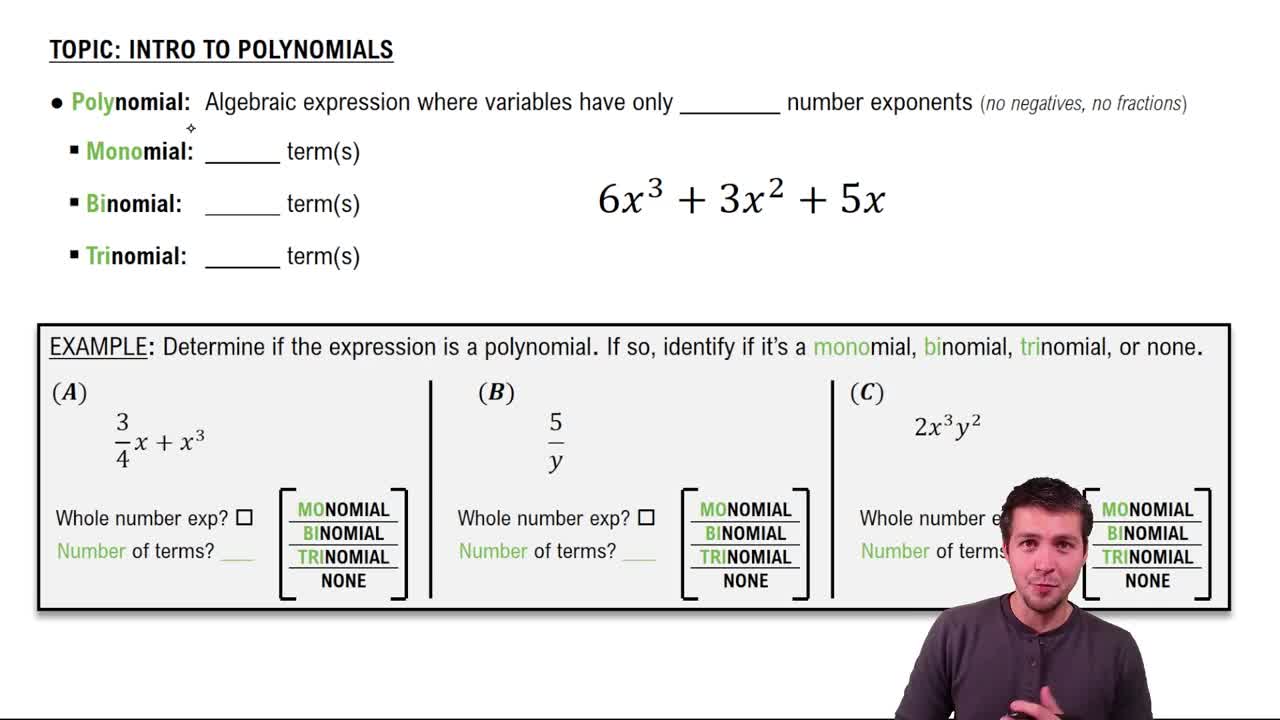
Introduction to Polynomials
Related Videos
Related Practice
Textbook Question
313
views