Solve each rational inequality in Exercises 43–60 and graph the solution set on a real number line. Express each solution set in interval notation. (x + 1)/(x + 3) < 2
Table of contents
- 0. Review of Algebra4h 18m
- 1. Equations & Inequalities3h 18m
- 2. Graphs of Equations1h 43m
- 3. Functions2h 17m
- 4. Polynomial Functions1h 44m
- 5. Rational Functions1h 23m
- 6. Exponential & Logarithmic Functions2h 28m
- 7. Systems of Equations & Matrices4h 5m
- 8. Conic Sections2h 23m
- 9. Sequences, Series, & Induction1h 22m
- 10. Combinatorics & Probability1h 45m
1. Equations & Inequalities
Linear Inequalities
Struggling with College Algebra?
Join thousands of students who trust us to help them ace their exams!Watch the first videoMultiple Choice
Express the given set in interval notation and graph.
{ | 14 ≤ < 26}
A
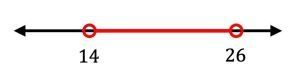
(14,26)
B
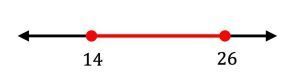
[14,26]
C
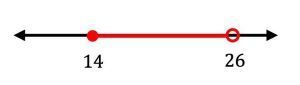
[14, 26)
D
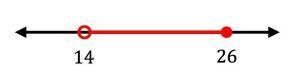
(14,26]
Verified step by step guidance1
Understand the set notation {xx | 14 ≤ xx < 26}. This means the set includes all numbers x such that x is greater than or equal to 14 and less than 26.
Interval notation is a way of writing subsets of the real number line. The notation [14, 26) represents all numbers from 14 to 26, including 14 but not including 26.
In interval notation, a square bracket [ or ] indicates that the endpoint is included in the interval, while a parenthesis ( or ) indicates that the endpoint is not included.
To graph the interval [14, 26), draw a number line. Place a solid dot at 14 to indicate that 14 is included in the interval, and an open circle at 26 to indicate that 26 is not included.
Shade the region between 14 and 26 on the number line to represent all the numbers in the interval [14, 26).
Related Videos
Related Practice
Textbook Question
421
views
Linear Inequalities practice set

