Find each product. See Examples 3–5. (m-n+k)(m+2n-3k)
Verified step by step guidance
1
Identify the expression to be expanded: \((m-n+k)(m+2n-3k)\).
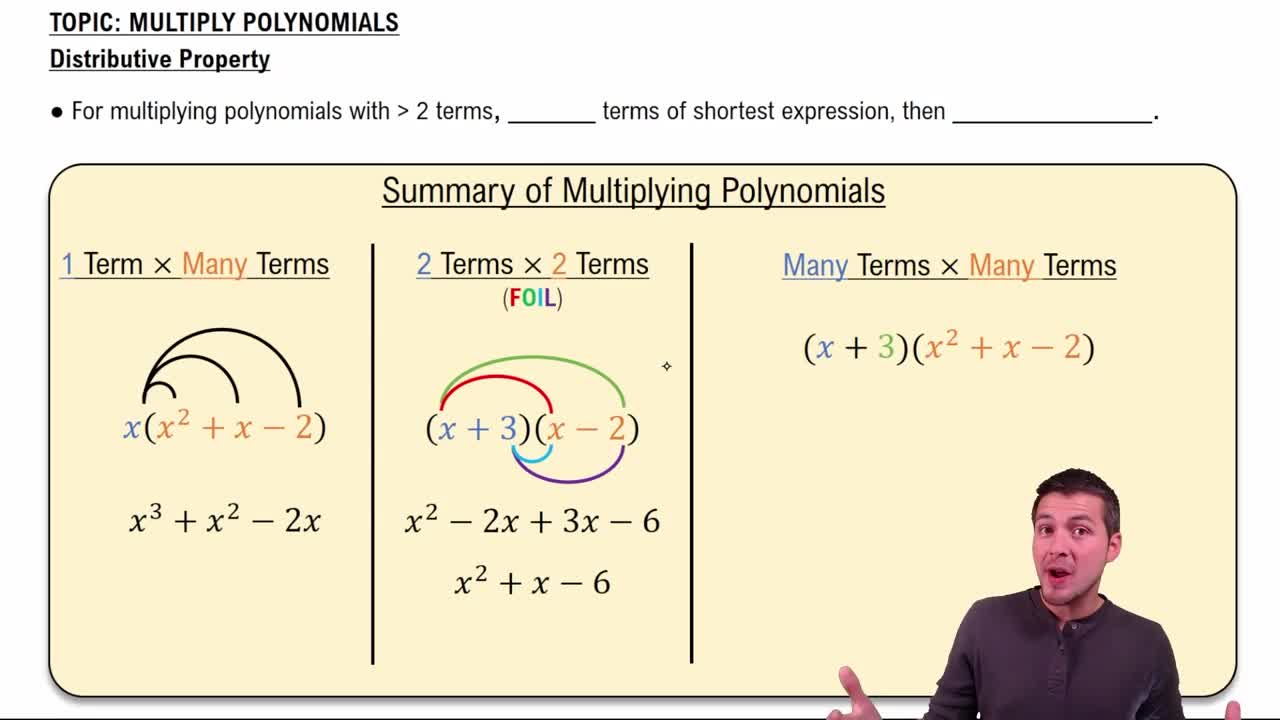
Apply the distributive property (also known as the FOIL method for binomials) to expand the expression.
Multiply each term in the first polynomial \((m-n+k)\) by each term in the second polynomial \((m+2n-3k)\).
Combine like terms by adding or subtracting the coefficients of terms with the same variables.
Write the simplified expression as the final expanded form.
Verified video answer for a similar problem:
This video solution was recommended by our tutors as helpful for the problem above
Video duration:
3m
Play a video:
Was this helpful?
Key Concepts
Here are the essential concepts you must grasp in order to answer the question correctly.
Polynomial Multiplication
Polynomial multiplication involves distributing each term in one polynomial to every term in another polynomial. This process is often referred to as the FOIL method for binomials, which stands for First, Outside, Inside, Last. Understanding how to combine like terms after distribution is crucial for simplifying the resulting expression.
Like terms are terms that have the same variable raised to the same power. For example, in the expression 3m and 5m, both terms are like terms because they both contain the variable m to the first power. Identifying and combining like terms is essential for simplifying polynomial expressions after multiplication.
The distributive property states that a(b + c) = ab + ac, allowing us to multiply a single term by each term within a parenthesis. This property is fundamental in polynomial multiplication, as it enables the systematic expansion of expressions. Mastery of this property is key to accurately finding products of polynomials.