In Exercises 35–54, use the FOIL method to multiply the binomials.
(2x−3)(4x−5)
Verified step by step guidance
1
Identify the binomials to be multiplied: \((2x - 3)\) and \((4x - 5)\).
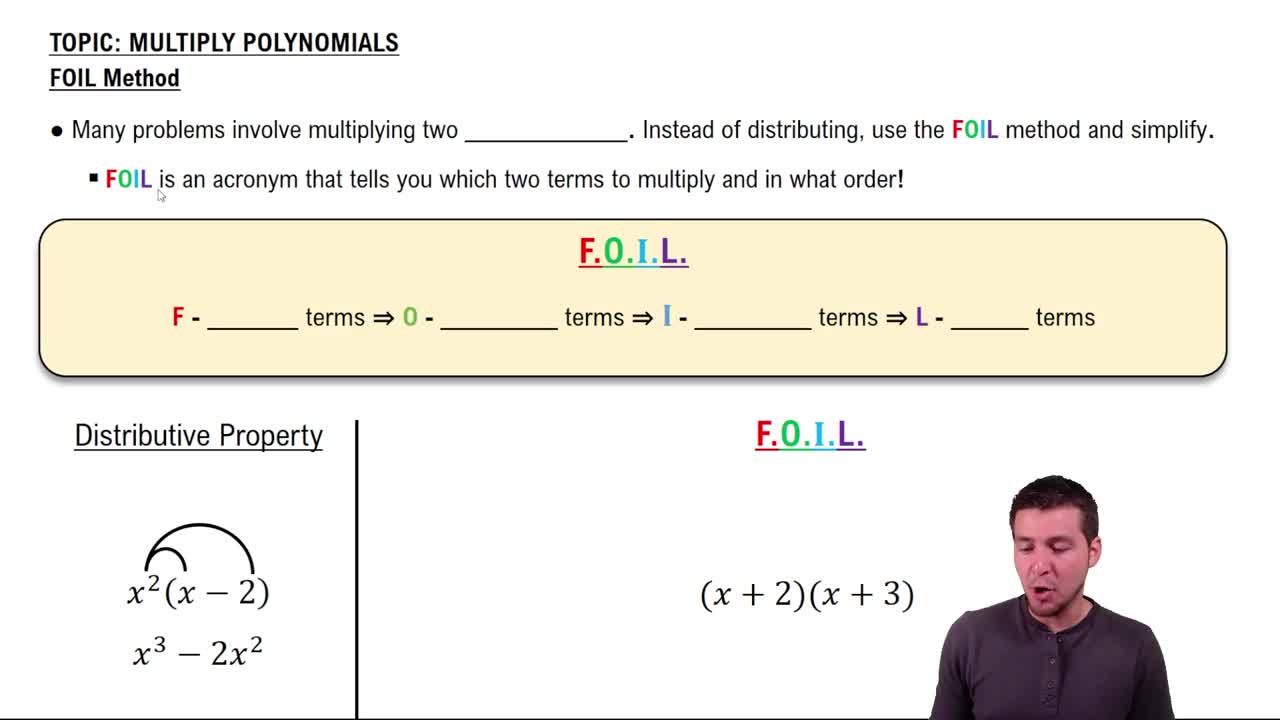
Apply the FOIL method, which stands for First, Outer, Inner, Last, to multiply the terms in the binomials.
First: Multiply the first terms of each binomial: \(2x \times 4x\).
Outer: Multiply the outer terms of the binomials: \(2x \times -5\).
Inner: Multiply the inner terms of the binomials: \(-3 \times 4x\).
Verified video answer for a similar problem:
This video solution was recommended by our tutors as helpful for the problem above.
Video duration:
6m
Play a video:
0 Comments
Key Concepts
Here are the essential concepts you must grasp in order to answer the question correctly.
FOIL Method
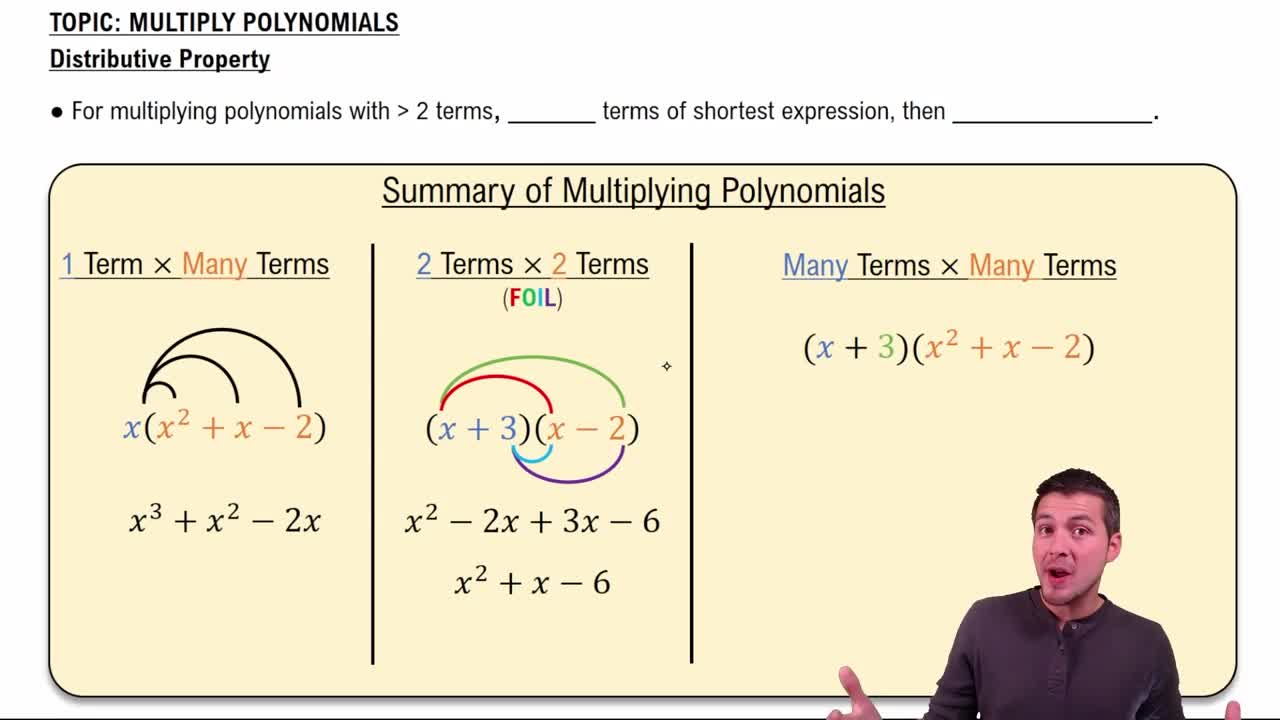
The FOIL method is a technique used to multiply two binomials. FOIL stands for First, Outside, Inside, Last, which refers to the order in which you multiply the terms of the binomials. This method helps ensure that all combinations of terms are accounted for, leading to the correct product.
A binomial is a polynomial that consists of exactly two terms, typically separated by a plus or minus sign. In the expression (2x−3)(4x−5), both (2x−3) and (4x−5) are binomials. Understanding the structure of binomials is essential for applying the FOIL method effectively.
The distributive property states that a(b + c) = ab + ac, allowing you to distribute a single term across terms within parentheses. This property is fundamental to the FOIL method, as it involves distributing each term in the first binomial to each term in the second binomial, ensuring all products are calculated.

 6:40 minutes
 Verified step by step guidance
 03:41
03:41