Rewrite the bases on both sides of the equation to have the same base. Note that \(\frac{1}{e} = e^{-1}\), so rewrite the left side as \(\left(e^{-1}\right)^{-x}\) and the right side as \(\left(e^{-2}\right)^{x+1}\).
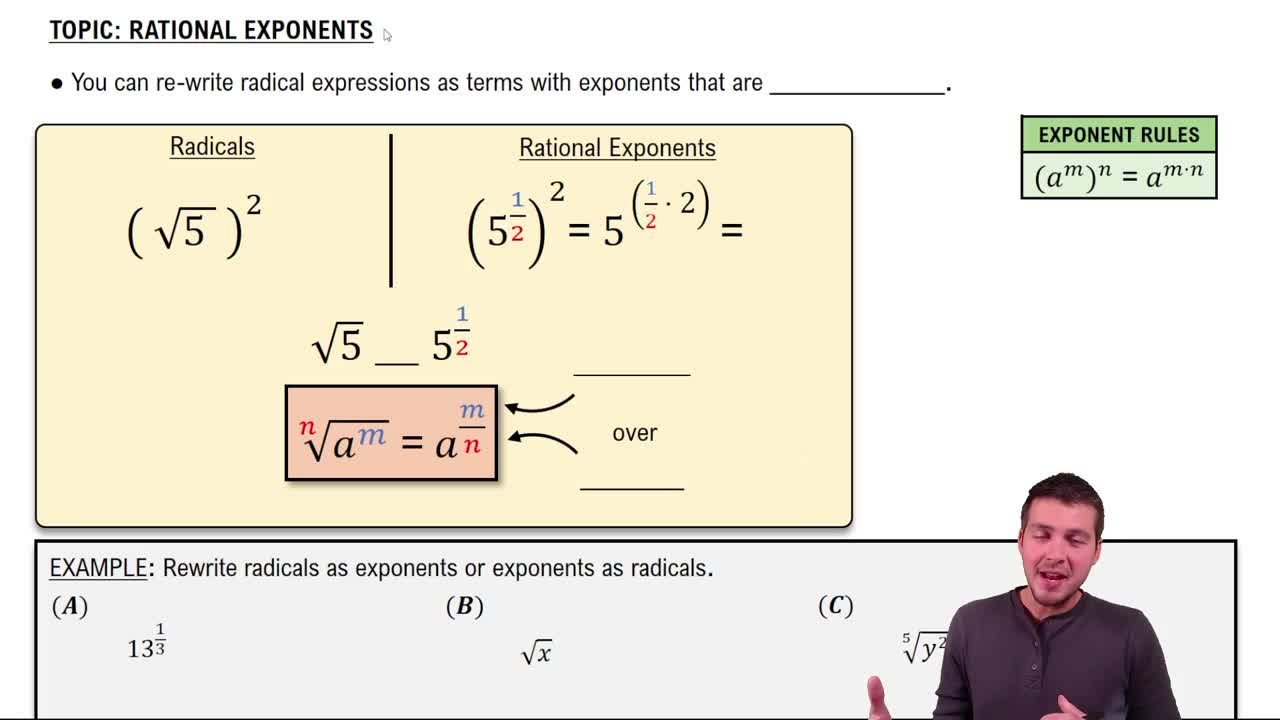
Apply the power of a power rule, which states that \(\left(a^m\right)^n = a^{m \cdot n}\), to simplify both sides: the left side becomes \(e^{-1 \cdot (-x)} = e^{x}\), and the right side becomes \(e^{-2 \cdot (x+1)} = e^{-2x - 2}\).
Since the bases are the same (both are \(e\)), set the exponents equal to each other: \(x = -2x - 2\).
Solve the resulting linear equation for \(x\) by first adding \$2x\( to both sides to get \)x + 2x = -2\(, which simplifies to \)3x = -2$.
Divide both sides by 3 to isolate \(x\), giving \(x = \frac{-2}{3}\).
Verified video answer for a similar problem:
This video solution was recommended by our tutors as helpful for the problem above
Video duration:
3m
Play a video:
Was this helpful?
Key Concepts
Here are the essential concepts you must grasp in order to answer the question correctly.
Properties of Exponents
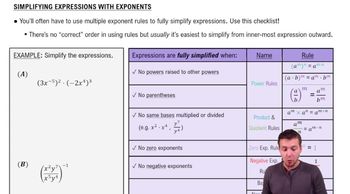
Understanding how to manipulate exponents is essential, including rules like (a^m)^n = a^(mn) and a^(-m) = 1/a^m. These properties allow simplification and rewriting of expressions to solve equations involving powers.
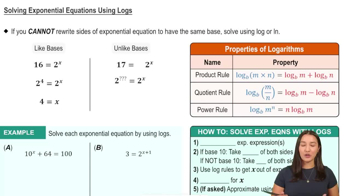
An exponential equation involves variables in the exponent. Solving such equations often requires rewriting both sides with the same base or applying logarithms to isolate the variable.
If two exponential expressions with the same positive base are equal, their exponents must be equal. This principle allows setting the exponents equal to each other to solve for the unknown variable.