Concept Check. If ƒ(x) = ax and ƒ(3) = 27, determine each function value. ƒ(2)
Verified step by step guidance
1
Identify the given function: \(f(x) = a^x\), where \(a\) is the base we need to find.
Use the given information \(f(3) = 27\) to set up the equation: \(a^3 = 27\).
Solve for \(a\) by taking the cube root of both sides: \(a = \sqrt[3]{27}\).
Once you find the value of \(a\), substitute it back into the function to find \(f(2)\): \(f(2) = a^2\).
Calculate \(a^2\) using the value of \(a\) found in step 3 to determine \(f(2)\).
Verified video answer for a similar problem:
This video solution was recommended by our tutors as helpful for the problem above
Video duration:
3m
Play a video:
Was this helpful?
Key Concepts
Here are the essential concepts you must grasp in order to answer the question correctly.
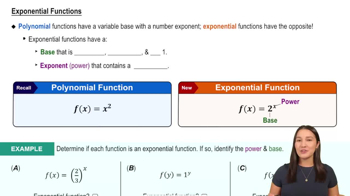
Exponential Functions
An exponential function has the form f(x) = a^x, where the base a is a positive constant and the exponent x is a variable. These functions model growth or decay processes and have unique properties such as always being positive and increasing or decreasing depending on the base.
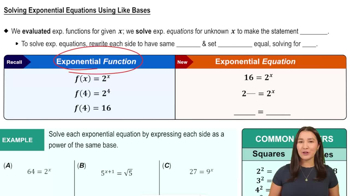
When a function value is given, such as f(3) = 27, you can substitute x = 3 into f(x) = a^x to form an equation a^3 = 27. Solving this equation helps determine the base a, which is essential for evaluating the function at other points.
Once the base a is known, you can find the function value at any input by substituting that input into f(x) = a^x. For example, to find f(2), calculate a^2 using the previously determined base, which gives the function value at x = 2.