Use the rules for radicals to perform the indicated operations. Assume all variable expressions represent positive real numbers. 4n4m
Verified step by step guidance
1
Identify the given expression: the fourth root of \( \frac{m}{n^4} \), which can be written as \( \sqrt[4]{\frac{m}{n^4}} \).
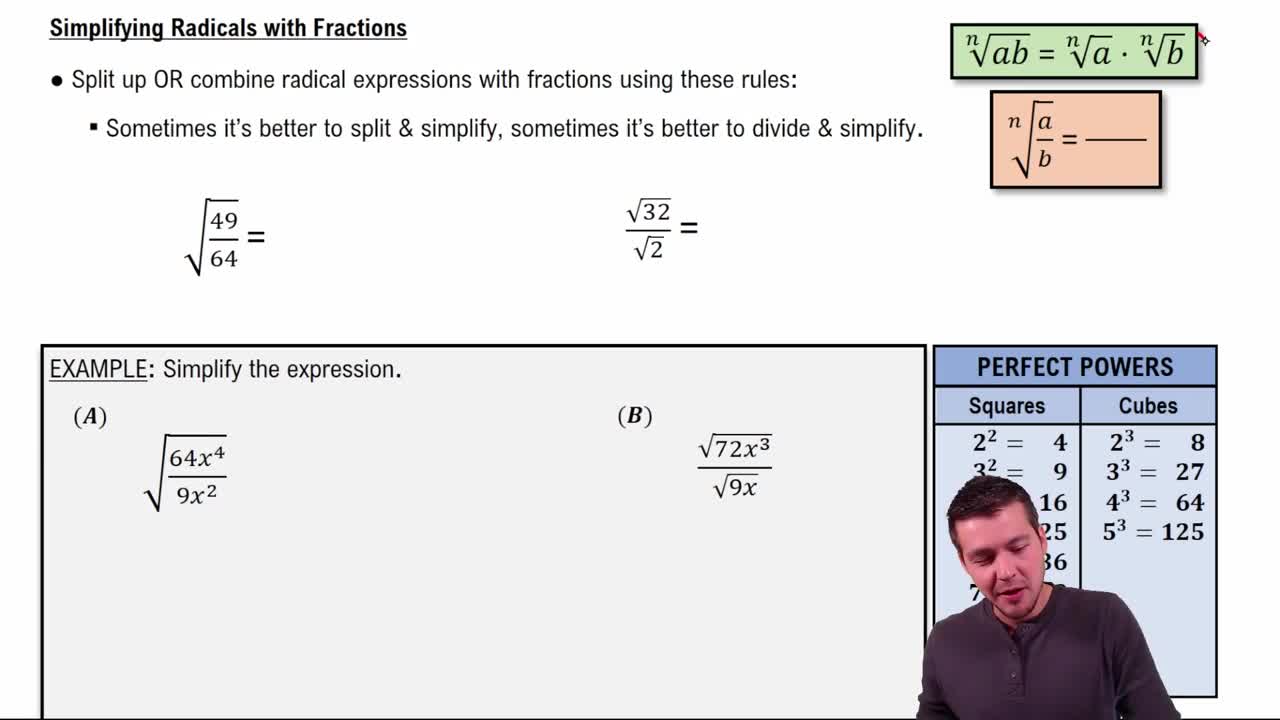
Recall the property of radicals that \( \sqrt[4]{\frac{a}{b}} = \frac{\sqrt[4]{a}}{\sqrt[4]{b}} \). Apply this to separate the numerator and denominator inside the radical: \( \frac{\sqrt[4]{m}}{\sqrt[4]{n^4}} \).
Use the rule that \( \sqrt[4]{n^4} = n^{\frac{4}{4}} = n^1 = n \), since the fourth root and the fourth power cancel each other out.
Rewrite the expression as \( \frac{\sqrt[4]{m}}{n} \).
This is the simplified form using the rules for radicals, assuming all variables represent positive real numbers.
Verified video answer for a similar problem:
This video solution was recommended by our tutors as helpful for the problem above
Video duration:
2m
Play a video:
Was this helpful?
Key Concepts
Here are the essential concepts you must grasp in order to answer the question correctly.
Radical Expressions and Their Properties
Radical expressions involve roots such as square roots, cube roots, and fourth roots. Understanding how to simplify and manipulate these expressions is essential, including recognizing that the nth root of a quotient equals the quotient of the nth roots.
Operations with radicals follow specific rules, such as the product rule (√a * √b = √(ab)) and the quotient rule (√(a/b) = √a / √b). Applying these rules allows simplification of expressions involving radicals, especially when variables and exponents are involved.
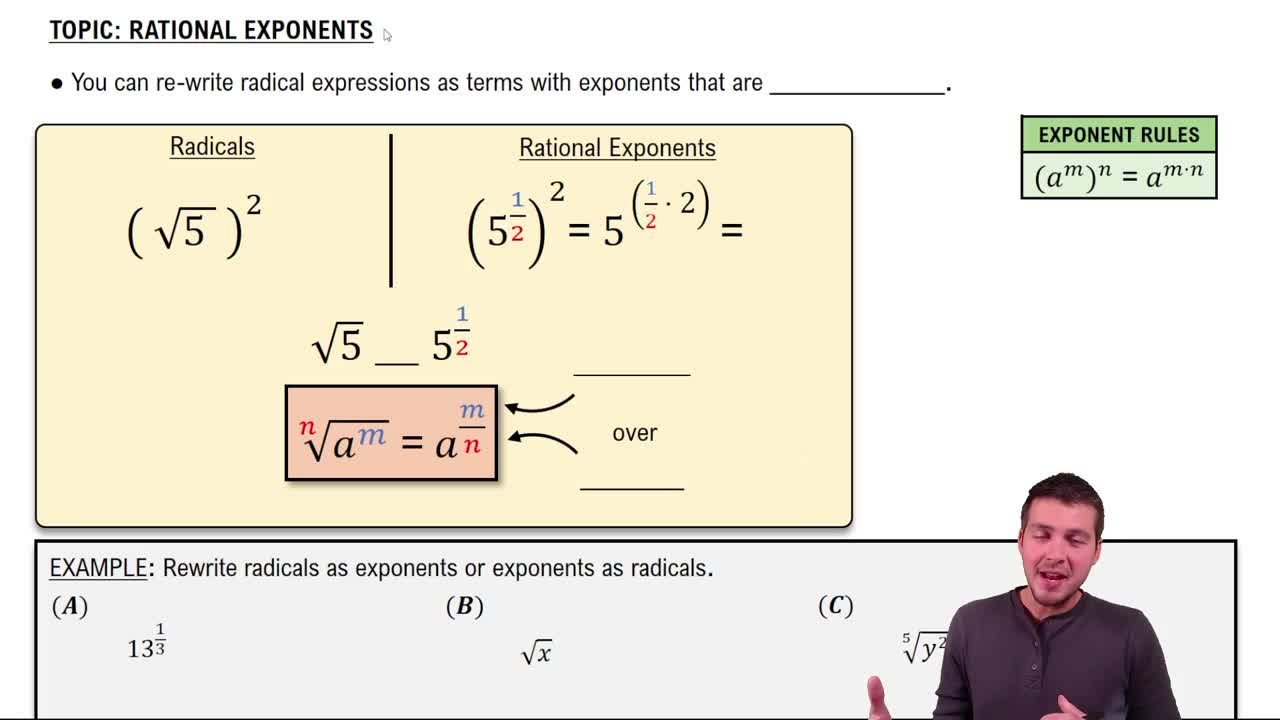
Radicals can be expressed as fractional exponents, where the nth root of a variable is the variable raised to the 1/n power. This connection helps in simplifying and performing operations on radical expressions by converting between radical and exponential forms.