Simplify each expression. Write answers without negative exponents. Assume all vari-ables represent nonzero real numbers. See Examples 5 and 6. -4r-2(r4)2
Verified step by step guidance
1
Start by rewriting the expression clearly: \(-4r^{-2}(r^{4})^{2}\).
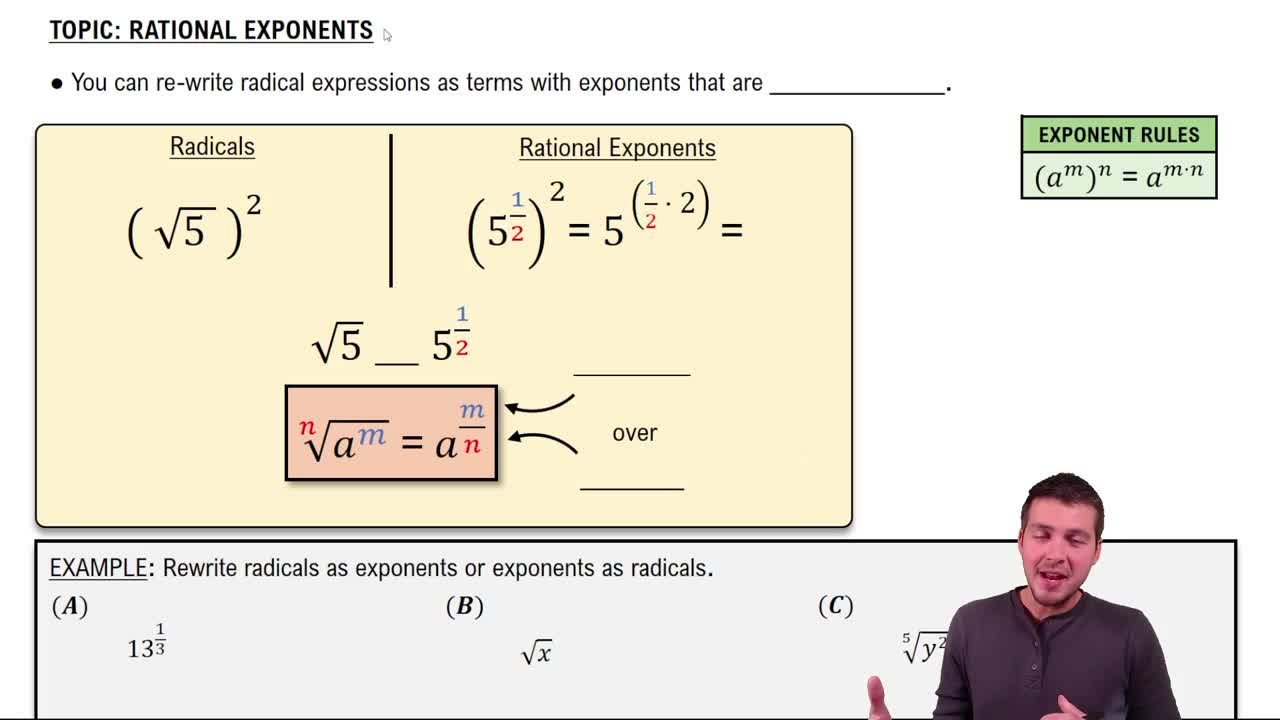
Apply the power of a power rule to simplify \((r^{4})^{2}\), which means multiplying the exponents: \(r^{4 \times 2} = r^{8}\).
Now the expression becomes \(-4r^{-2} \cdot r^{8}\).
Use the product of powers rule to combine \(r^{-2}\) and \(r^{8}\) by adding the exponents: \(r^{-2 + 8} = r^{6}\).
Rewrite the expression as \(-4r^{6}\), which has no negative exponents and is fully simplified.
Verified video answer for a similar problem:
This video solution was recommended by our tutors as helpful for the problem above
Video duration:
2m
Play a video:
Was this helpful?
Key Concepts
Here are the essential concepts you must grasp in order to answer the question correctly.
Laws of Exponents
The laws of exponents govern how to simplify expressions involving powers. Key rules include multiplying exponents when raising a power to another power, adding exponents when multiplying like bases, and understanding negative exponents represent reciprocals. These rules help simplify complex expressions systematically.
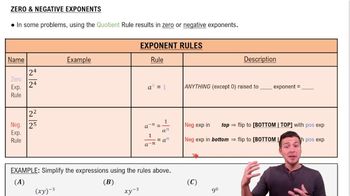
Negative exponents indicate the reciprocal of the base raised to the positive exponent. For example, r^-2 equals 1/r^2. To write answers without negative exponents, rewrite terms with negative exponents as fractions, ensuring the final expression contains only positive exponents.
When simplifying expressions, follow the order of operations: parentheses, exponents, multiplication, and division. This ensures correct simplification, especially when dealing with powers raised to powers and products of terms with exponents. Applying these steps carefully avoids errors.