Simplify the radical expressions in Exercises 58 - 62. ∜(32x5)/∜(16x) (Assume that x > 0.)
Verified step by step guidance
1
Rewrite the expression by combining the fourth roots into a single fourth root: \(\frac{\sqrt[4]{32x^5}}{\sqrt[4]{16x}} = \sqrt[4]{\frac{32x^5}{16x}}\).
Simplify the fraction inside the radical: \(\frac{32x^5}{16x} = 2x^{5-1} = 2x^4\).
Now the expression is \(\sqrt[4]{2x^4}\). Recognize that \(\sqrt[4]{x^4} = x\) since \(x > 0\).
Separate the fourth root into the product of two fourth roots: \(\sqrt[4]{2x^4} = \sqrt[4]{2} \times \sqrt[4]{x^4} = \sqrt[4]{2} \times x\).
Write the simplified expression as \(x \sqrt[4]{2}\), which is the simplified form of the original expression.
Verified video answer for a similar problem:
This video solution was recommended by our tutors as helpful for the problem above
Video duration:
3m
Play a video:
Was this helpful?
Key Concepts
Here are the essential concepts you must grasp in order to answer the question correctly.
Properties of Radicals
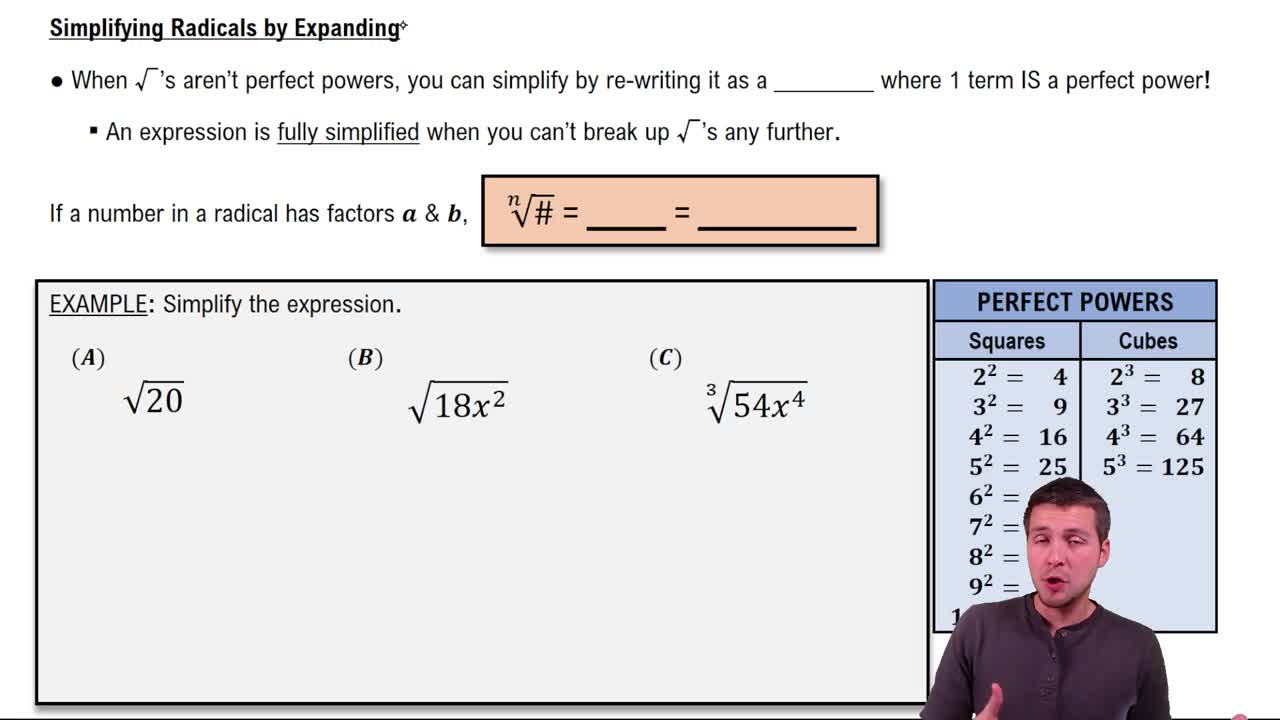
Radicals represent roots, such as square roots or fourth roots. Key properties include the ability to separate radicals over multiplication and division, for example, ⁿ√(a/b) = ⁿ√a / ⁿ√b. Understanding these properties allows simplification of complex radical expressions.
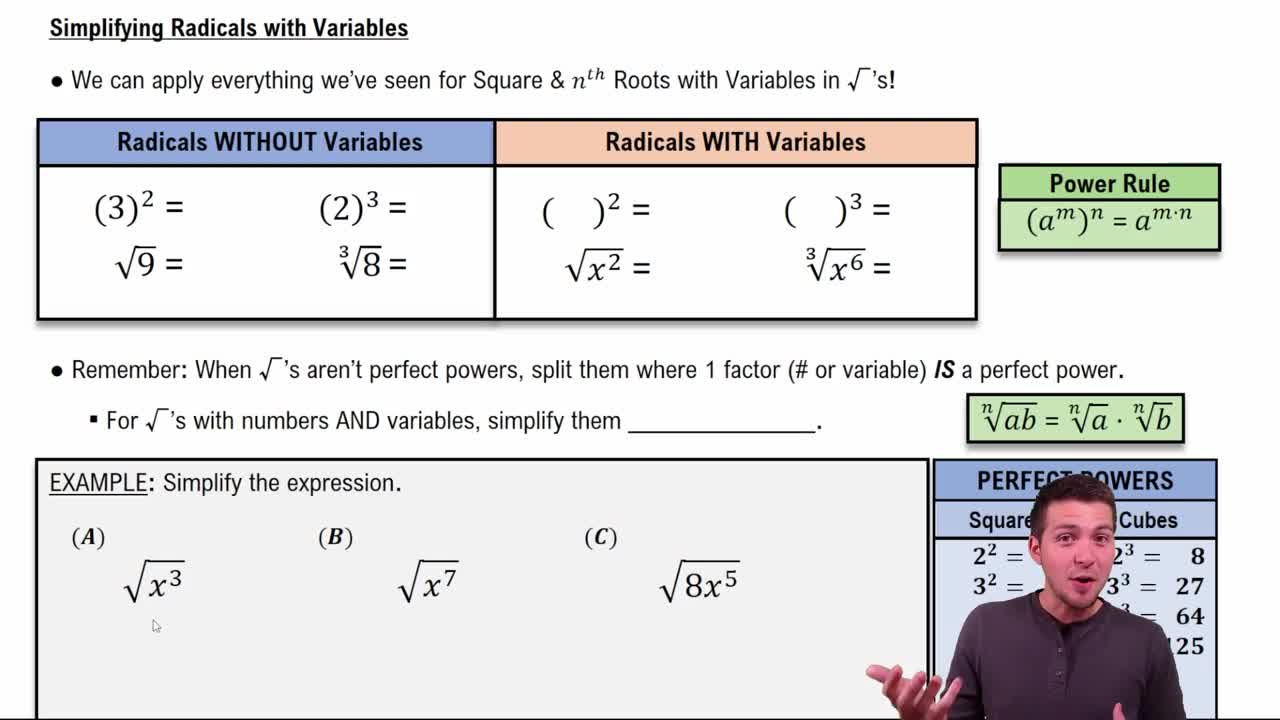
When simplifying radicals containing variables, apply the root to both the coefficient and the variable separately. For variables with exponents, divide the exponent by the root's index, extracting whole powers outside the radical and leaving the remainder inside.
The fourth root (⁴√) of a number is the value that, when raised to the fourth power, returns the original number. Using exponent rules, ⁿ√(a^m) = a^(m/n), helps convert radicals into fractional exponents, simplifying calculations and expressions.