In Exercises 69–82, multiply using the rule for the product of the sum and difference of two terms.
(y³ + 2)(y³ − 2)
Verified step by step guidance
1
Identify the expression as a product of the sum and difference of two terms: \((a + b)(a - b)\).
Recognize that \(a = y^3\) and \(b = 2\).
Apply the formula for the product of the sum and difference: \((a + b)(a - b) = a^2 - b^2\).
Substitute \(a = y^3\) and \(b = 2\) into the formula: \((y^3)^2 - 2^2\).
Simplify the expression: \(y^6 - 4\).
Verified video answer for a similar problem:
This video solution was recommended by our tutors as helpful for the problem above.
Video duration:
5m
Play a video:
0 Comments
Key Concepts
Here are the essential concepts you must grasp in order to answer the question correctly.
Product of Sum and Difference
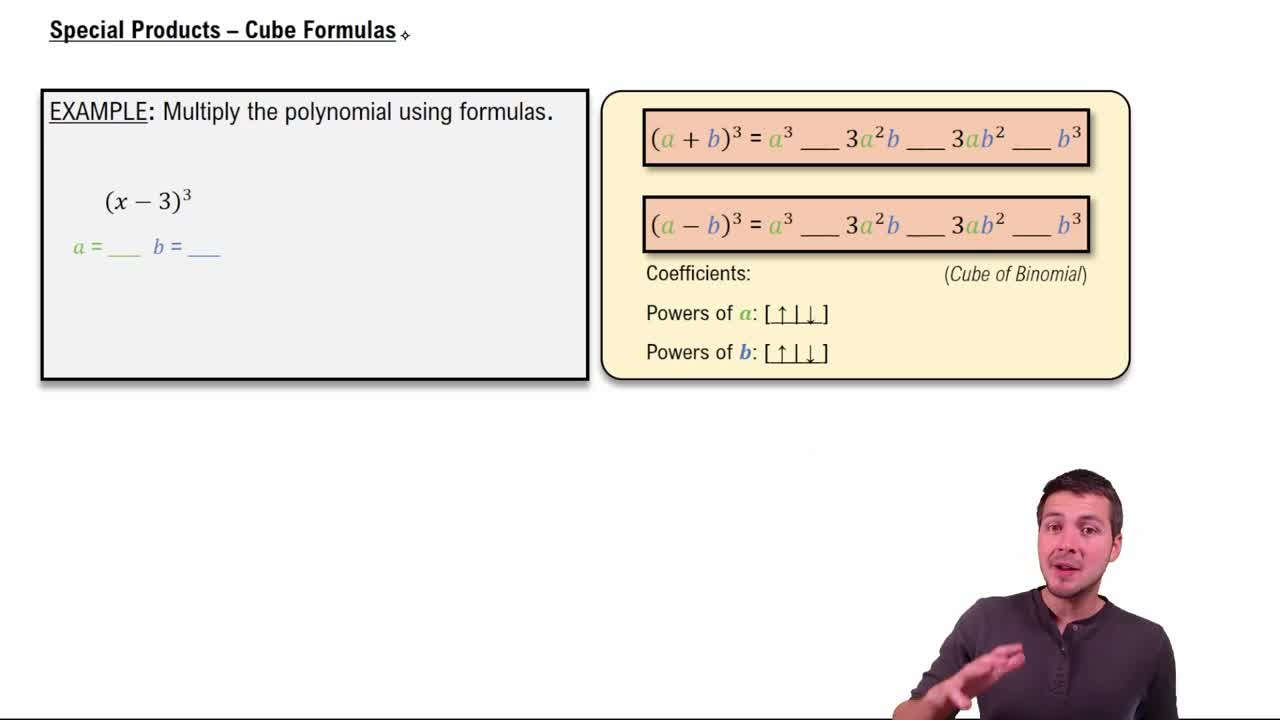
The product of the sum and difference of two terms follows the formula (a + b)(a - b) = a² - b². This identity simplifies the multiplication of expressions where one is the sum and the other is the difference of the same two terms, allowing for a straightforward calculation without expanding both expressions fully.
Polynomial multiplication involves multiplying two polynomials together, which can be done using various methods, including the distributive property or special product formulas. In this case, recognizing the structure of the polynomials allows for a more efficient calculation by applying the product of sum and difference rule.
Simplifying expressions is the process of reducing a mathematical expression to its simplest form. This often involves combining like terms, factoring, or applying algebraic identities, such as the product of sum and difference, to make calculations easier and clearer.

 5:07 minutes
 Verified step by step guidance
 03:41
03:41