In Exercises 69–82, multiply using the rule for the product of the sum and difference of two terms.
(8x + 7y)(8x − 7y)
Verified step by step guidance
1
Identify the expression as a product of the sum and difference of two terms: \((a + b)(a - b)\).
Recall the formula for the product of the sum and difference: \((a + b)(a - b) = a^2 - b^2\).
In the given expression \((8x + 7y)(8x - 7y)\), identify \(a = 8x\) and \(b = 7y\).
Apply the formula: \((8x)^2 - (7y)^2\).
Simplify each term: \((8x)^2 = 64x^2\) and \((7y)^2 = 49y^2\), resulting in \(64x^2 - 49y^2\).
Verified video answer for a similar problem:
This video solution was recommended by our tutors as helpful for the problem above.
Video duration:
5m
Play a video:
0 Comments
Key Concepts
Here are the essential concepts you must grasp in order to answer the question correctly.
Product of Sum and Difference
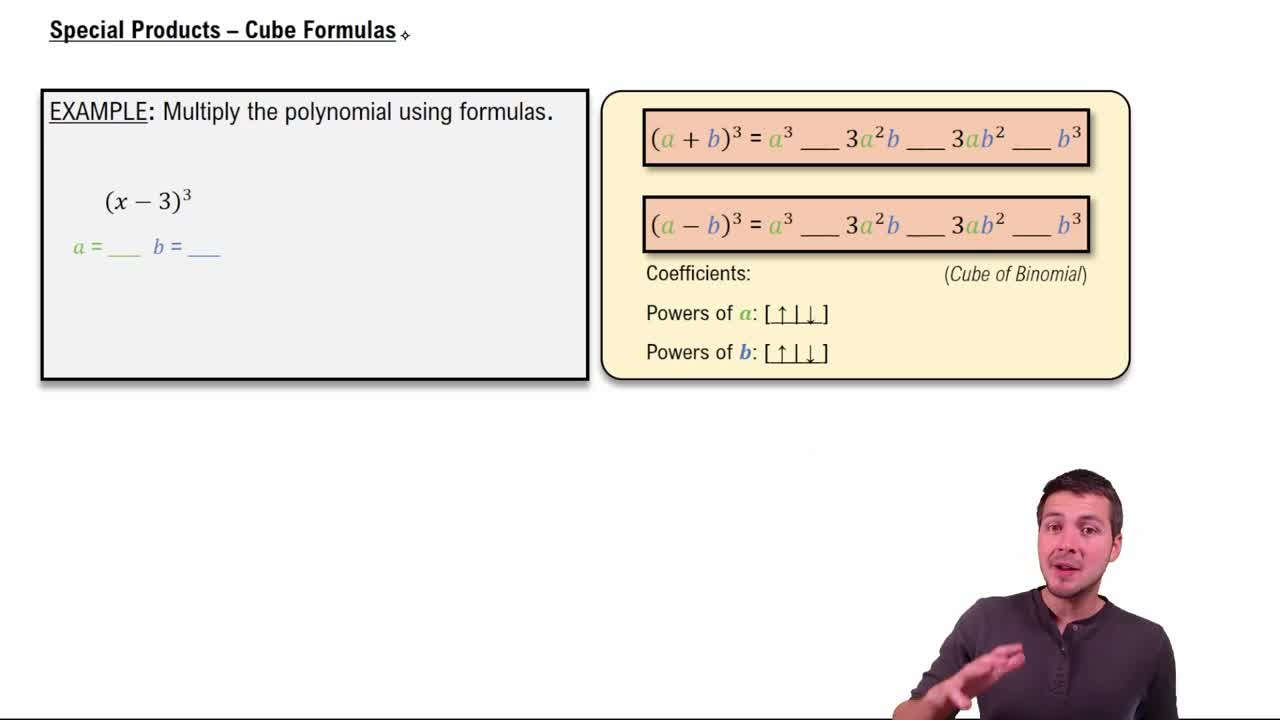
The product of the sum and difference of two terms follows the formula (a + b)(a - b) = a² - b². This identity simplifies the multiplication of expressions where one is the sum and the other is the difference of the same two terms, allowing for a quick calculation without expanding the entire expression.
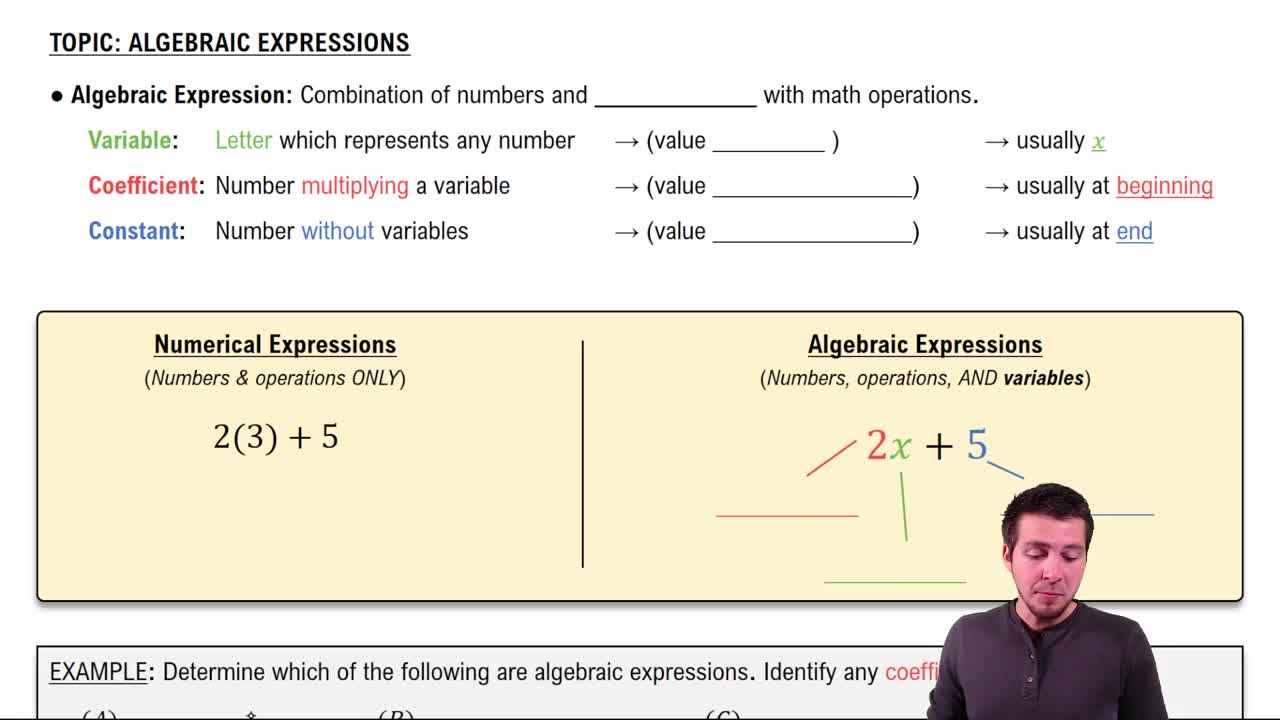
Algebraic expressions are combinations of numbers, variables, and operations. In the given expression (8x + 7y)(8x - 7y), the terms 8x and 7y are variables that can represent any real numbers, and understanding how to manipulate these expressions is fundamental in algebra.
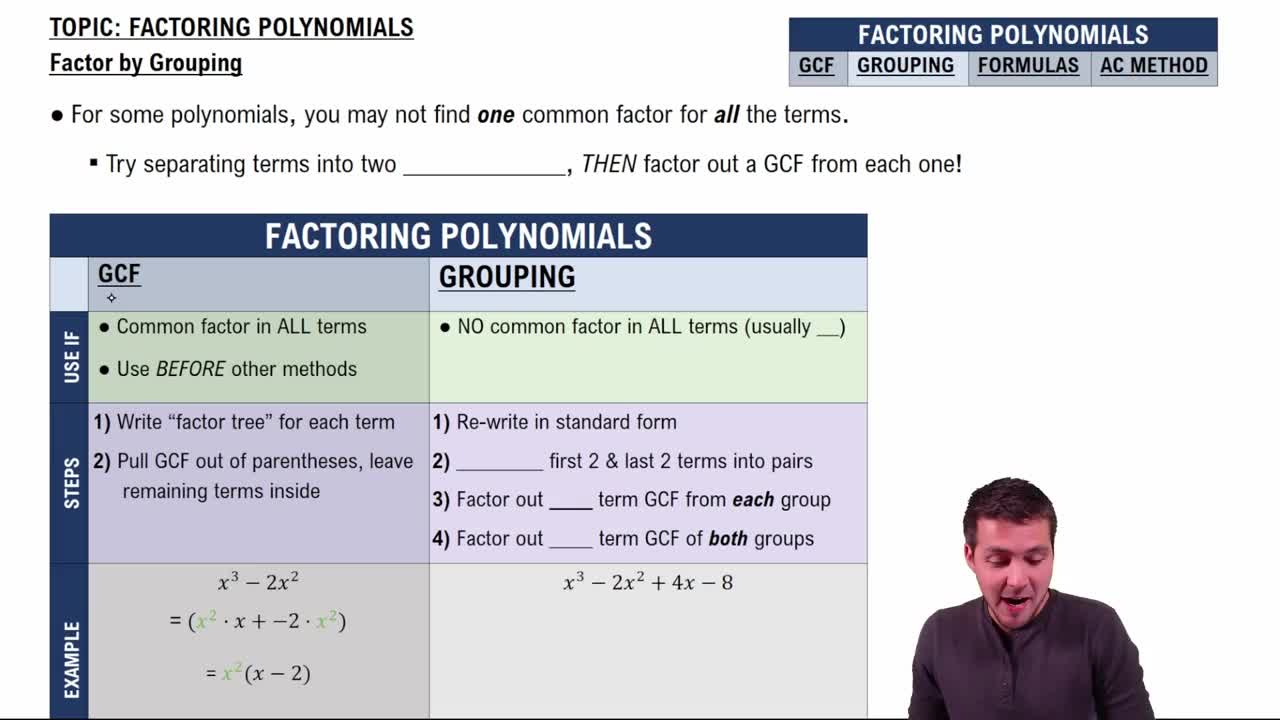
Factoring involves rewriting an expression as a product of its factors, while expanding is the process of multiplying out the factors to form a single expression. Mastery of both concepts is essential for solving algebraic problems, as they allow for simplification and manipulation of expressions effectively.

 5:08 minutes
 Verified step by step guidance
 03:41
03:41