In Exercises 1–4, determine if the given ordered triple is a solution of the system. (2,−1, 3) x+ y+0z=4, x−2y−0z=1, 2x−y−2z=−1
Table of contents
- 0. Review of Algebra4h 18m
- 1. Equations & Inequalities3h 18m
- 2. Graphs of Equations1h 43m
- 3. Functions2h 17m
- 4. Polynomial Functions1h 44m
- 5. Rational Functions1h 23m
- 6. Exponential & Logarithmic Functions2h 28m
- 7. Systems of Equations & Matrices4h 5m
- 8. Conic Sections2h 23m
- 9. Sequences, Series, & Induction1h 22m
- 10. Combinatorics & Probability1h 45m
7. Systems of Equations & Matrices
Introduction to Matrices
Problem 109
Textbook Question
Solve each problem. See Examples 5 and 9. Solve the system of equations (4), (5), and (6) from Example 9.
(4)
(5)
(6)
Verified step by step guidance1
Start by writing down the system of equations clearly:
\[25x + 40y + 20z = 2200\]
\[4x + 2y + 3z = 280\]
\[3x + 2y + z = 180\]
Choose two of the equations to eliminate one variable. For example, subtract equation (6) multiplied by an appropriate number from equation (5) multiplied by another number to eliminate variable \( y \). This will give you an equation with only \( x \) and \( z \).
Next, use the result from step 2 and one of the original equations (for example, equation (6)) to eliminate another variable, such as \( z \), to solve for \( x \) alone.
Once you have the value of \( x \), substitute it back into one of the two-variable equations from step 2 to find \( z \).
Finally, substitute the values of \( x \) and \( z \) into any of the original equations to solve for \( y \).
Verified video answer for a similar problem:This video solution was recommended by our tutors as helpful for the problem above
Video duration:
7mPlay a video:
Was this helpful?
Key Concepts
Here are the essential concepts you must grasp in order to answer the question correctly.
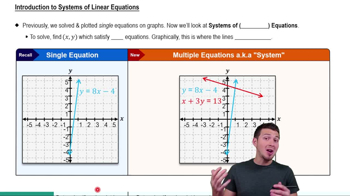
Systems of Linear Equations
A system of linear equations consists of multiple linear equations involving the same set of variables. The goal is to find values for these variables that satisfy all equations simultaneously. Understanding how to interpret and set up such systems is essential for solving them correctly.
Recommended video:
Guided course
Introduction to Systems of Linear Equations
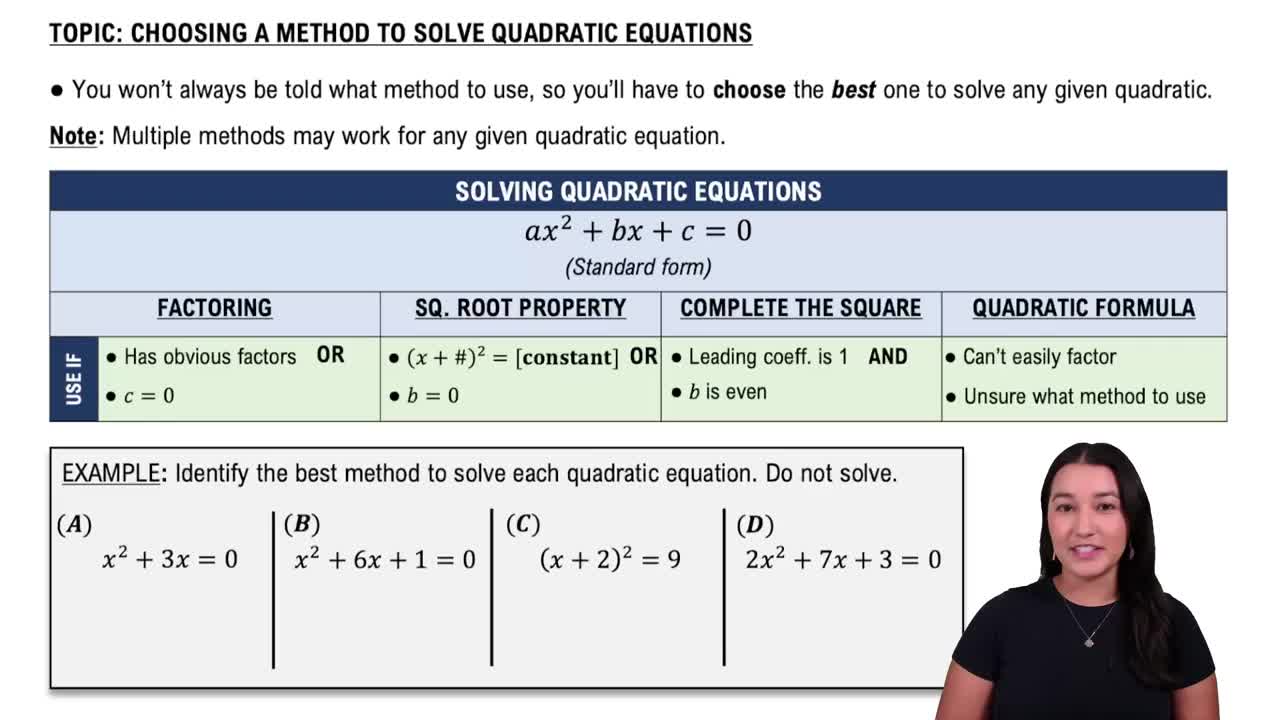
Methods for Solving Systems (Substitution, Elimination, and Matrix Methods)
Common techniques to solve systems include substitution, elimination, and using matrices (such as Gaussian elimination). These methods transform the system into simpler forms to isolate variables and find their values efficiently.
Recommended video:
Choosing a Method to Solve Quadratics
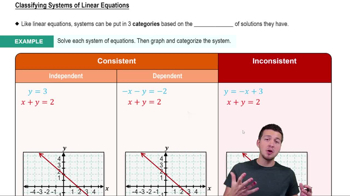
Checking Solutions for Consistency
After finding potential solutions, it is important to verify them by substituting back into the original equations. This ensures the solution satisfies all equations, confirming the system is consistent and the solution is correct.
Recommended video:
Guided course
Classifying Systems of Linear Equations
Watch next
Master Introduction to Matrices with a bite sized video explanation from Patrick
Start learningRelated Videos
Related Practice
Textbook Question
617
views
