Find the quadratic function y = ax^2 + bx + c whose graph passes through the points (1, 4), (3, 20), and (-2, 25).
Table of contents
- 0. Review of Algebra4h 18m
- 1. Equations & Inequalities3h 18m
- 2. Graphs of Equations1h 43m
- 3. Functions2h 17m
- 4. Polynomial Functions1h 44m
- 5. Rational Functions1h 23m
- 6. Exponential & Logarithmic Functions2h 28m
- 7. Systems of Equations & Matrices4h 5m
- 8. Conic Sections2h 23m
- 9. Sequences, Series, & Induction1h 22m
- 10. Combinatorics & Probability1h 45m
7. Systems of Equations & Matrices
Introduction to Matrices
Problem 102
Textbook Question
Solve each problem. See Examples 5 and 9. A cashier has a total of 30 bills, made up of ones, fives, and twenties. The number of twenties is 9 more than the number of ones. The total value of the money is \$351. How many of each denomination of bill are there?
Verified step by step guidance1
Define variables for the number of each type of bill: let \(x\) be the number of one-dollar bills, \(y\) be the number of five-dollar bills, and \(z\) be the number of twenty-dollar bills.
Write an equation for the total number of bills: since there are 30 bills in total, we have \(x + y + z = 30\).
Express the relationship between the number of twenties and ones: the number of twenties is 9 more than the number of ones, so \(z = x + 9\).
Write an equation for the total value of the bills: the total amount is \$351\(, so \)1 \cdot x + 5 \cdot y + 20 \cdot z = 351$.
Substitute \(z = x + 9\) into the first and third equations to reduce the system to two equations with two variables, then solve for \(x\) and \(y\), and finally find \(z\) using \(z = x + 9\).
Verified video answer for a similar problem:This video solution was recommended by our tutors as helpful for the problem above
Video duration:
7mPlay a video:
Was this helpful?
Key Concepts
Here are the essential concepts you must grasp in order to answer the question correctly.
Setting Up Variables for Word Problems
Assign variables to represent unknown quantities in the problem, such as the number of one-dollar, five-dollar, and twenty-dollar bills. This step translates the word problem into algebraic expressions, making it easier to form equations based on the given relationships.
Recommended video:
Guided course
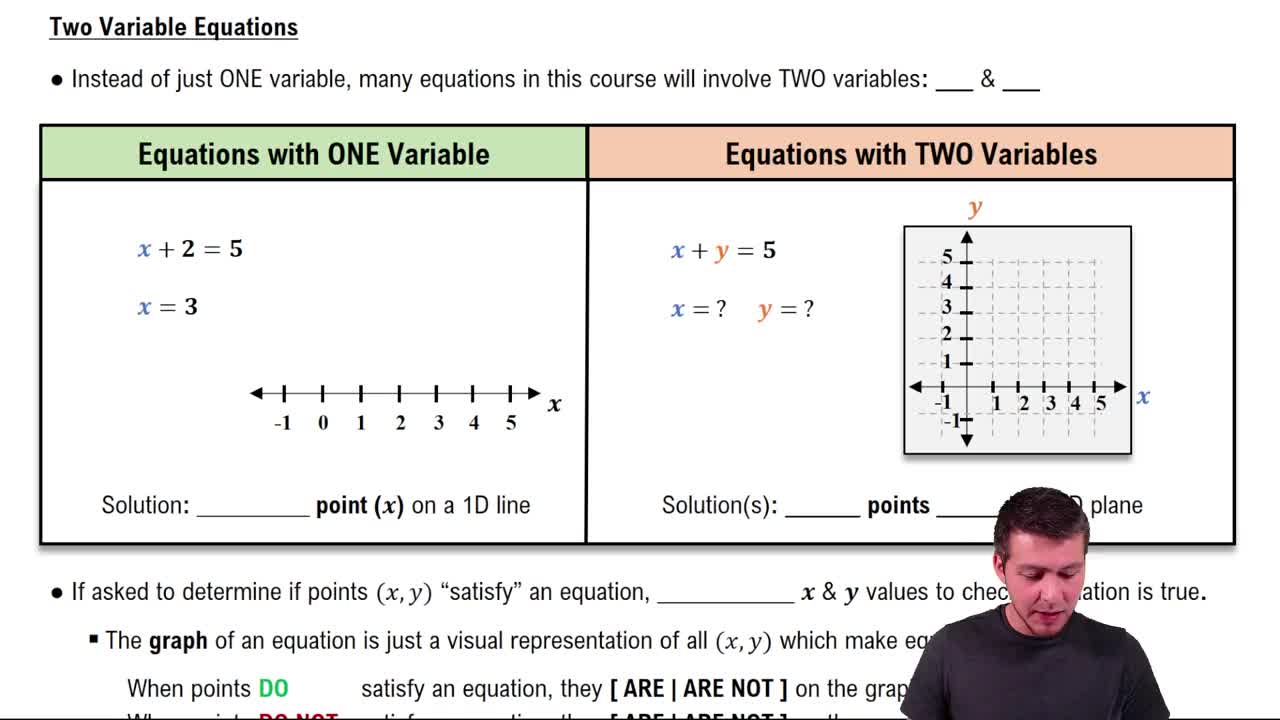
Equations with Two Variables
Formulating Systems of Linear Equations
Use the relationships described in the problem to create multiple linear equations. For example, the total number of bills, the relationship between the number of twenties and ones, and the total value of the bills each provide an equation that together form a system to solve.
Recommended video:
Guided course
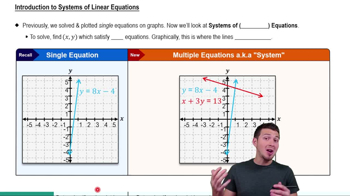
Introduction to Systems of Linear Equations
Solving Systems of Equations
Apply methods such as substitution or elimination to solve the system of linear equations. This process finds the values of the variables that satisfy all equations simultaneously, revealing the number of each type of bill.
Recommended video:
Guided course
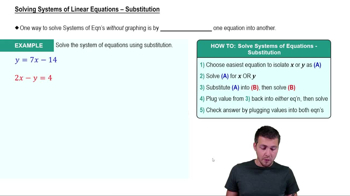
Solving Systems of Equations - Substitution
Watch next
Master Introduction to Matrices with a bite sized video explanation from Patrick
Start learningRelated Videos
Related Practice
Textbook Question
747
views