Determine the different possibilities for the numbers of positive, negative, and nonreal complex zeros of each function.
Table of contents
- 0. Review of Algebra4h 18m
- 1. Equations & Inequalities3h 18m
- 2. Graphs of Equations1h 43m
- 3. Functions2h 17m
- 4. Polynomial Functions1h 44m
- 5. Rational Functions1h 23m
- 6. Exponential & Logarithmic Functions2h 28m
- 7. Systems of Equations & Matrices4h 5m
- 8. Conic Sections2h 23m
- 9. Sequences, Series, & Induction1h 22m
- 10. Combinatorics & Probability1h 45m
4. Polynomial Functions
Zeros of Polynomial Functions
Problem 5
Textbook Question
Determine whether each statement is true or false. If false, explain why. A polynomial function having degree 6 and only real coefficients may have no real zeros.
Verified step by step guidance1
Recall the Fundamental Theorem of Algebra, which states that a polynomial of degree \(n\) has exactly \(n\) roots (zeros) in the complex number system, counting multiplicities.
Since the polynomial has degree 6, it must have exactly 6 roots in total, but these roots can be real or complex.
Because the polynomial has only real coefficients, any non-real complex roots must occur in conjugate pairs. This means complex roots come in pairs like \(a + bi\) and \(a - bi\).
If the polynomial had no real zeros, then all 6 roots would be complex and must come in conjugate pairs. Since 6 is even, it is possible to have 3 pairs of complex conjugate roots and no real roots.
Therefore, it is possible for a degree 6 polynomial with real coefficients to have no real zeros, making the statement true.
Verified video answer for a similar problem:This video solution was recommended by our tutors as helpful for the problem above
Video duration:
1mPlay a video:
Was this helpful?
Key Concepts
Here are the essential concepts you must grasp in order to answer the question correctly.
Polynomial Degree and Zeros
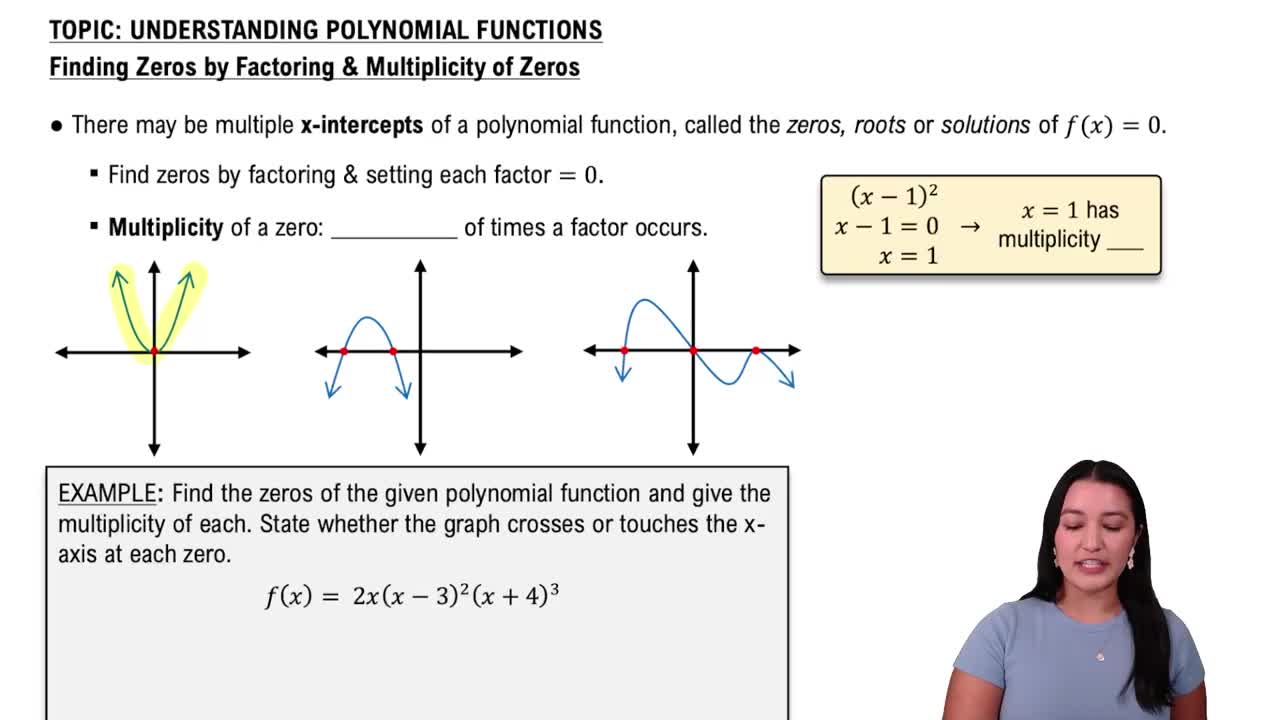
The degree of a polynomial indicates the highest power of the variable and determines the maximum number of zeros (roots) the polynomial can have. A polynomial of degree 6 can have up to 6 zeros, counting multiplicities and including complex zeros.
Recommended video:
Finding Zeros & Their Multiplicity
Real and Complex Zeros
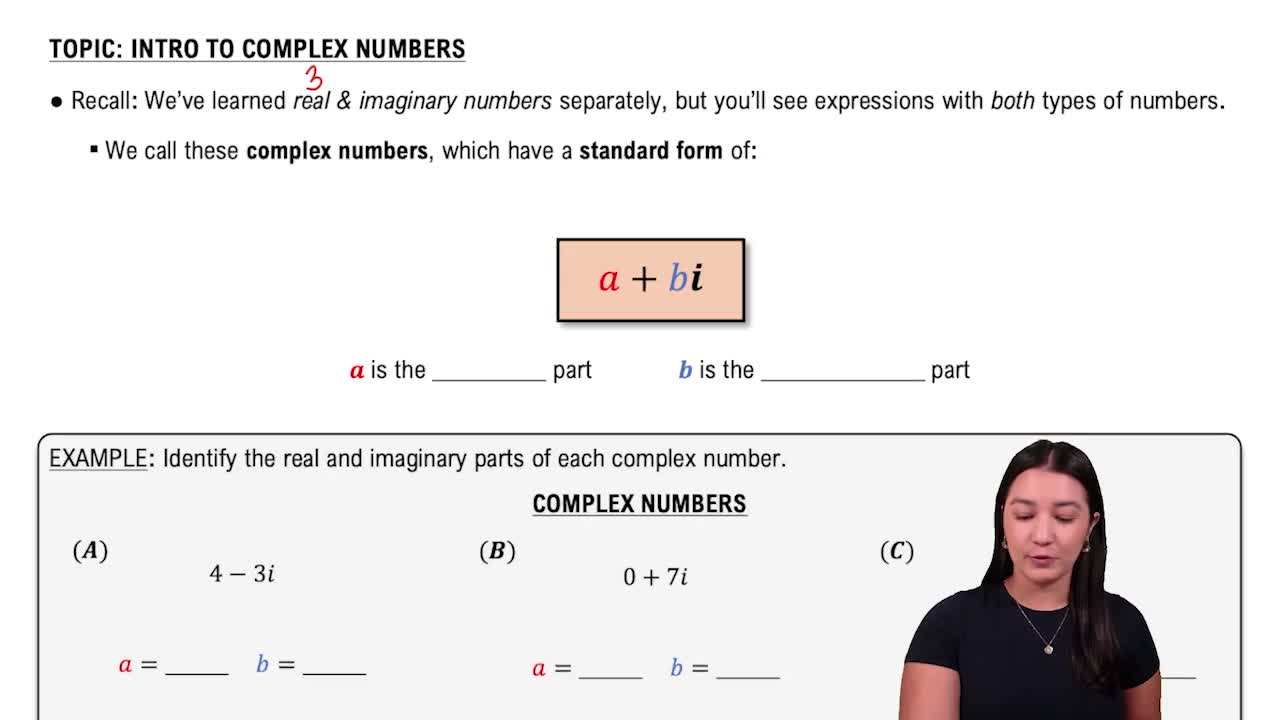
Polynomials with real coefficients may have zeros that are real or complex. Complex zeros occur in conjugate pairs, meaning if a + bi is a zero, then a - bi is also a zero. This ensures the polynomial's coefficients remain real.
Recommended video:
Introduction to Complex Numbers
Fundamental Theorem of Algebra
This theorem states that every non-constant polynomial has at least one complex root. For polynomials with real coefficients, all roots (real or complex) sum to the degree of the polynomial, but it is possible for a polynomial to have no real roots if all zeros are complex conjugates.
Recommended video:
Guided course
Introduction to Algebraic Expressions
Related Videos
Related Practice
Textbook Question
416
views