In Exercises 53-58, begin by graphing f(x) = log₂ x. Then use transformations of this graph to graph the given function. What is the vertical asymptote? Use the graphs to determine each function's domain and range. g(x) = (1/2)log₂ x
Verified step by step guidance
1
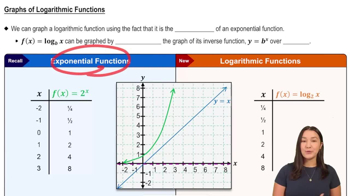
Start by graphing the basic function \( f(x) = \log_2 x \). This is a logarithmic function with base 2, which has a vertical asymptote at \( x = 0 \) and passes through the point \( (1, 0) \).
The domain of \( f(x) = \log_2 x \) is \( (0, \infty) \) because logarithms are only defined for positive values of \( x \). The range is \( (-\infty, \infty) \) because a logarithmic function can take any real value.
To graph \( g(x) = \frac{1}{2}\log_2 x \), apply a vertical compression to the graph of \( f(x) = \log_2 x \) by a factor of \( \frac{1}{2} \). This means that each \( y \)-value of \( f(x) \) is halved in \( g(x) \).
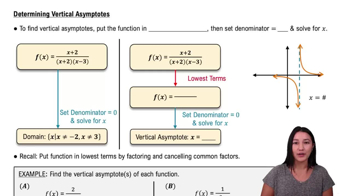
The vertical asymptote of \( g(x) = \frac{1}{2}\log_2 x \) remains the same as \( f(x) \), which is \( x = 0 \).
The domain of \( g(x) \) is the same as \( f(x) \), which is \( (0, \infty) \), and the range is also \( (-\infty, \infty) \) because the transformation does not affect the range.
Verified video answer for a similar problem:
This video solution was recommended by our tutors as helpful for the problem above
Video duration:
3m
Play a video:
Was this helpful?
Key Concepts
Here are the essential concepts you must grasp in order to answer the question correctly.
Logarithmic Functions
Logarithmic functions, such as f(x) = log₂ x, are the inverses of exponential functions. They are defined for positive real numbers and have a vertical asymptote at x = 0. Understanding their basic shape and properties, including how they increase and their domain and range, is essential for graphing and transforming these functions.
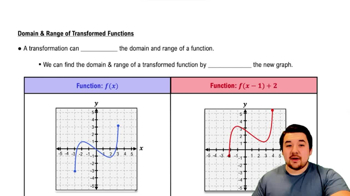
Transformations of functions involve shifting, stretching, compressing, or reflecting the graph of a function. For example, the function g(x) = (1/2)log₂ x represents a vertical compression of f(x) = log₂ x by a factor of 1/2. Recognizing how these transformations affect the graph helps in accurately sketching the new function and understanding its characteristics.
Asymptotes are lines that a graph approaches but never touches, with vertical asymptotes indicating values where the function is undefined. The domain of a function is the set of all possible input values, while the range is the set of all possible output values. For g(x) = (1/2)log₂ x, identifying the vertical asymptote, domain, and range is crucial for understanding the behavior of the function.