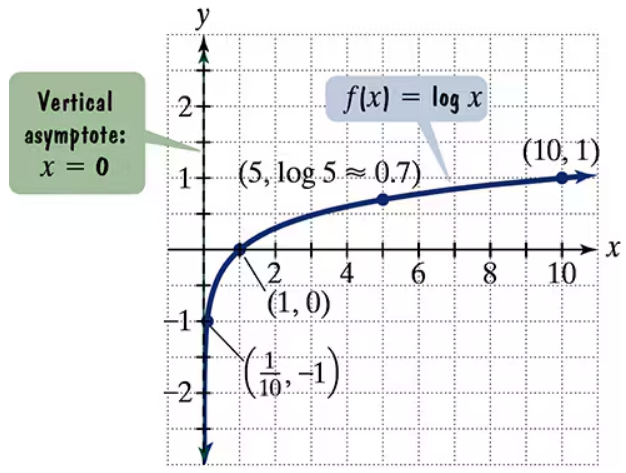
The figure shows the graph of f(x) = log x. In Exercises 59–64, use transformations of this graph to graph each function. Graph and give equations of the asymptotes. Use the graphs to determine each function's domain and range. g(x) = log(x − 1)
Verified step by step guidance
1
Identify the base function: The base function is \( f(x) = \log x \).
Determine the transformation: The function \( g(x) = \log(x - 1) \) represents a horizontal shift of the base function \( f(x) = \log x \) to the right by 1 unit.
Graph the transformed function: Shift the graph of \( f(x) = \log x \) to the right by 1 unit to obtain the graph of \( g(x) = \log(x - 1) \).
Identify the asymptote: The vertical asymptote of \( f(x) = \log x \) is at \( x = 0 \). After the transformation, the vertical asymptote of \( g(x) = \log(x - 1) \) is at \( x = 1 \).
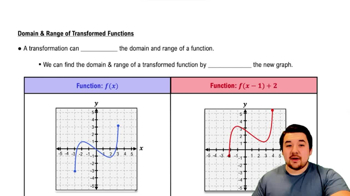
Determine the domain and range: The domain of \( g(x) = \log(x - 1) \) is \( x > 1 \), and the range is all real numbers, \( (-\infty, \infty) \).
Verified video answer for a similar problem:
This video solution was recommended by our tutors as helpful for the problem above
Video duration:
5m
Play a video:
Was this helpful?
Key Concepts
Here are the essential concepts you must grasp in order to answer the question correctly.
Logarithmic Functions
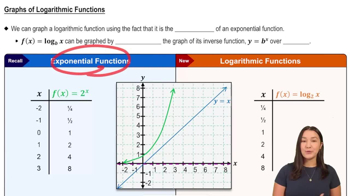
Logarithmic functions, such as f(x) = log x, are the inverses of exponential functions. They are defined for positive real numbers and have a vertical asymptote at x = 0. Understanding the basic properties of logarithms, including their domain, range, and behavior, is essential for analyzing transformations and graphing related functions.
Transformations of functions involve shifting, stretching, compressing, or reflecting the graph of a function. For g(x) = log(x - 1), the graph of f(x) = log x is shifted to the right by 1 unit. Recognizing how these transformations affect the graph's position and shape is crucial for accurately graphing the new function and determining its asymptotes.
Asymptotes are lines that a graph approaches but never touches. For logarithmic functions, vertical asymptotes occur at the values that make the argument of the logarithm zero. In the case of g(x) = log(x - 1), the vertical asymptote is at x = 1, which is important for understanding the function's behavior and determining its domain and range.