First, understand the expression \( \sqrt{x^6} \). This represents the square root of \( x^6 \).
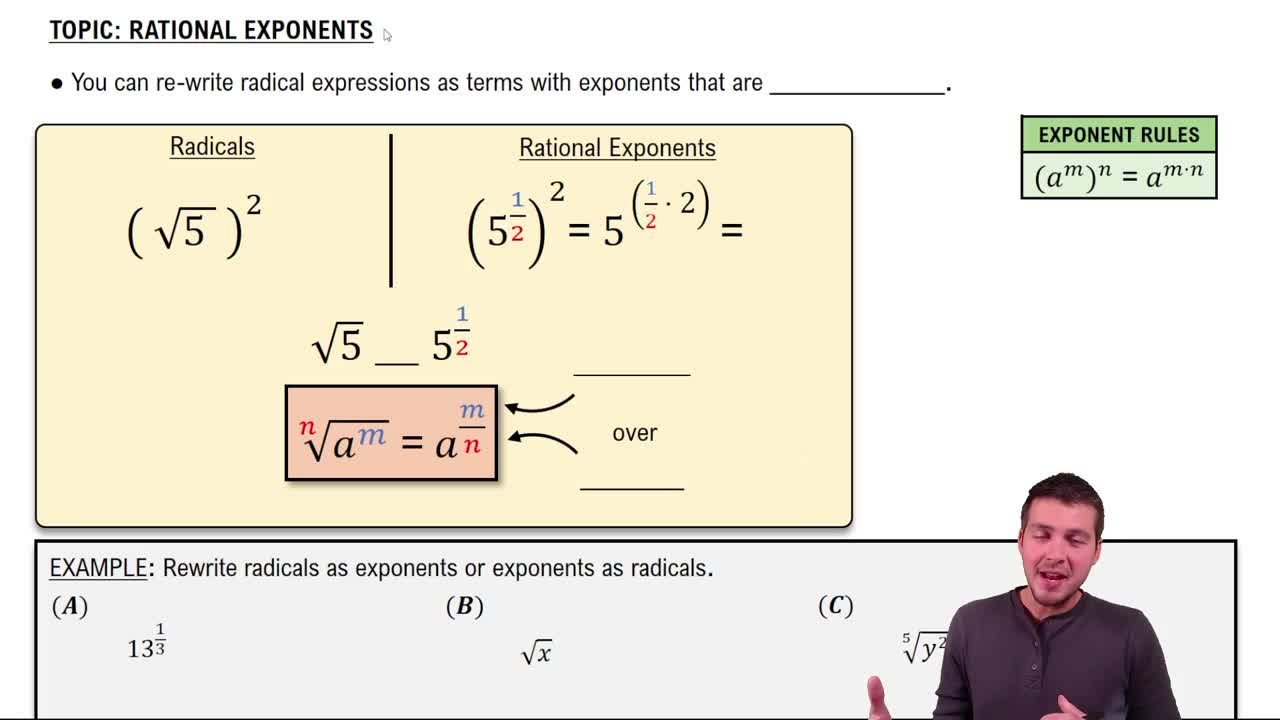
Recall that the square root of a number is the same as raising that number to the power of \( \frac{1}{2} \). So, \( \sqrt{x^6} = (x^6)^{\frac{1}{2}} \).
Apply the power of a power property of exponents: \((a^m)^n = a^{m \cdot n}\). Therefore, \((x^6)^{\frac{1}{2}} = x^{6 \cdot \frac{1}{2}} = x^3\).
Now, substitute \( x = -2 \) into the expression \( x^3 \).
Calculate \( (-2)^3 \) to verify if it equals \( \sqrt{(-2)^6} \).
Verified video answer for a similar problem:
This video solution was recommended by our tutors as helpful for the problem above
Video duration:
4m
Play a video:
Was this helpful?
Key Concepts
Here are the essential concepts you must grasp in order to answer the question correctly.
Square Roots
The square root of a number is a value that, when multiplied by itself, gives the original number. In algebra, the square root function is denoted by the radical symbol (√). For example, √4 = 2 because 2 × 2 = 4. Understanding how square roots work is essential for solving equations involving them.
Exponents represent repeated multiplication of a number by itself. For instance, x³ means x multiplied by itself three times. In the expression x⁶, the exponent indicates that x is multiplied by itself six times. Mastery of exponent rules, such as the power of a power and the product of powers, is crucial for simplifying expressions.
When dealing with negative numbers raised to even powers, the result is always positive. For example, (-2)² = 4 and (-2)⁶ = 64. This property is important when evaluating expressions involving negative bases, as it affects the outcome of square roots and other operations involving exponents.