Solve each equation. In Exercises 11–34, give irrational solutions as decimals correct to the nearest thousandth. In Exercises 35-40, give solutions in exact form. e2x - 6ex + 8 = 0
Table of contents
- 0. Review of Algebra4h 18m
- 1. Equations & Inequalities3h 18m
- 2. Graphs of Equations1h 43m
- 3. Functions2h 17m
- 4. Polynomial Functions1h 44m
- 5. Rational Functions1h 23m
- 6. Exponential & Logarithmic Functions2h 28m
- 7. Systems of Equations & Matrices4h 5m
- 8. Conic Sections2h 23m
- 9. Sequences, Series, & Induction1h 22m
- 10. Combinatorics & Probability1h 45m
6. Exponential & Logarithmic Functions
Solving Exponential and Logarithmic Equations
Problem 39
Textbook Question
Solve each equation. In Exercises 11–34, give irrational solutions as decimals correct to the nearest thousandth. In Exercises 35-40, give solutions in exact form. 52x + 3(5x) = 28
Verified step by step guidance1
Recognize that the equation involves exponential expressions with the same base, 5. The equation is \$5^{2x} + 3(5^x) = 28$.
Rewrite \$5^{2x}\( as \)(5^x)^2\( to express the equation in terms of a single variable. Let \)y = 5^x\(, so the equation becomes \)y^2 + 3y = 28$.
Rewrite the equation as a quadratic equation by moving all terms to one side: \(y^2 + 3y - 28 = 0\).
Solve the quadratic equation \(y^2 + 3y - 28 = 0\) using the quadratic formula \(y = \frac{-b \pm \sqrt{b^2 - 4ac}}{2a}\), where \(a=1\), \(b=3\), and \(c=-28\).
After finding the values of \(y\), substitute back \(y = 5^x\) and solve for \(x\) by taking the logarithm base 5: \(x = \log_5(y)\). Calculate the decimal values of \(x\) to the nearest thousandth.
Verified video answer for a similar problem:This video solution was recommended by our tutors as helpful for the problem above
Video duration:
3mPlay a video:
Was this helpful?
Key Concepts
Here are the essential concepts you must grasp in order to answer the question correctly.
Exponential Equations
Exponential equations involve variables in the exponent position, such as 5^x. Solving these requires understanding how to manipulate and rewrite expressions to isolate the variable, often by expressing terms with the same base or using substitution.
Recommended video:
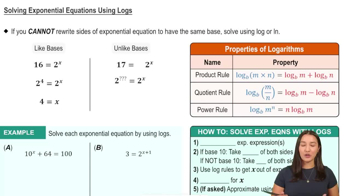
Solving Exponential Equations Using Logs
Substitution Method
When an equation contains terms like 5^(2x) and 5^x, substitution simplifies the problem. For example, letting y = 5^x transforms the equation into a quadratic form, making it easier to solve using algebraic methods.
Recommended video:
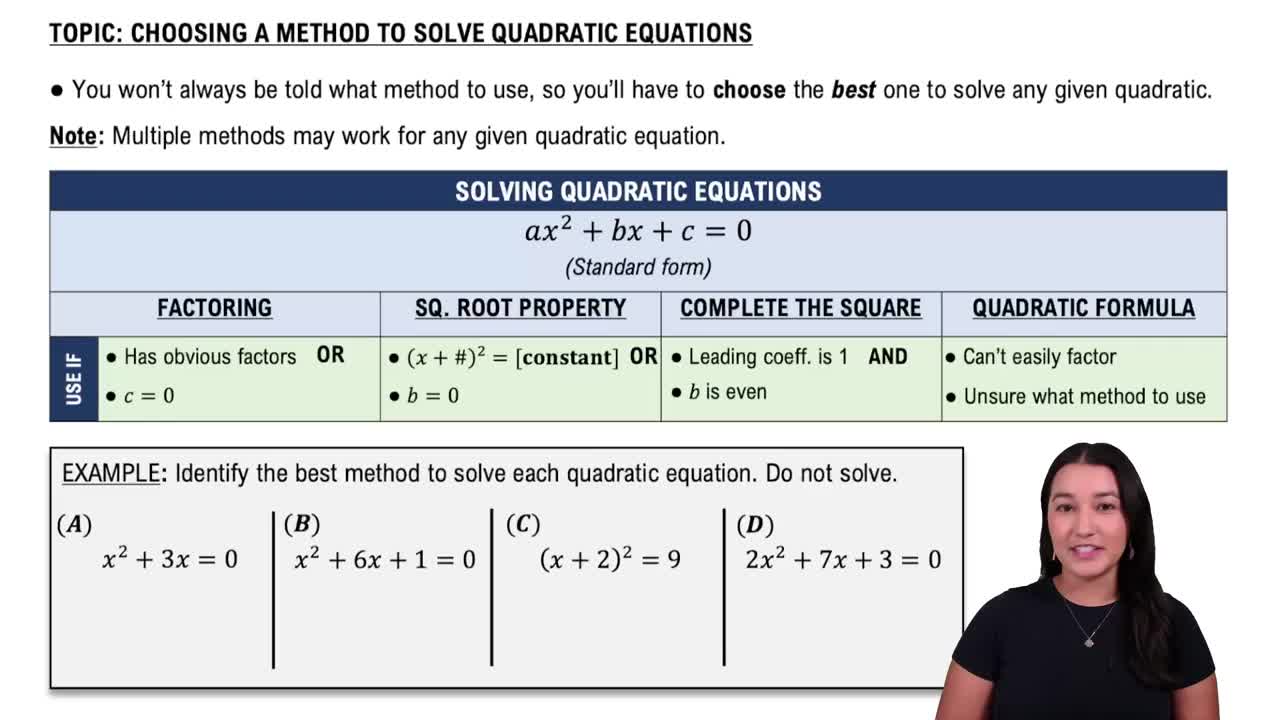
Choosing a Method to Solve Quadratics
Rounding Irrational Solutions
Some solutions to exponential equations are irrational numbers. These should be approximated as decimals rounded to a specified place value, such as the nearest thousandth, to provide a practical and understandable answer.
Recommended video:
The Number e
Watch next
Master Solving Exponential Equations Using Like Bases with a bite sized video explanation from Patrick
Start learningRelated Videos
Related Practice
Textbook Question
590
views