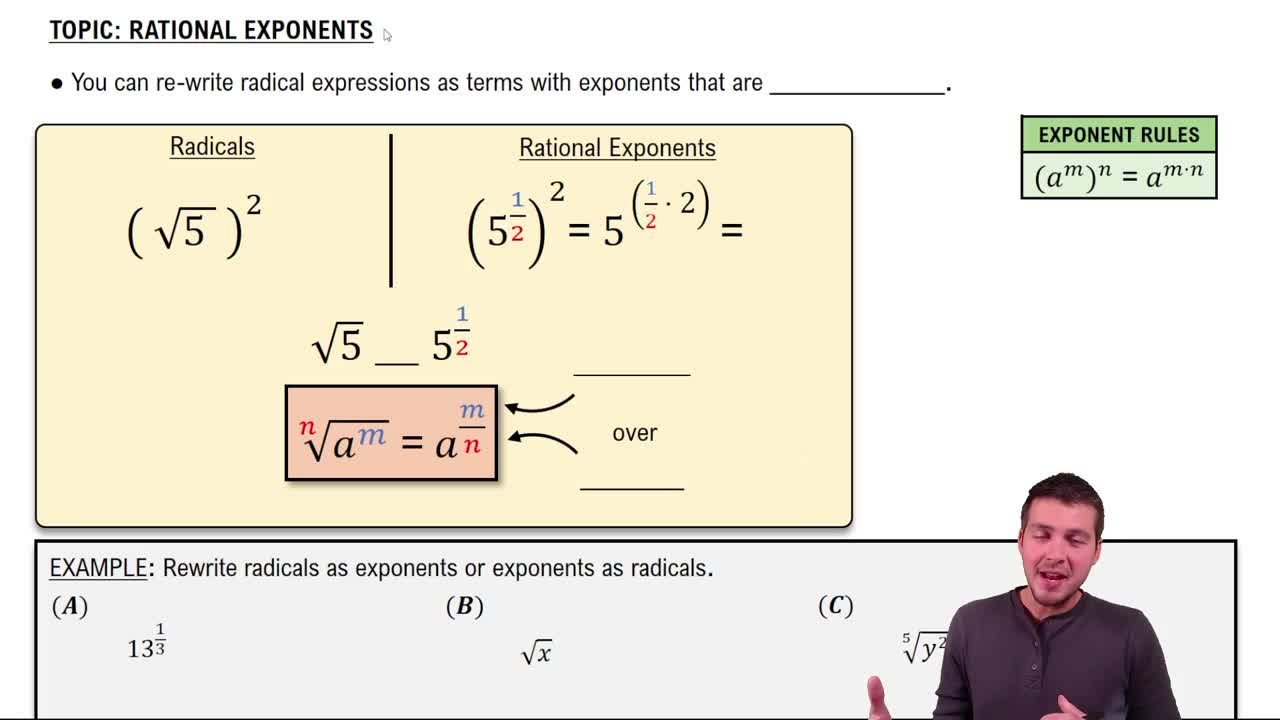
Recognize that the expression \$16^{1/4}\( represents the fourth root of 16. In general, \)a^{1/n} = \sqrt[n]{a}\(, where \)n$ is the root.
Rewrite the expression using the root notation: \$16^{1/4} = \sqrt[4]{16}$.
Identify the number that, when raised to the 4th power, equals 16. This means finding \(x\) such that \(x^4 = 16\).
Recall or calculate the powers of numbers to find \(x\): for example, \$2^4 = 16\(, so \)x = 2$ is a candidate.
Conclude that \$16^{1/4} = 2$ because 2 raised to the 4th power equals 16.
Verified video answer for a similar problem:
This video solution was recommended by our tutors as helpful for the problem above
Video duration:
1m
Play a video:
Was this helpful?
Key Concepts
Here are the essential concepts you must grasp in order to answer the question correctly.
Exponents and Powers
Exponents indicate how many times a base number is multiplied by itself. For example, in 16^1/4, 16 is the base and 1/4 is the exponent, which means taking the fourth root of 16. Understanding how to interpret and manipulate exponents is essential for evaluating expressions.
Fractional exponents represent roots; the denominator of the fraction indicates the root, and the numerator indicates the power. For instance, a^(m/n) means the nth root of a raised to the mth power. In 16^(1/4), it means the fourth root of 16.
Evaluating roots involves finding a number that, when raised to a specific power, equals the original number. The fourth root of 16 is the number which raised to the 4th power equals 16. Recognizing perfect powers helps simplify such expressions quickly.