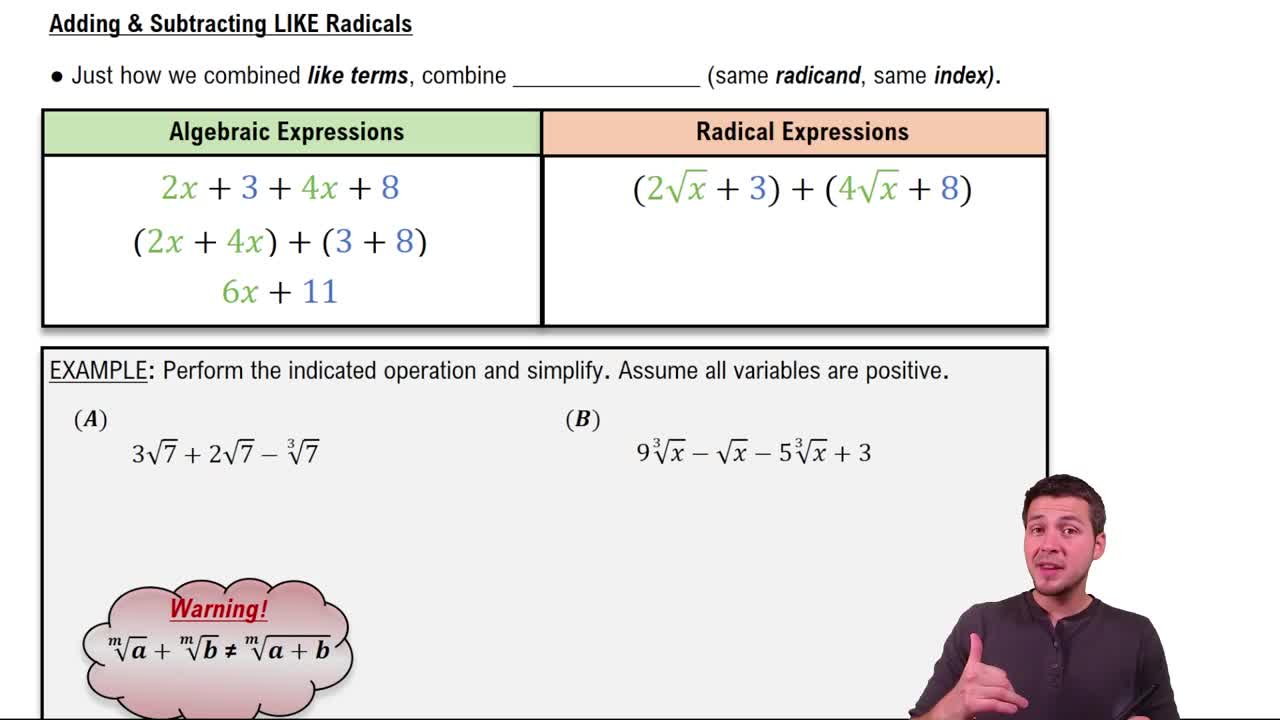
Identify the like terms in the expression. Both terms have the fifth root of 2, which can be written as \$4 \sqrt[5]{2}\( and \)3 \sqrt[5]{2}$.
Since the radical parts are the same (\(\sqrt[5]{2}\)), you can combine the coefficients (the numbers in front of the radicals).
Add the coefficients: \$4 + 3 = 7$.
Write the combined expression as the sum of the new coefficient and the common radical: \$7 \sqrt[5]{2}$.
This is the simplified form of the expression after combining like terms.
Verified video answer for a similar problem:
This video solution was recommended by our tutors as helpful for the problem above
Video duration:
2m
Play a video:
Was this helpful?
Key Concepts
Here are the essential concepts you must grasp in order to answer the question correctly.
Like Terms
Like terms are terms that have the same variable parts raised to the same powers. In expressions involving radicals, terms with the same radicand and root index can be combined by adding or subtracting their coefficients.
A radical expression involves roots, such as square roots or fifth roots. Understanding how to interpret and manipulate radicals, including recognizing when two radicals are like terms, is essential for simplifying expressions.
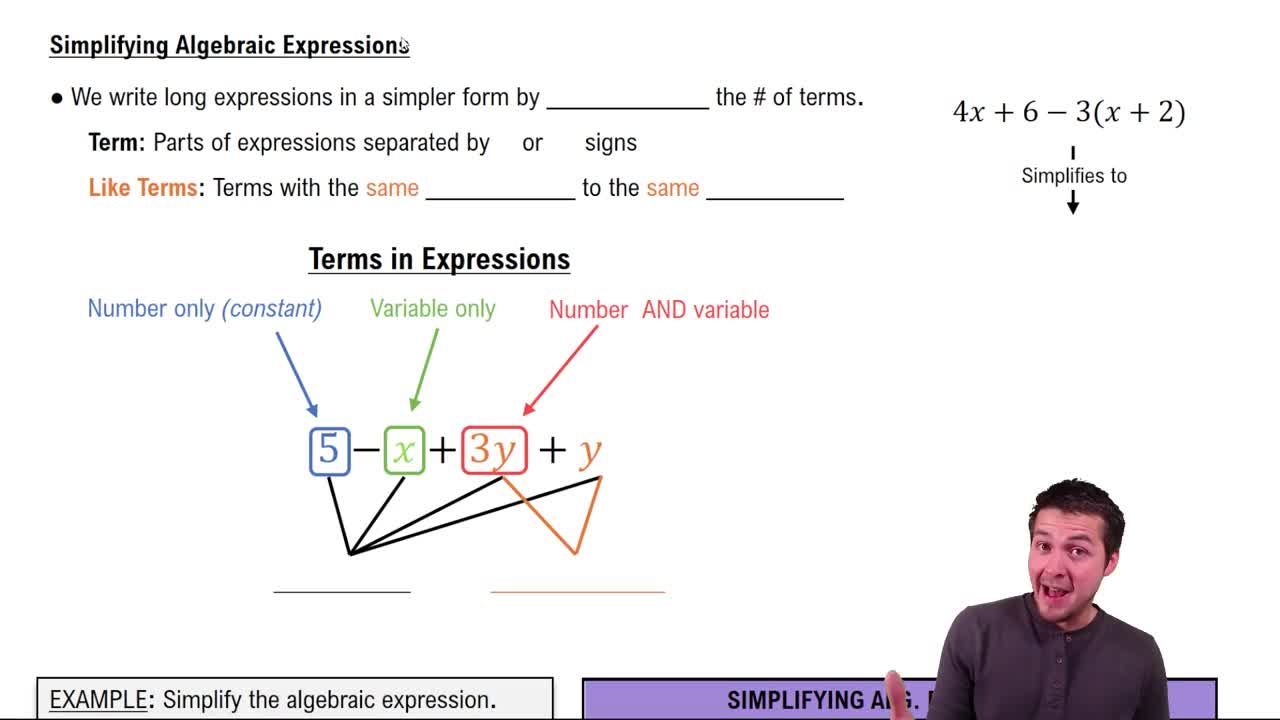
Simplifying expressions involves combining like terms and reducing expressions to their simplest form. This includes adding or subtracting coefficients of like radical terms to write the expression more concisely.