Recognize that the expression is the cube root of \(x^3\), which can be written as \(\sqrt[3]{x^3}\).
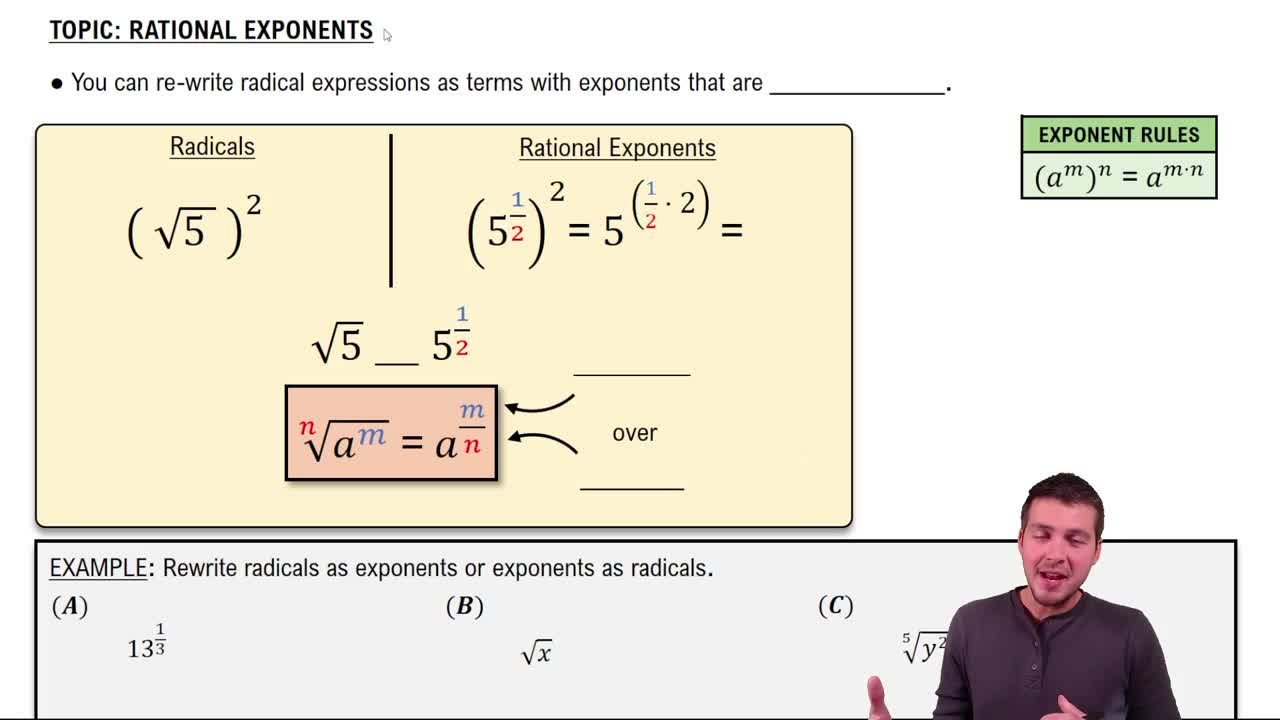
Recall the property of radicals and exponents: \(\sqrt[n]{a^m} = a^{\frac{m}{n}}\). Applying this, rewrite the expression as \(x^{\frac{3}{3}}\).
Simplify the exponent \(\frac{3}{3}\) to 1, so the expression becomes \(x^1\).
Understand that \(x^1\) is simply \(x\), so the cube root of \(x^3\) simplifies to \(x\).
Note that this simplification holds for all real numbers \(x\), considering the cube root function is defined for all real numbers.
Verified video answer for a similar problem:
This video solution was recommended by our tutors as helpful for the problem above
Video duration:
45s
Play a video:
Was this helpful?
Key Concepts
Here are the essential concepts you must grasp in order to answer the question correctly.
Cube Roots
The cube root of a number is a value that, when multiplied by itself three times, gives the original number. For example, the cube root of 8 is 2 because 2³ = 8. Cube roots can be positive, negative, or zero.
Exponents indicate how many times a base is multiplied by itself. Key properties include that (a^m)^n = a^(m*n) and that roots can be expressed as fractional exponents, such as the cube root of x being x^(1/3).
Simplifying radicals involves rewriting expressions to their simplest form. For cube roots, this means recognizing when the radicand is a perfect cube, allowing the root and exponent to cancel out, such as ∛(x³) = x.