In Exercises 33–38, express the function, f, in simplified form. Assume that x can be any real number.
_______
f(x) = ³√48(x-2)³
Verified step by step guidance
1
Identify the expression inside the cube root: \(48(x-2)^3\).
Recognize that the cube root of a cube, \(\sqrt[3]{(x-2)^3}\), simplifies to \(x-2\).
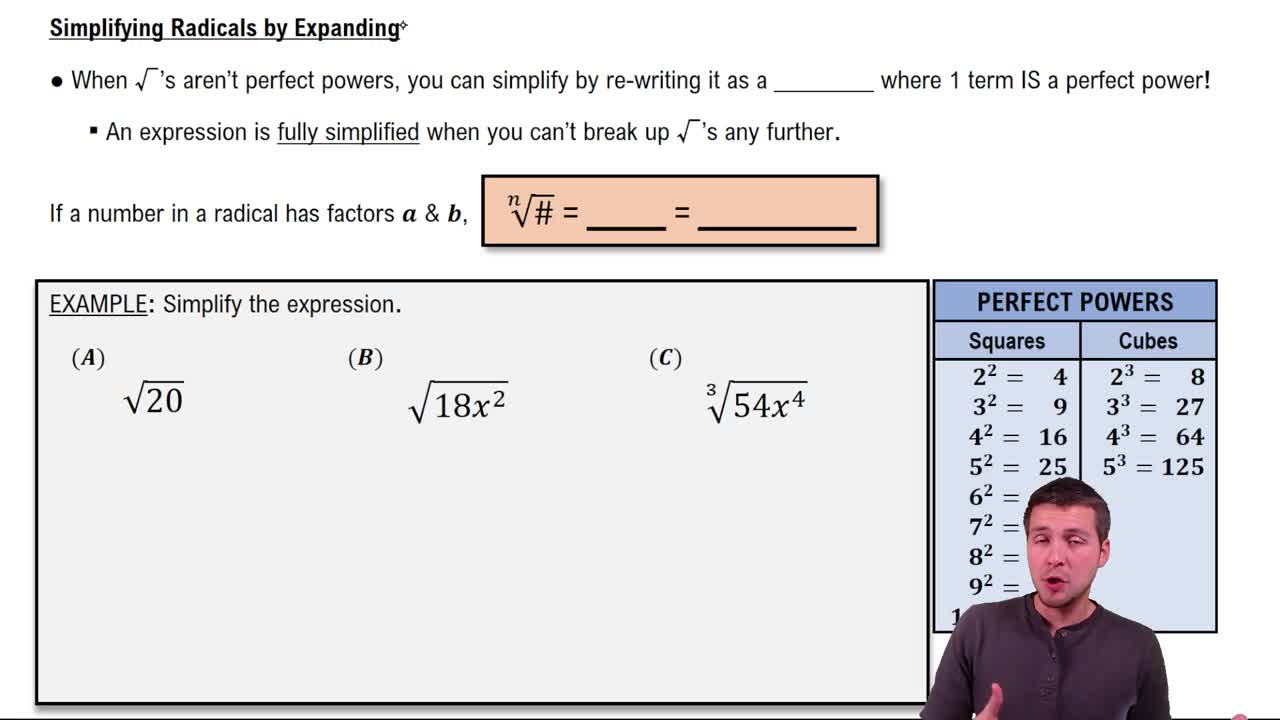
Apply the property of cube roots: \(\sqrt[3]{a \cdot b} = \sqrt[3]{a} \cdot \sqrt[3]{b}\).
Simplify \(\sqrt[3]{48}\) separately, which involves finding the cube root of 48.
Combine the simplified cube root of 48 with \(x-2\) to express \(f(x)\) in its simplest form.
Verified video answer for a similar problem:
This video solution was recommended by our tutors as helpful for the problem above.
Video duration:
2m
Play a video:
0 Comments
Key Concepts
Here are the essential concepts you must grasp in order to answer the question correctly.
Radical Functions
Radical functions involve roots, such as square roots or cube roots. In this case, the function f(x) includes a cube root, which is represented by the notation ³√. Understanding how to manipulate and simplify expressions involving radicals is essential for solving problems related to these functions.
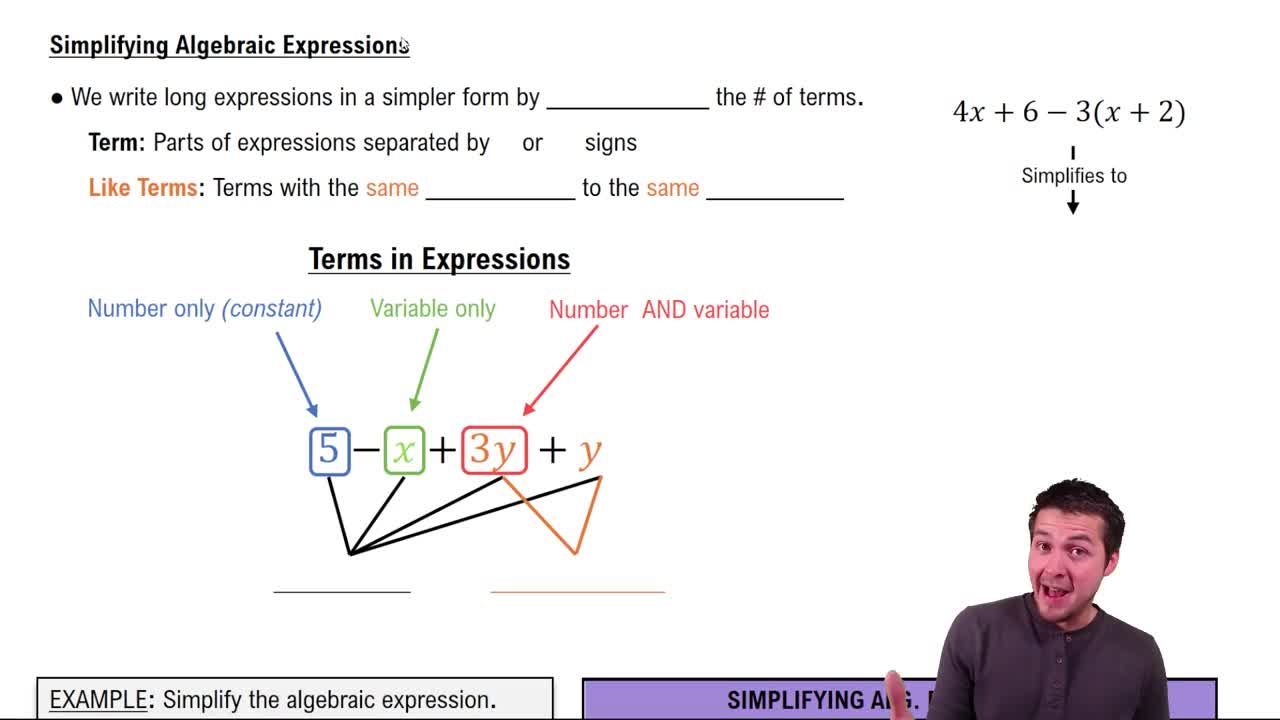
Simplifying expressions involves reducing them to their most basic form, often by factoring or combining like terms. In the context of the given function, this means rewriting f(x) in a way that makes it easier to analyze or compute, which may involve simplifying the radical and the polynomial expression inside it.
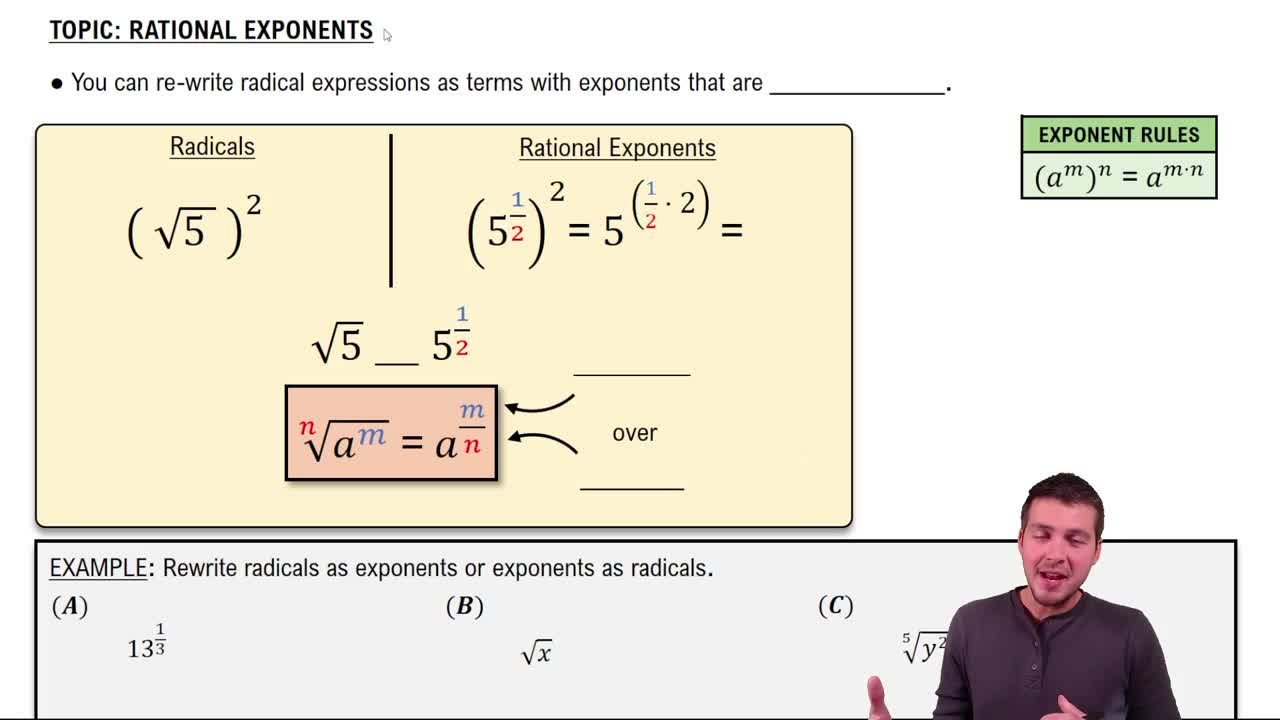
Properties of exponents are rules that govern how to manipulate expressions involving powers. For example, when simplifying expressions with roots, one can convert the radical into an exponent (e.g., ³√a = a^(1/3)). This understanding is crucial for rewriting the function f(x) in a simplified form, especially when dealing with polynomial expressions.

 2:04 minutes
 Verified step by step guidance
 05:20
05:20