For each polynomial function, use the remainder theorem to find ƒ(k). ƒ(x) = x2 + 4; k = 2i
Table of contents
- 0. Review of Algebra4h 18m
- 1. Equations & Inequalities3h 18m
- 2. Graphs of Equations1h 43m
- 3. Functions2h 17m
- 4. Polynomial Functions1h 44m
- 5. Rational Functions1h 23m
- 6. Exponential & Logarithmic Functions2h 28m
- 7. Systems of Equations & Matrices4h 5m
- 8. Conic Sections2h 23m
- 9. Sequences, Series, & Induction1h 22m
- 10. Combinatorics & Probability1h 45m
4. Polynomial Functions
Dividing Polynomials
Problem 61
Textbook Question
Use synthetic division to determine whether the given number k is a zero of the polynomial function. If it is not, give the value of ƒ(k). ƒ(x) = 4x4 + x2 + 17x + 3; k= -3/2
Verified step by step guidance1
Write down the coefficients of the polynomial ƒ(x) = 4x^4 + 0x^3 + 1x^2 + 17x + 3. Note that the coefficient of x^3 is 0, so the coefficients are: 4, 0, 1, 17, 3.
Set up synthetic division using k = -\frac{3}{2}. Write the coefficients in a row and place k to the left.
Bring down the first coefficient (4) as it is. Then multiply this number by k (4 \times -\frac{3}{2}) and write the result under the next coefficient.
Add the second coefficient (0) and the number just written, then repeat the multiply and add process for all coefficients.
After completing the synthetic division, check the final number (the remainder). If it is zero, then k is a zero of the polynomial. If not, this remainder is the value of ƒ(k).
Verified video answer for a similar problem:This video solution was recommended by our tutors as helpful for the problem above
Video duration:
9mPlay a video:
Was this helpful?
Key Concepts
Here are the essential concepts you must grasp in order to answer the question correctly.
Synthetic Division
Synthetic division is a shortcut method for dividing a polynomial by a linear binomial of the form (x - k). It simplifies the long division process by using only the coefficients of the polynomial, making it faster and less error-prone. This method helps determine the remainder when the polynomial is evaluated at k.
Recommended video:
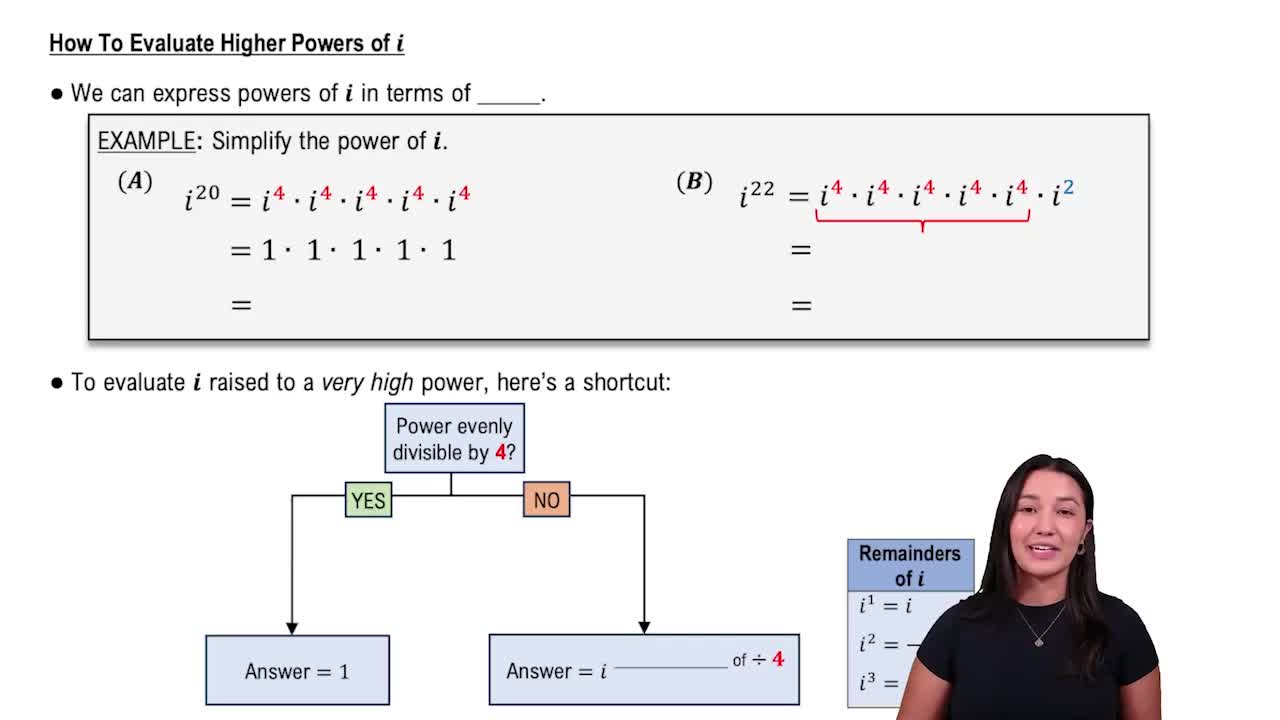
Higher Powers of i
Zeros of a Polynomial
A zero of a polynomial is a value of x that makes the polynomial equal to zero. If substituting k into the polynomial results in zero, then k is a root or zero of the polynomial. Identifying zeros is essential for factoring and solving polynomial equations.
Recommended video:
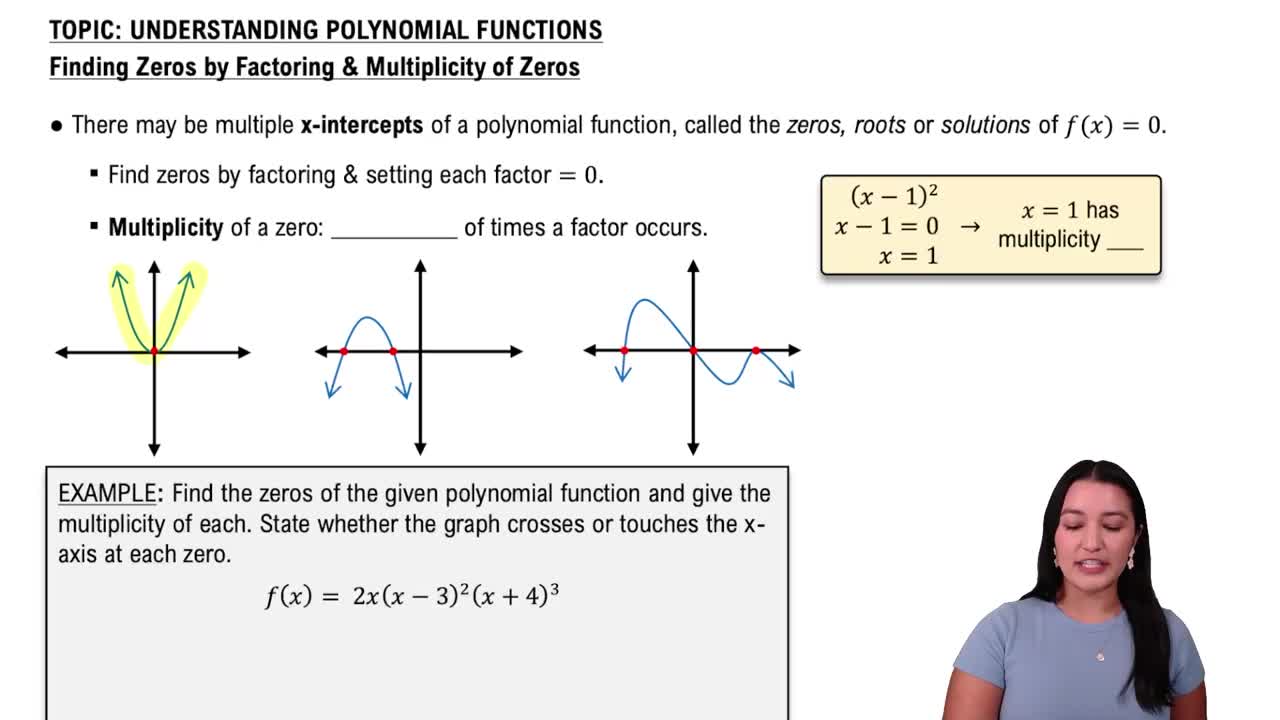
Finding Zeros & Their Multiplicity
Evaluating Polynomials
Evaluating a polynomial at a specific value k means substituting k into the polynomial and calculating the result. If the result is zero, k is a zero of the polynomial; otherwise, the result is the value of the polynomial at k, denoted as ƒ(k). Synthetic division provides a quick way to find this value.
Recommended video:
Guided course
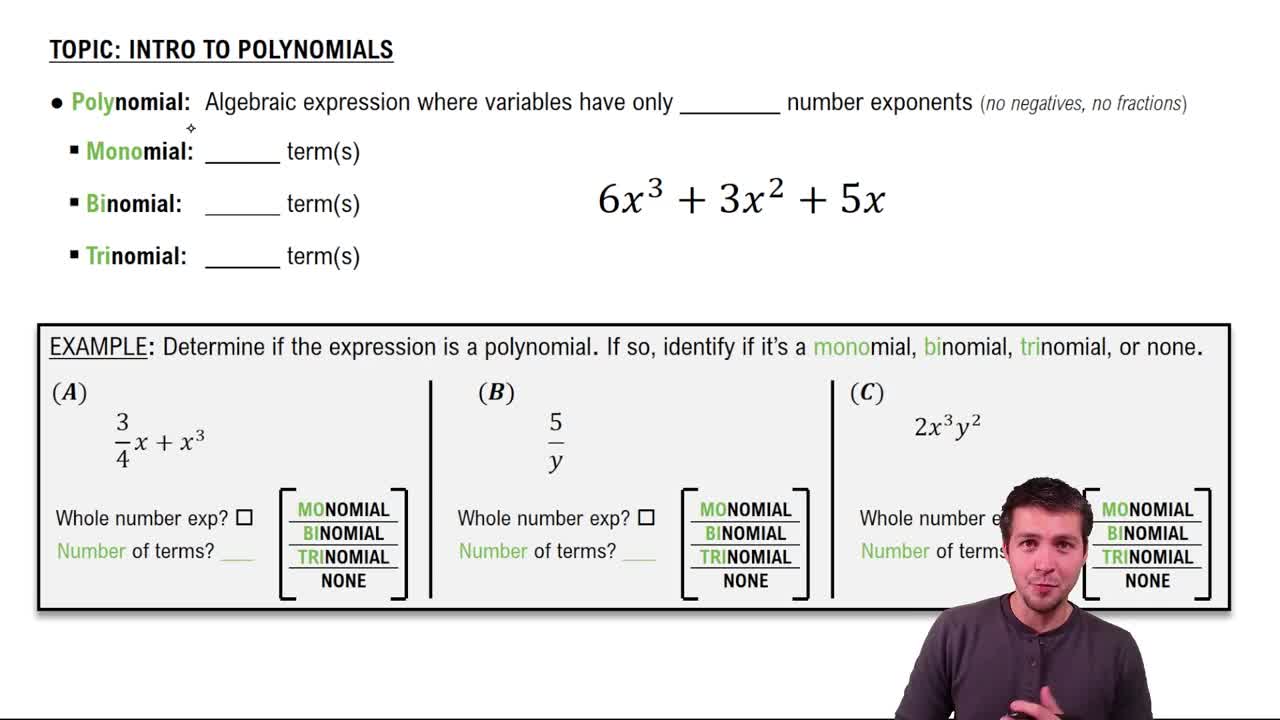
Introduction to Polynomials
Related Videos
Related Practice
Textbook Question
502
views