Ch. 5 - Systems and Matrices
Lial - College Algebra 13th Edition
Lial13th EditionCollege AlgebraISBN: 9780136881063Not the one you use?Change textbook
Chapter 6, Problem 57

Solve each problem using a system of equations in two variables. See Example 6. Find two numbers whose squares have a sum of 100 and a difference of 28.

Verified step by step guidance
1
Define the two numbers as variables: let the first number be \(x\) and the second number be \(y\).
Translate the problem statements into equations: the sum of their squares is 100, so write \(x^{2} + y^{2} = 100\).
The difference of the numbers is 28, so write \(x - y = 28\).
From the second equation, express one variable in terms of the other, for example, \(x = y + 28\).
Substitute \(x = y + 28\) into the first equation to get an equation in one variable: \((y + 28)^{2} + y^{2} = 100\), then expand and simplify to solve for \(y\).

Verified video answer for a similar problem:

This video solution was recommended by our tutors as helpful for the problem above.
Video duration:
5m
Was this helpful?

Key Concepts

Here are the essential concepts you must grasp in order to answer the question correctly.

Systems of Equations in Two Variables

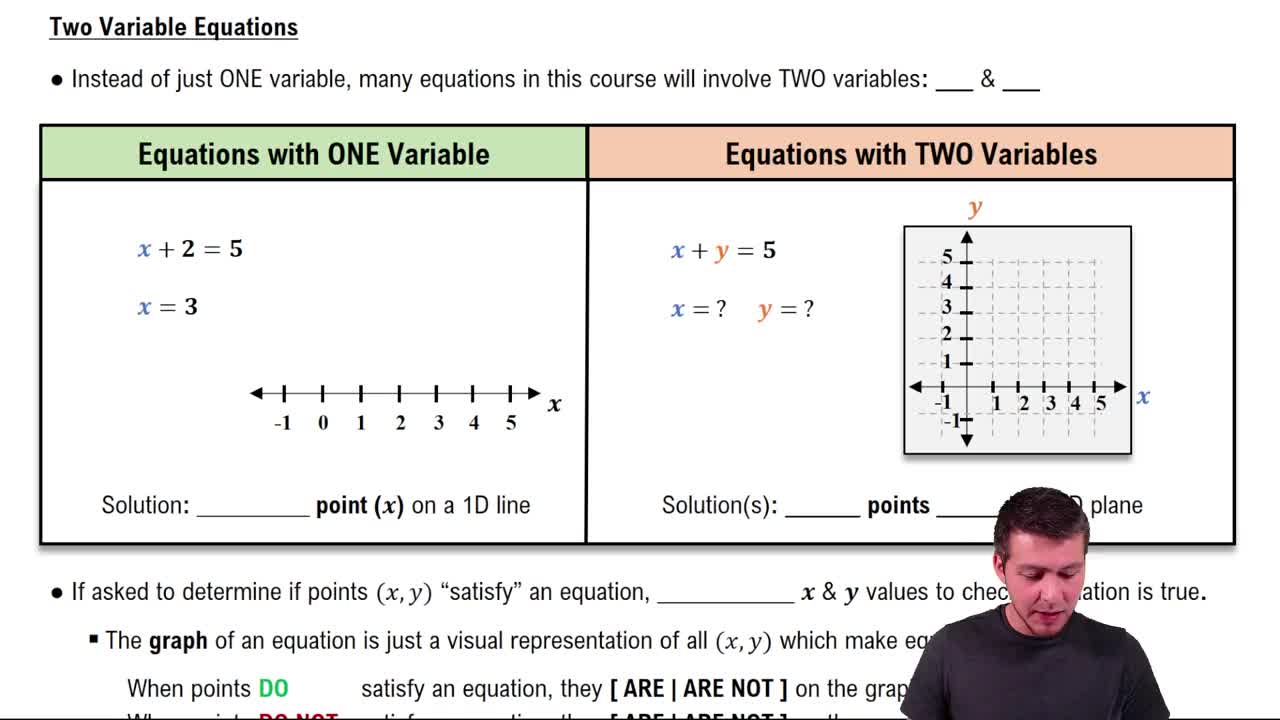
A system of equations consists of two or more equations with the same set of variables. Solving such a system means finding values for the variables that satisfy all equations simultaneously. In this problem, two variables represent the unknown numbers, and their relationships are expressed through two equations.
Recommended video:
Guided course
05:28
Equations with Two Variables

Formulating Equations from Word Problems

Translating a word problem into mathematical equations involves identifying variables and expressing given conditions as equations. Here, the sum of the squares and the difference of the numbers are translated into algebraic expressions, forming the system to solve.
Recommended video:
05:56
Introduction to Rational Equations

Solving Quadratic Systems

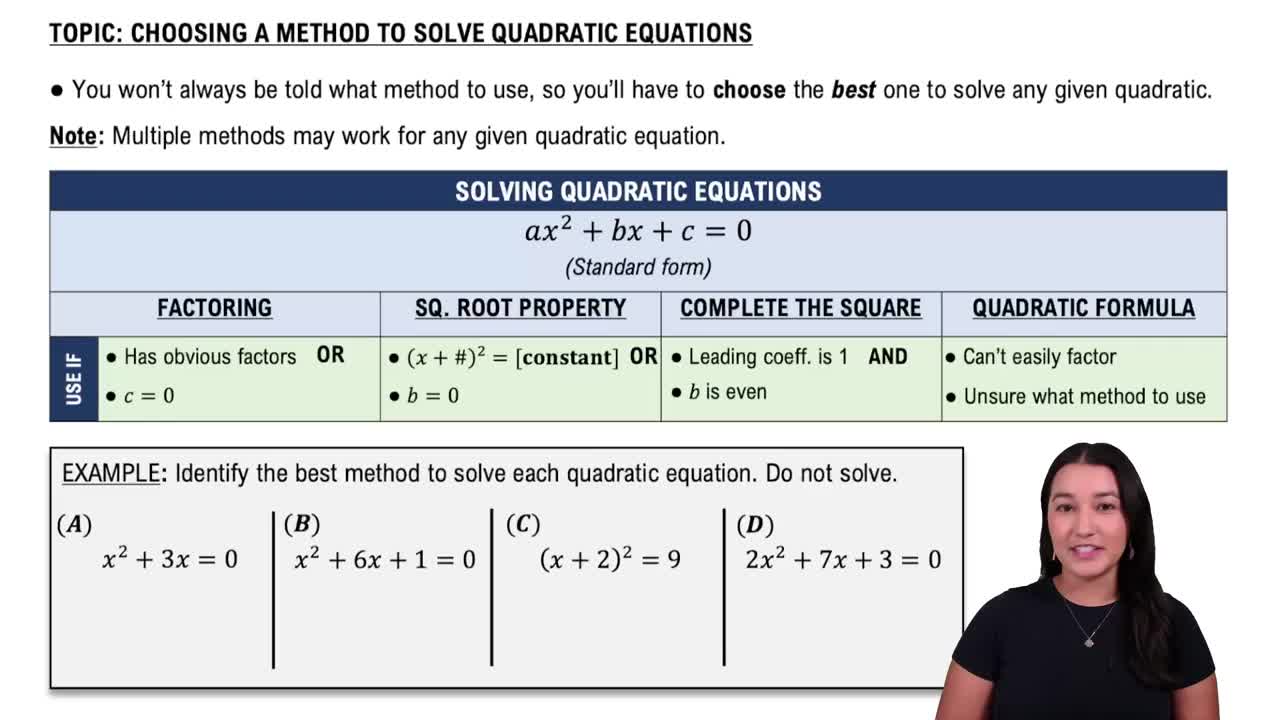
When systems involve squares of variables, they form quadratic equations. Solving such systems may require substitution or elimination methods, followed by solving quadratic equations to find the values of the variables that satisfy both conditions.
Recommended video:
04:03
Choosing a Method to Solve Quadratics