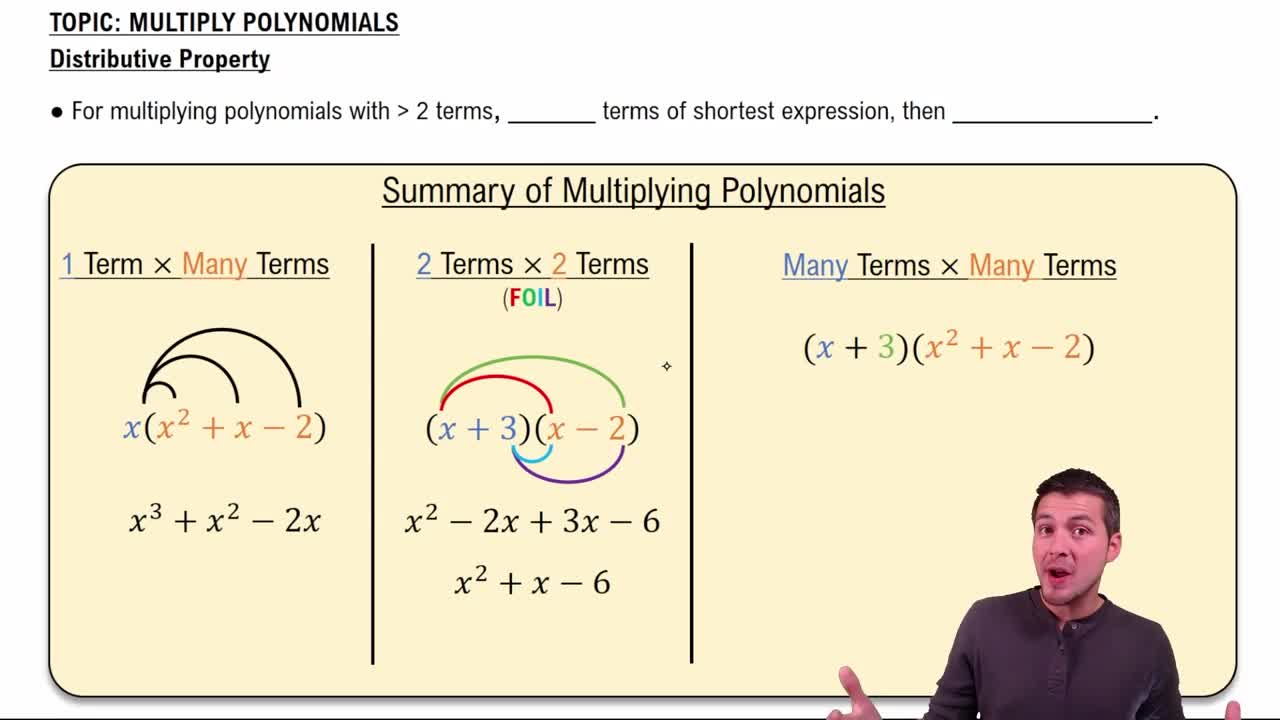
In Exercises 1–38, multiply as indicated. If possible, simplify any radical expressions that appear in the product.√6 (4√6 - 3√2)
Verified step by step guidance
1
Step 1: Distribute the \( \sqrt{6} \) to each term inside the parentheses.
Step 2: Multiply \( \sqrt{6} \) by \( 4\sqrt{6} \).
Step 3: Multiply \( \sqrt{6} \) by \( -3\sqrt{2} \).
Step 4: Simplify the expression \( \sqrt{6} \times \sqrt{6} \) to \( 6 \).
Step 5: Combine and simplify the terms, if possible, to get the final expression.
Verified video answer for a similar problem:
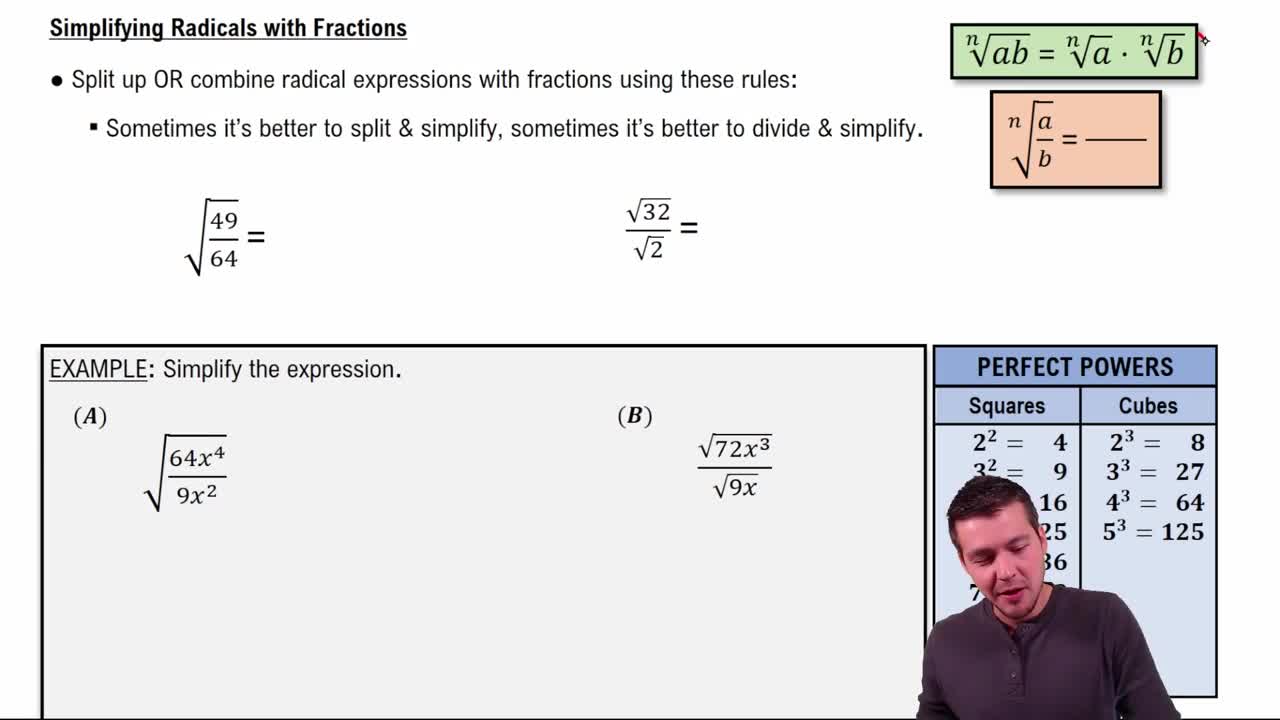
This video solution was recommended by our tutors as helpful for the problem above
Video duration:
3m
Play a video:
Was this helpful?
Key Concepts
Here are the essential concepts you must grasp in order to answer the question correctly.
Radical Expressions
Radical expressions involve roots, such as square roots, cube roots, etc. In this context, √6 and √2 are square roots that can be manipulated according to algebraic rules. Understanding how to simplify and combine these expressions is crucial for solving problems involving radicals.
The distributive property states that a(b + c) = ab + ac. This property allows us to multiply a single term by each term within a parenthesis. In the given problem, applying the distributive property is essential to multiply √6 by each term in the expression (4√6 - 3√2).
Multiply Polynomials Using the Distributive Property
Simplifying Radical Expressions
Simplifying radical expressions involves reducing them to their simplest form, which may include combining like terms or rationalizing denominators. In this exercise, after applying the distributive property, it is important to simplify any resulting radical expressions to achieve the final answer in its simplest form.