In Exercises 1–20, use radical notation to rewrite each expression. Simplify, if possible.
(xy)^⅓
Verified step by step guidance
1
Identify the expression given: \((xy)^{\frac{1}{3}}\).
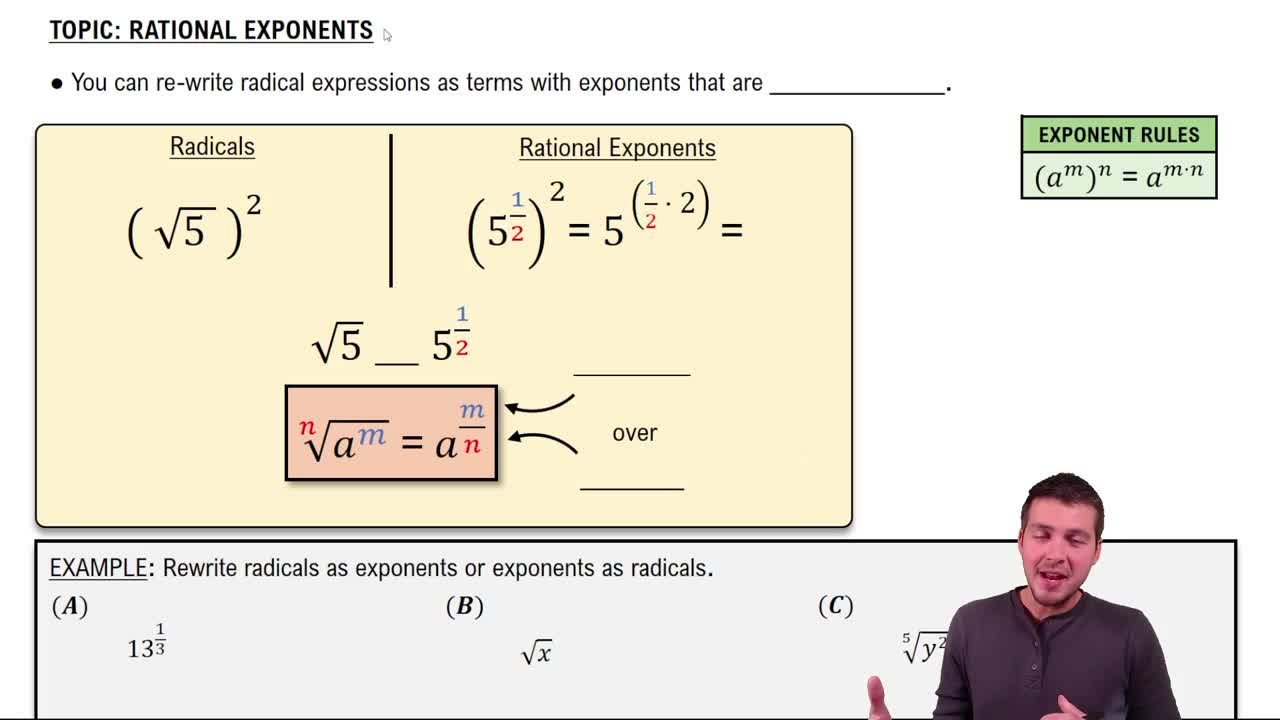
Recognize that the exponent \(\frac{1}{3}\) indicates a cube root.
Rewrite the expression using radical notation: \(\sqrt[3]{xy}\).
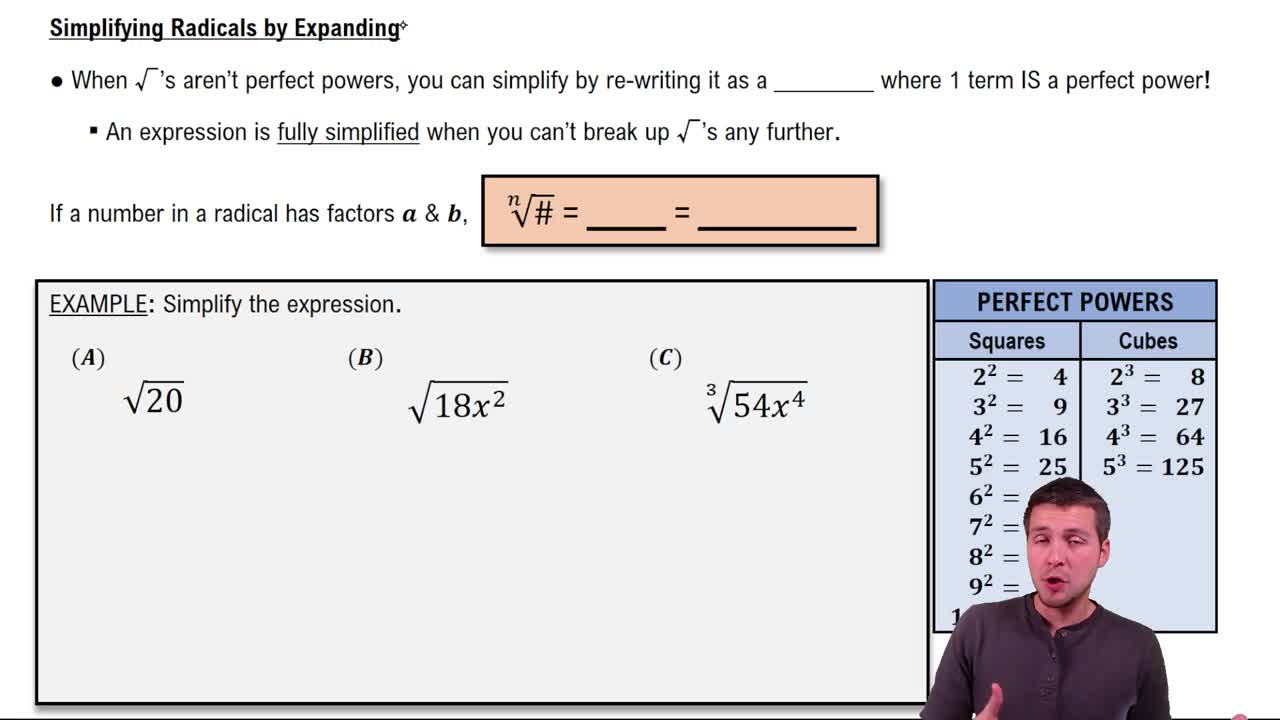
Check if the expression inside the radical can be simplified further.
Since \(xy\) is already in its simplest form, the expression \(\sqrt[3]{xy}\) is the simplified radical notation.
Verified video answer for a similar problem:
This video solution was recommended by our tutors as helpful for the problem above.
Video duration:
2m
Play a video:
0 Comments
Key Concepts
Here are the essential concepts you must grasp in order to answer the question correctly.
Radical Notation
Radical notation is a mathematical notation used to represent roots of numbers or expressions. The symbol '√' denotes the square root, while '∛' represents the cube root. In the expression (xy)^(1/3), the exponent 1/3 indicates that we are taking the cube root of the product xy. Understanding how to interpret and manipulate radical notation is essential for simplifying expressions involving roots.
Exponents are a way to express repeated multiplication of a number by itself. A fractional exponent, such as 1/3, indicates a root; specifically, the denominator represents the root's degree. For example, x^(1/3) means the cube root of x. Recognizing how to convert between radical and exponential forms is crucial for simplifying expressions like (xy)^(1/3).
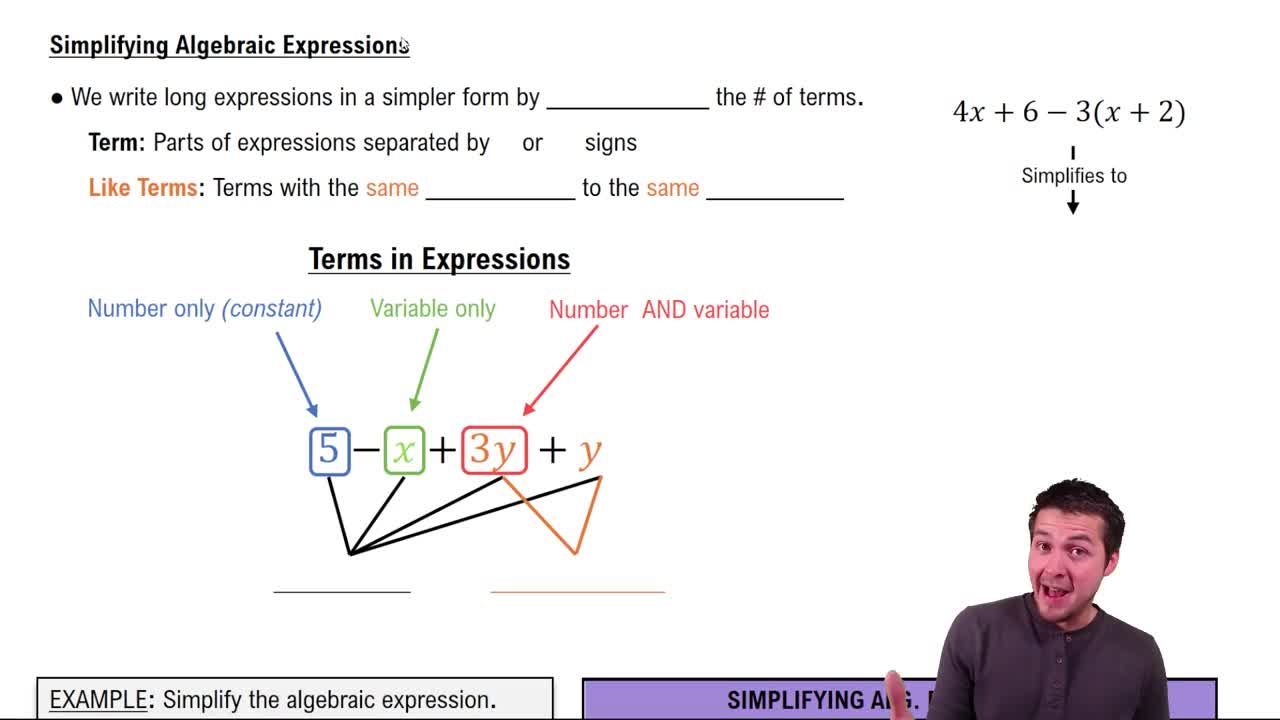
Simplifying expressions involves reducing them to their most basic form while maintaining their value. This can include combining like terms, factoring, and applying properties of exponents and radicals. In the context of the expression (xy)^(1/3), simplification may involve rewriting it as ∛(xy) or further breaking it down if x and y have specific values or relationships. Mastery of simplification techniques is vital for effective problem-solving in algebra.

 2:10 minutes
 Verified step by step guidance
 05:20
05:20