Evaluate each expression in Exercises 1–12, or indicate that the root is not a real number. √−25
Verified step by step guidance
1
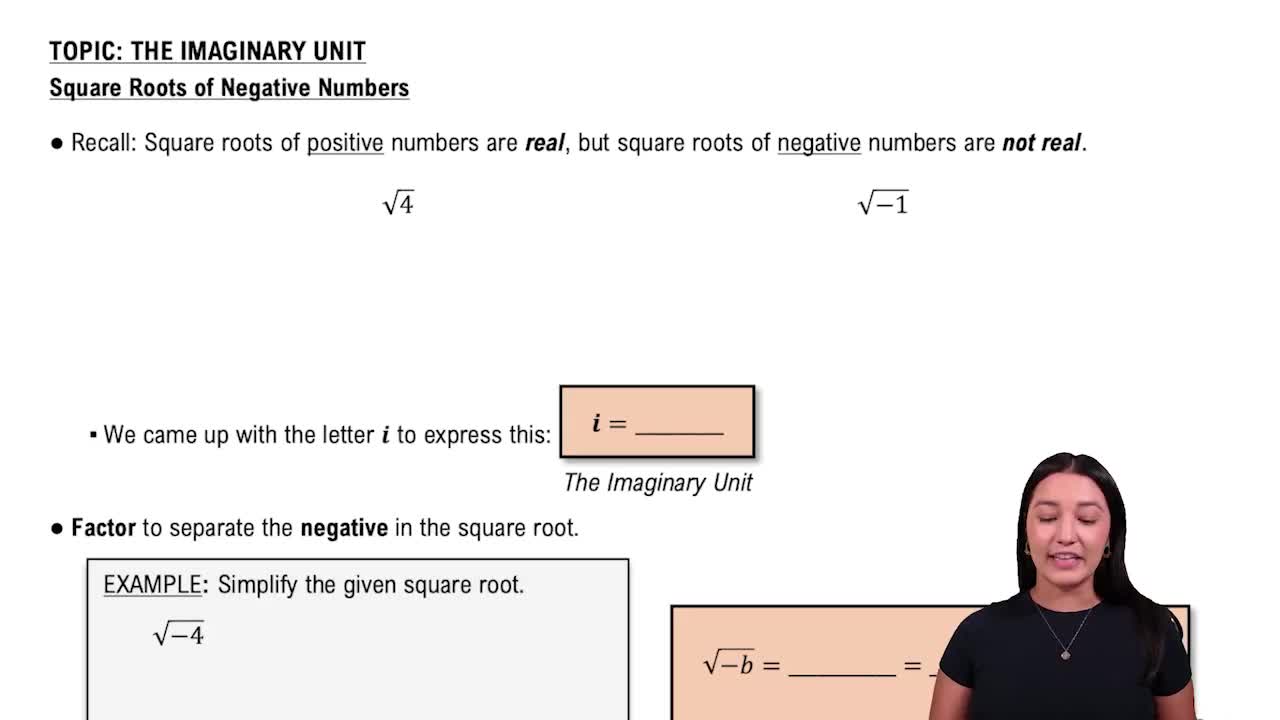
Recognize that the problem involves taking the square root of a negative number, specifically √−25.
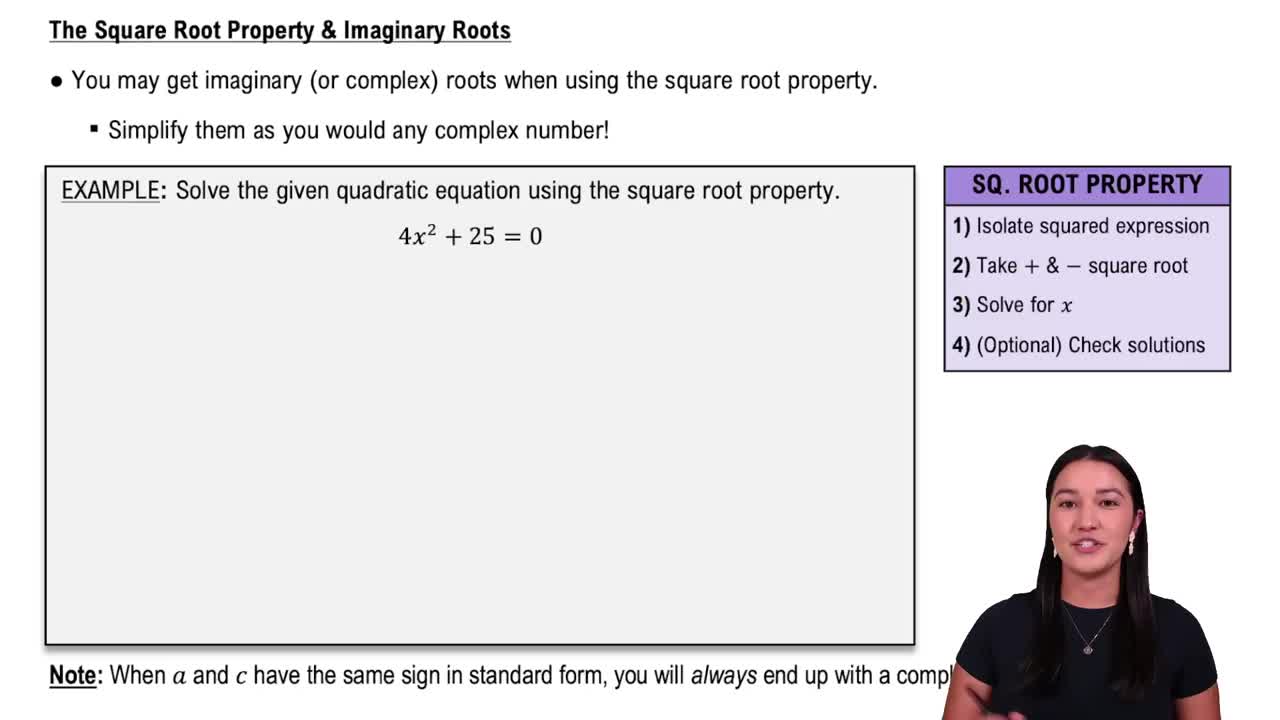
Recall that the square root of a negative number is not a real number in the set of real numbers. Instead, it is expressed using imaginary numbers.
Rewrite the square root of the negative number using the imaginary unit 'i', where i = √−1. For this problem, √−25 can be rewritten as √(25) × √(−1).
Simplify the square root of 25 to 5, and the square root of −1 to 'i'. Combine these results to express the solution as 5i.
Conclude that the root is not a real number, but rather an imaginary number, specifically 5i.
Verified video answer for a similar problem:
This video solution was recommended by our tutors as helpful for the problem above
Video duration:
1m
Play a video:
Was this helpful?
Key Concepts
Here are the essential concepts you must grasp in order to answer the question correctly.
Square Roots
A square root of a number 'x' is a value 'y' such that y² = x. For real numbers, square roots are defined only for non-negative values. When evaluating square roots, if 'x' is negative, the result is not a real number, leading to the concept of imaginary numbers.
Imaginary numbers are defined as multiples of the imaginary unit 'i', where i = √−1. This concept extends the real number system to include solutions to equations that do not have real solutions, such as the square root of negative numbers. For example, √−25 can be expressed as 5i.
Complex numbers are numbers that have a real part and an imaginary part, expressed in the form a + bi, where 'a' is the real part and 'b' is the coefficient of the imaginary part. This concept is essential for understanding how to work with square roots of negative numbers and performing operations involving both real and imaginary components.