In Exercises 1–20, evaluate each expression, or state that the expression is not a real number.____-√9/16
Verified step by step guidance
1
Identify the expression to evaluate: \(-\sqrt{\frac{9}{16}}\).
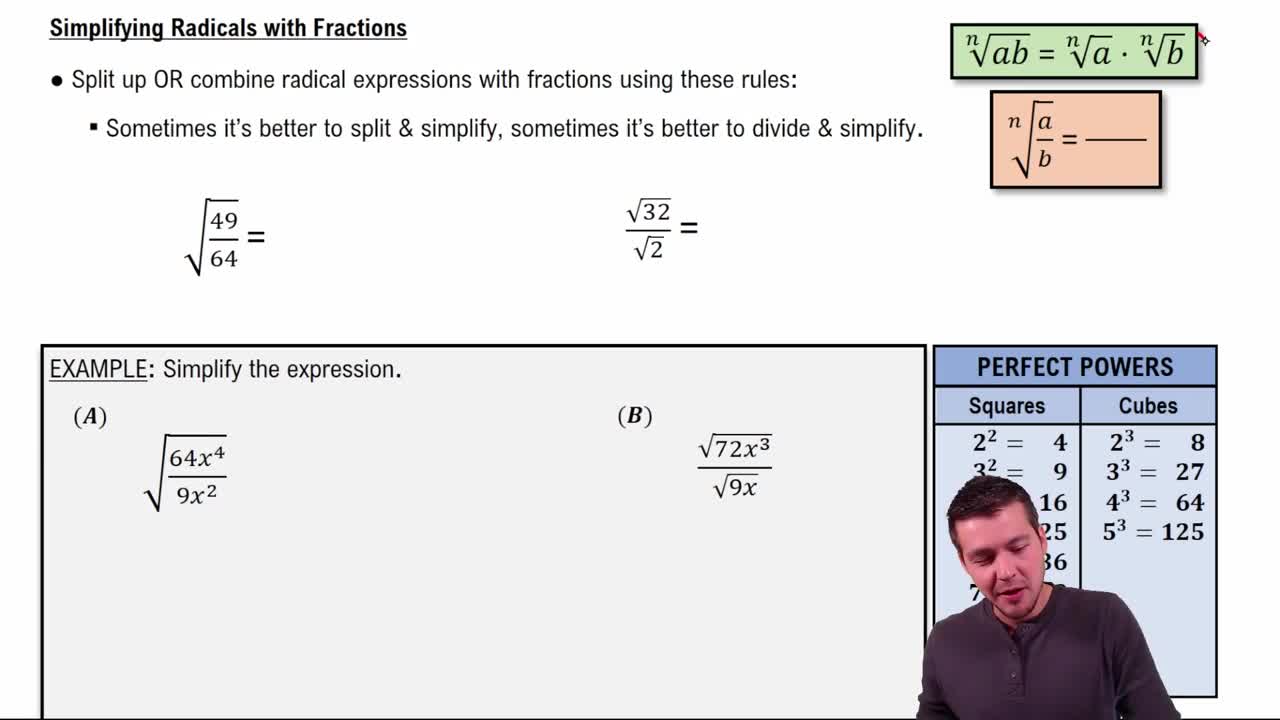
Recognize that the square root of a fraction can be expressed as the square root of the numerator divided by the square root of the denominator: \(\sqrt{\frac{9}{16}} = \frac{\sqrt{9}}{\sqrt{16}}\).
Calculate the square root of the numerator: \(\sqrt{9} = 3\).
Calculate the square root of the denominator: \(\sqrt{16} = 4\).
Combine the results to express the square root of the fraction: \(\frac{3}{4}\), and apply the negative sign: \(-\frac{3}{4}\).
Verified video answer for a similar problem:
This video solution was recommended by our tutors as helpful for the problem above
Video duration:
50s
Play a video:
Was this helpful?
Key Concepts
Here are the essential concepts you must grasp in order to answer the question correctly.
Square Roots
A square root of a number 'x' is a value 'y' such that y² = x. For non-negative numbers, square roots yield real numbers, while negative numbers do not have real square roots. For example, √9 = 3, since 3² = 9, but √-1 is not a real number.
Real numbers include all rational and irrational numbers, but they do not include imaginary numbers. When evaluating expressions involving square roots, if the radicand (the number under the square root) is negative, the result is not a real number. For instance, the square root of a negative number results in an imaginary number.
A fractional expression is a ratio of two numbers, where the denominator is not zero. In the expression -√9/16, the numerator is the square root of 9, which is 3, and the denominator is 16. This results in a real number, specifically -3/16, since both components are real.