In Exercises 1–20, use radical notation to rewrite each expression. Simplify, if possible.
(2xy³)^⅕
Verified step by step guidance
1
Identify the expression given: \((2xy^3)^{\frac{1}{5}}\).
Recognize that the expression is in exponential form and needs to be rewritten in radical notation.
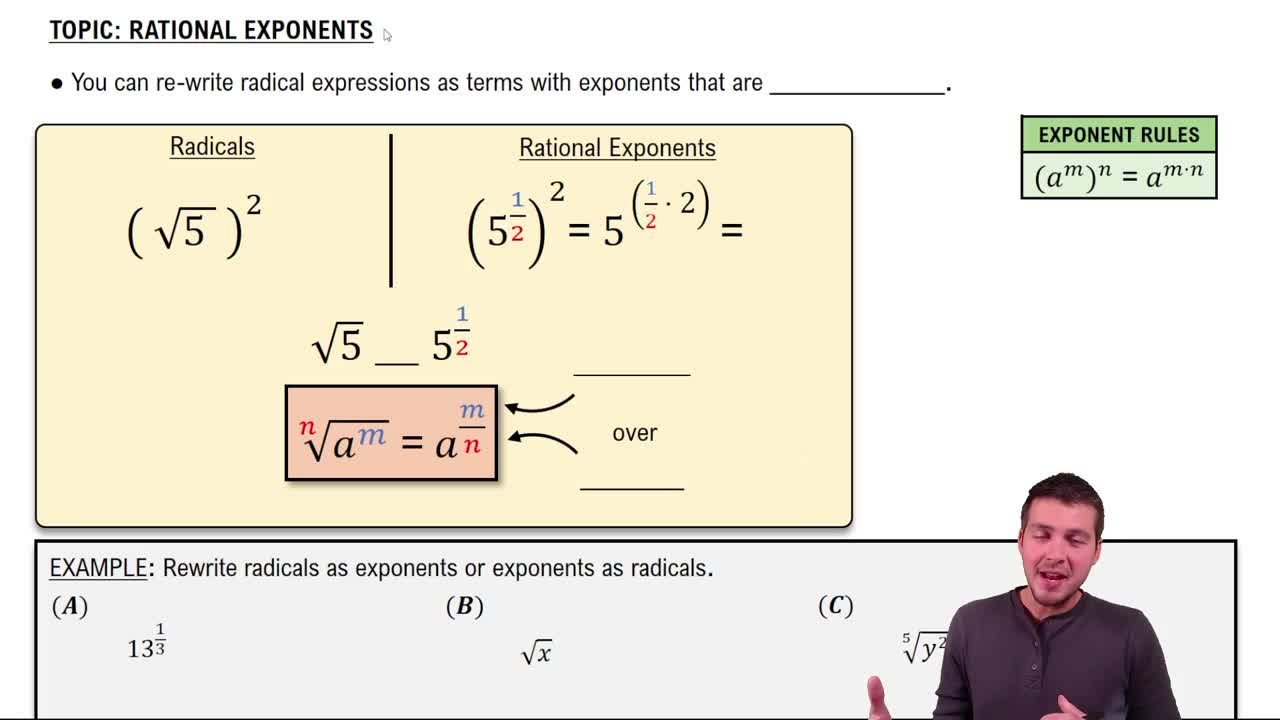
Use the property that \(a^{\frac{m}{n}} = \sqrt[n]{a^m}\) to convert the expression to radical form.
Apply this property to the expression: \((2xy^3)^{\frac{1}{5}} = \sqrt[5]{2xy^3}\).
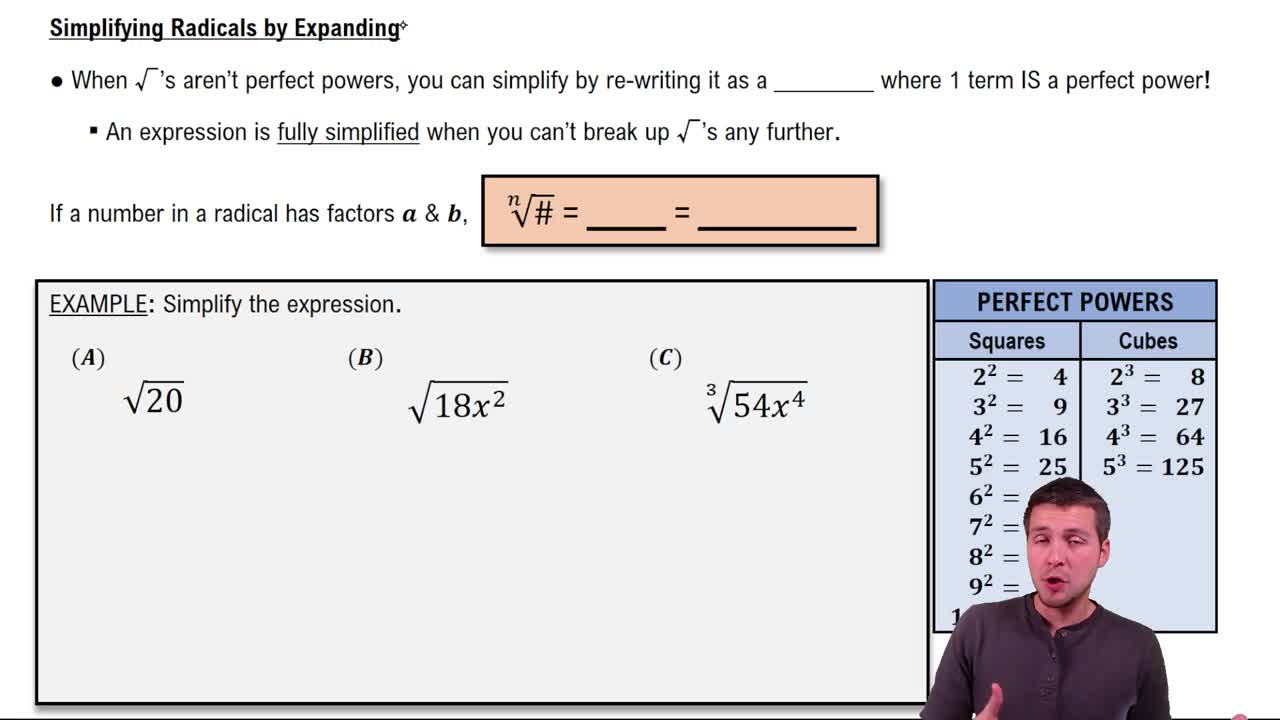
Check if the expression inside the radical can be simplified further, but in this case, it remains as \(\sqrt[5]{2xy^3}\).
Verified video answer for a similar problem:
This video solution was recommended by our tutors as helpful for the problem above.
Video duration:
2m
Play a video:
0 Comments
Key Concepts
Here are the essential concepts you must grasp in order to answer the question correctly.
Radical Notation
Radical notation is a way to express roots of numbers or variables using the radical symbol (√). For example, the square root of a number 'a' is written as √a. In algebra, radical notation can also represent fractional exponents, where the expression a^(1/n) is equivalent to the nth root of 'a'. Understanding this notation is essential for rewriting expressions involving roots.
Exponents indicate how many times a number or variable is multiplied by itself. Fractional exponents, such as 1/n, represent roots; for instance, x^(1/2) is the square root of x. When simplifying expressions with fractional exponents, it's important to apply the rules of exponents correctly, including the product and power rules, to achieve the simplest form.
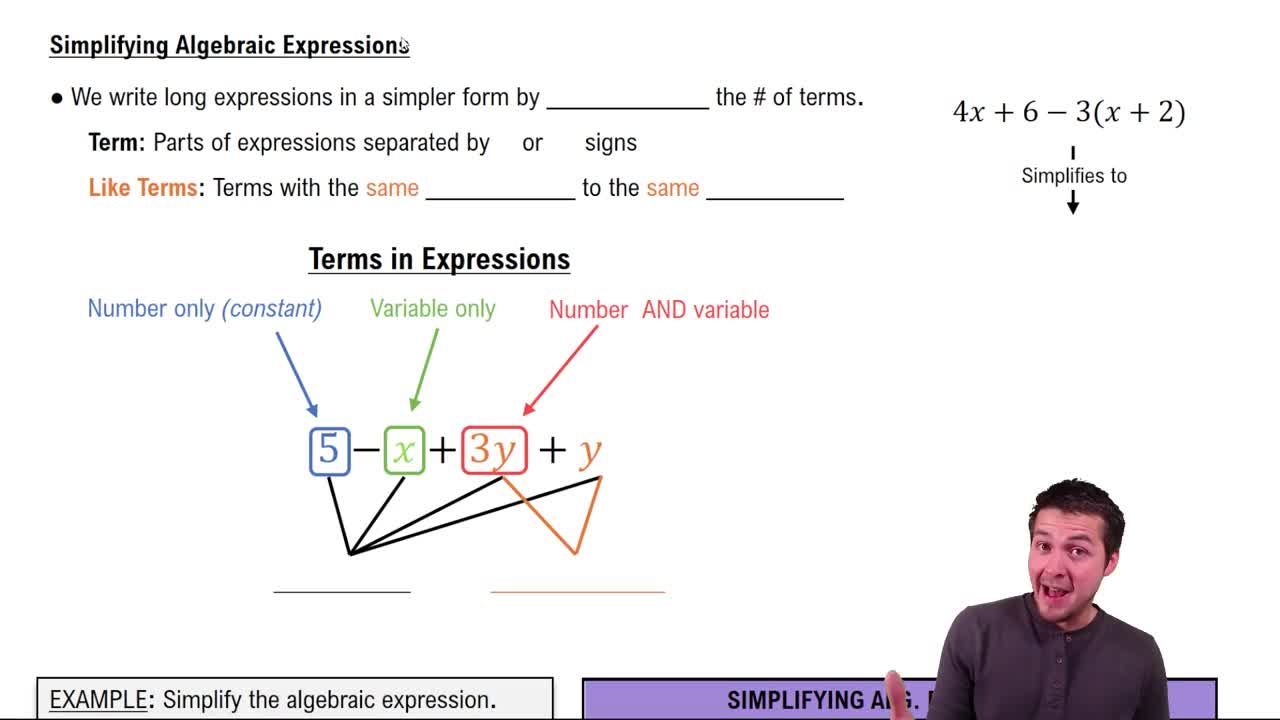
Simplifying expressions involves reducing them to their most basic form while maintaining equivalence. This process may include combining like terms, factoring, and applying the properties of exponents and radicals. In the context of the given expression, simplifying means rewriting (2xy³)^(1/5) in a way that clearly shows the roots of each component, making it easier to interpret and use in further calculations.

 2:32 minutes
 Verified step by step guidance
 05:20
05:20