Determine whether each statement is true or false. If false, correct the right side of the equation. (m2/3)(m1/3) = m2/9
Verified step by step guidance
1
Recall the property of exponents that states when multiplying powers with the same base, you add the exponents: \(a^x \cdot a^y = a^{x+y}\).
Apply this property to the expression \((m^{2/3})(m^{1/3})\). Add the exponents: \(\frac{2}{3} + \frac{1}{3}\).
Calculate the sum of the exponents: \(\frac{2}{3} + \frac{1}{3} = \frac{3}{3} = 1\).
Rewrite the product using the sum of the exponents: \((m^{2/3})(m^{1/3}) = m^1\).
Compare this result to the right side of the original equation \(m^{2/9}\). Since \(m^1 \neq m^{2/9}\), the original statement is false. The correct equation is \((m^{2/3})(m^{1/3}) = m^1\).
Verified video answer for a similar problem:
This video solution was recommended by our tutors as helpful for the problem above
Video duration:
2m
Play a video:
Was this helpful?
Key Concepts
Here are the essential concepts you must grasp in order to answer the question correctly.
Laws of Exponents
The laws of exponents govern how to simplify expressions involving powers. Specifically, when multiplying terms with the same base, you add their exponents. For example, m^a * m^b = m^(a+b). This rule is essential for simplifying the given expression.
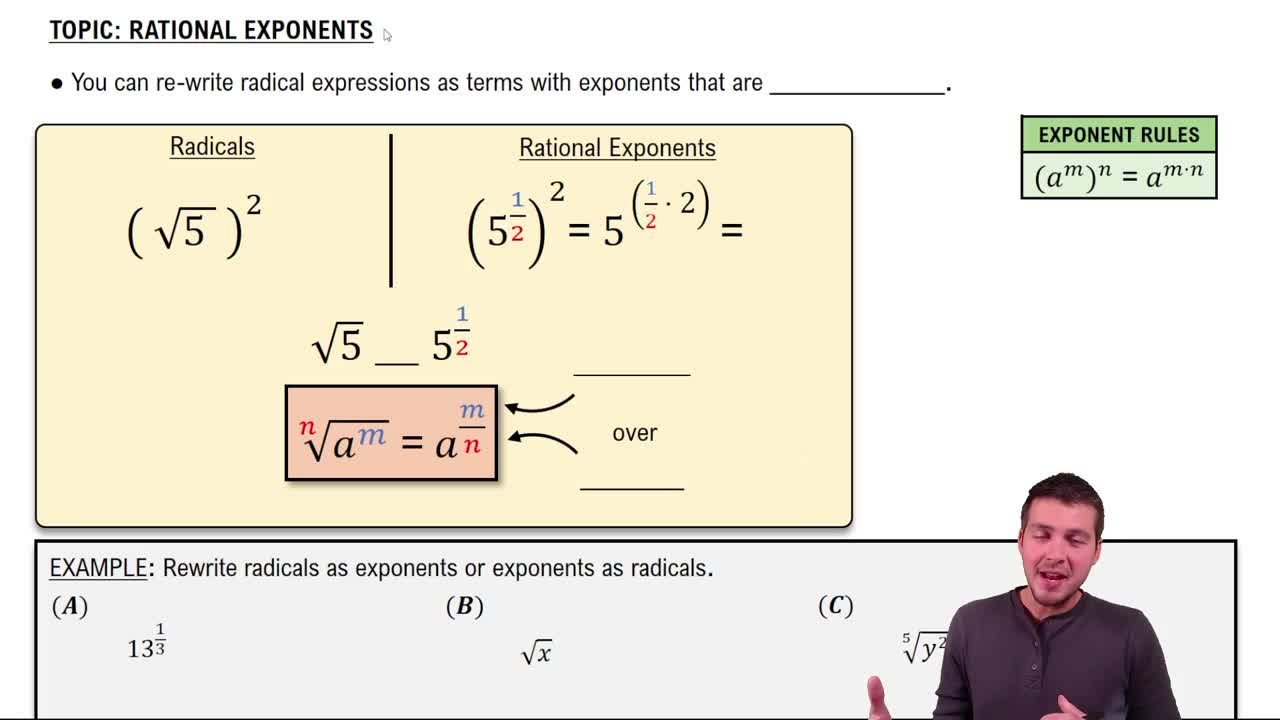
Fractional exponents represent roots and powers simultaneously. For instance, m^(1/3) means the cube root of m. Understanding how to manipulate fractional exponents is crucial for correctly adding or multiplying powers with fractional indices.
Simplifying exponential expressions involves applying exponent rules accurately to combine or reduce terms. In this problem, recognizing that (m^(2/3))*(m^(1/3)) equals m raised to the sum of the exponents (2/3 + 1/3) helps determine if the given equation is true or false.