Table of contents
- 0. Review of Algebra4h 18m
- 1. Equations & Inequalities3h 18m
- 2. Graphs of Equations1h 43m
- 3. Functions2h 17m
- 4. Polynomial Functions1h 44m
- 5. Rational Functions1h 23m
- 6. Exponential & Logarithmic Functions2h 28m
- 7. Systems of Equations & Matrices4h 5m
- 8. Conic Sections2h 23m
- 9. Sequences, Series, & Induction1h 22m
- 10. Combinatorics & Probability1h 45m
9. Sequences, Series, & Induction
Geometric Sequences
Problem 57
Textbook Question
In Exercises 57–62, let {an} = - 5, 10, - 20, 40, ..., {bn} = 10, - 5, - 20, - 35, ..., {cn} = - 2, 1, - 1/2, 1/4 Find a10 + b10.
Verified step by step guidance1
Identify the type of sequences given for {a_n} and {b_n}. Check if they are arithmetic or geometric by examining the pattern of terms.
For sequence {a_n} = -5, 10, -20, 40, ..., observe the pattern of signs and values. Determine the common ratio if it is geometric by dividing the second term by the first term: . Confirm this ratio for the next terms.
Once confirmed that {a_n} is geometric, use the geometric sequence formula for the nth term: , where is the first term and is the common ratio. Calculate the expression for .
For sequence {b_n} = 10, -5, -20, -35, ..., check if it is arithmetic by finding the difference between consecutive terms: , , etc. If the difference is constant, use the arithmetic sequence formula: , where is the common difference. Calculate the expression for .
Add the expressions for and to find . This sum will be the final expression representing the solution.
Verified video answer for a similar problem:This video solution was recommended by our tutors as helpful for the problem above
Video duration:
7mPlay a video:
Was this helpful?
Key Concepts
Here are the essential concepts you must grasp in order to answer the question correctly.
Sequences and Terms
A sequence is an ordered list of numbers defined by a specific pattern or rule. Each number in the sequence is called a term, denoted as a_n for the nth term. Understanding how to identify or express terms is essential for finding specific values like a10 or b10.
Recommended video:
Guided course
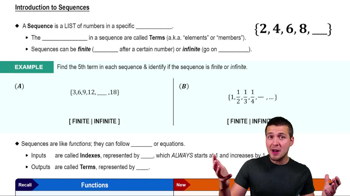
Introduction to Sequences
Arithmetic and Geometric Sequences
Arithmetic sequences have a constant difference between consecutive terms, while geometric sequences have a constant ratio. Recognizing the type of sequence helps determine the formula for the nth term, which is necessary to calculate terms like a10 and b10.
Recommended video:
Guided course
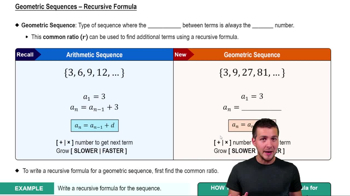
Geometric Sequences - Recursive Formula
Finding the nth Term and Summation
To find a specific term such as a10 or b10, you must derive or use the nth term formula. Once the terms are found, operations like addition (a10 + b10) can be performed. This involves algebraic manipulation and substitution of n=10 into the formulas.
Recommended video:
Guided course
Nth Roots
Watch next
Master Geometric Sequences - Recursive Formula with a bite sized video explanation from Patrick
Start learningRelated Videos
Related Practice
Textbook Question
In Exercises 51–56, the general term of a sequence is given. Determine whether the sequence is arithmetic, geometric, or neither. If the sequence is arithmetic, find the common difference; if it is geometric, find the common ratio.an = n + 5
707
views