Use the technique described in Exercises 87–90 to solve each inequality. Write the solution set in interval notation. -x2 + 4x + 1 ≥ 0
Table of contents
- 0. Review of Algebra4h 18m
- 1. Equations & Inequalities3h 18m
- 2. Graphs of Equations1h 43m
- 3. Functions2h 17m
- 4. Polynomial Functions1h 44m
- 5. Rational Functions1h 23m
- 6. Exponential & Logarithmic Functions2h 28m
- 7. Systems of Equations & Matrices4h 5m
- 8. Conic Sections2h 23m
- 9. Sequences, Series, & Induction1h 22m
- 10. Combinatorics & Probability1h 45m
1. Equations & Inequalities
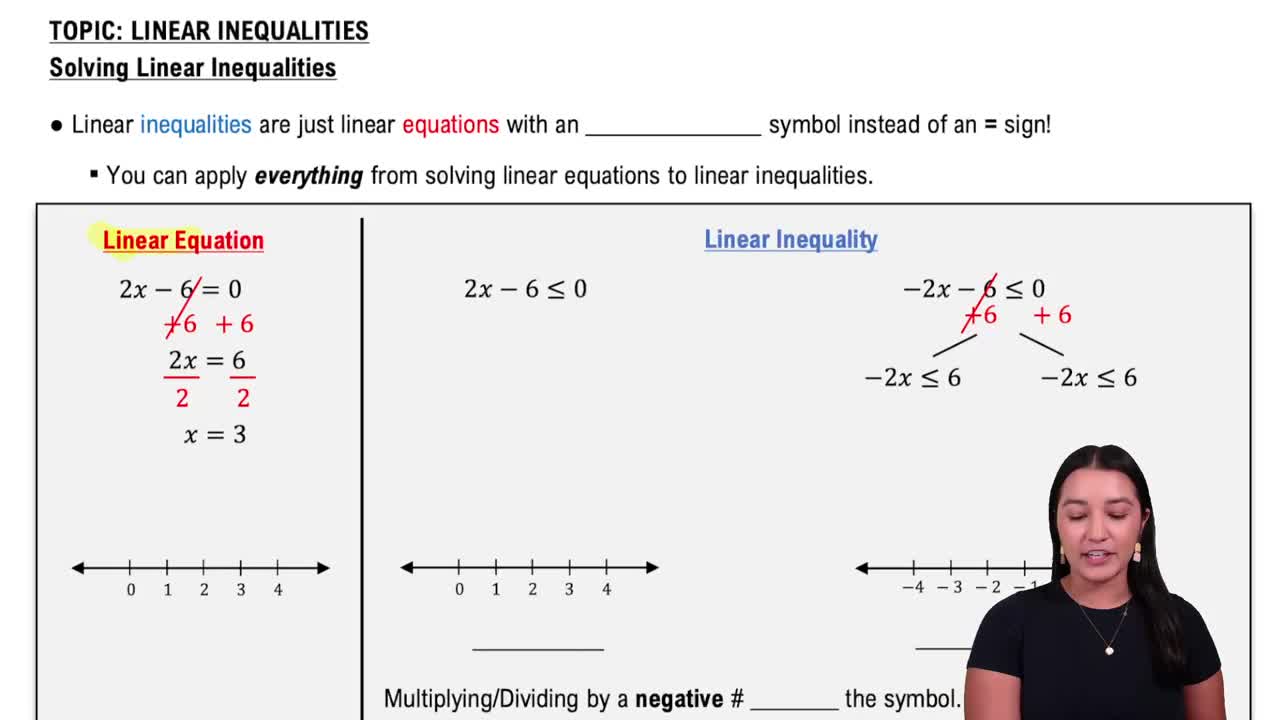
Linear Inequalities
Problem 5
Textbook Question
Use the graph to solve each equation or inequality. Use interval notation where appropriate. 7x(x - 1)(x - 2) > 0

Verified step by step guidance1
Identify the roots of the function from the equation \$7x(x - 1)(x - 2) = 0\(. These roots are the values of \)x\( where the function equals zero, which are \)x = 0\(, \)x = 1\(, and \)x = 2$.
Use the roots to divide the number line into intervals: \((-\infty, 0)\), \((0, 1)\), \((1, 2)\), and \((2, \infty)\).
Determine the sign of the function \$7x(x - 1)(x - 2)$ on each interval by either testing a point from each interval in the function or by analyzing the graph provided.
From the graph, identify where the function is greater than zero (i.e., where the graph is above the x-axis). These intervals correspond to the solution of the inequality \$7x(x - 1)(x - 2) > 0$.
Express the solution in interval notation by combining the intervals where the function is positive, excluding the points where the function equals zero since the inequality is strict (greater than zero, not greater than or equal to zero).
Verified video answer for a similar problem:This video solution was recommended by our tutors as helpful for the problem above
Video duration:
5mPlay a video:
Was this helpful?
Key Concepts
Here are the essential concepts you must grasp in order to answer the question correctly.
Polynomial Inequalities
Polynomial inequalities involve expressions where a polynomial is compared to zero or another value using inequality signs. Solving them requires finding intervals where the polynomial is positive or negative, often by analyzing the roots and the sign of the polynomial in each interval.
Recommended video:
Linear Inequalities
Roots and Zeros of a Polynomial
The roots or zeros of a polynomial are the values of x where the polynomial equals zero. These points divide the number line into intervals, which are tested to determine where the polynomial is positive or negative, crucial for solving inequalities.
Recommended video:
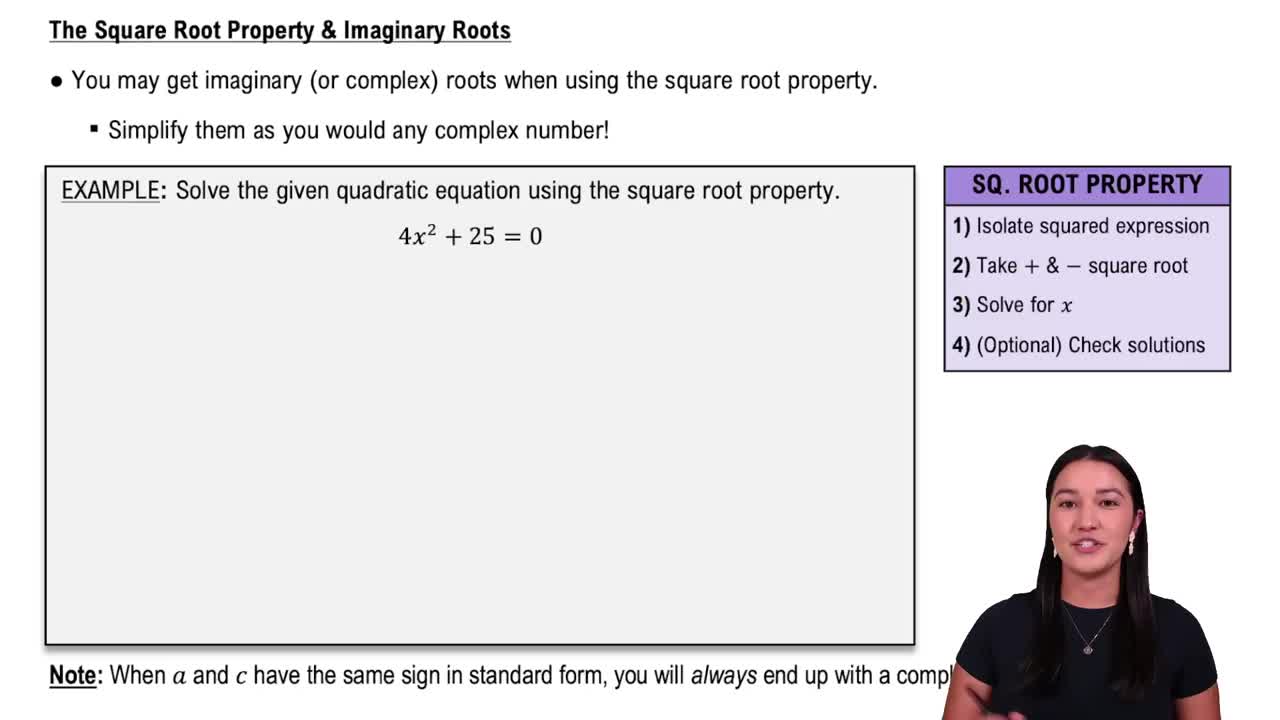
Imaginary Roots with the Square Root Property
Graph Interpretation for Inequalities
Using the graph of a polynomial function helps visualize where the function is above or below the x-axis. Regions where the graph lies above the x-axis correspond to positive values of the polynomial, aiding in solving inequalities like 7x(x-1)(x-2) > 0.
Recommended video:
Guided course
Linear Inequalities
Related Videos
Related Practice
Textbook Question
447
views