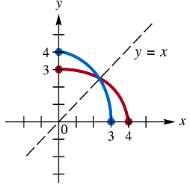
Determine whether each pair of functions graphed are inverses.
Verified step by step guidance
1
Step 1: Understand the concept of inverse functions. Two functions are inverses if one 'undoes' the effect of the other. Graphically, their graphs are reflections of each other across the line \(y = x\).
Step 2: Identify the given functions on the graph. The orange and blue curves represent the two functions, and the dashed line \(y = x\) is the line of reflection for inverse functions.
Step 3: Check if the graphs are symmetric with respect to the line \(y = x\). This means that for every point \((a, b)\) on one function, there should be a corresponding point \((b, a)\) on the other function.
Step 4: Observe the points where the orange and blue curves intersect the line \(y = x\). If these points match and the curves are mirror images across this line, the functions are inverses.
Step 5: Conclude based on the symmetry. If the orange and blue graphs are reflections of each other across the line \(y = x\), then the functions are inverses; otherwise, they are not.
Verified video answer for a similar problem:
This video solution was recommended by our tutors as helpful for the problem above
Video duration:
1m
Play a video:
Was this helpful?
Key Concepts
Here are the essential concepts you must grasp in order to answer the question correctly.
Inverse Functions
Inverse functions reverse the effect of each other, meaning if f(x) maps x to y, then its inverse f⁻¹(x) maps y back to x. Graphically, two functions are inverses if one is the reflection of the other across the line y = x.
The line y = x acts as a mirror for inverse functions. If the graph of one function is reflected over this line, it should coincide with the graph of its inverse. This line helps visually verify if two functions are inverses.
To determine if two graphed functions are inverses, check if each point (a, b) on one graph corresponds to a point (b, a) on the other. This means the graphs are symmetric about the line y = x, confirming the inverse relationship.