The remainder theorem indicates that when a polynomial ƒ(x) is divided by x-k, the remainder is equal to ƒ(k). Consider the polynomial function ƒ(x) = x^3 - 2x^2 - x+2. Use the remainder theorem to find each of the following. Then determine the coor-dinates of the corresponding point on the graph of ƒ(x). ƒ (-2)
Verified step by step guidance
1
Identify the polynomial function: \( f(x) = x^3 - 2x^2 - x + 2 \).
According to the remainder theorem, when a polynomial \( f(x) \) is divided by \( x - k \), the remainder is \( f(k) \).
Substitute \( x = -2 \) into the polynomial to find \( f(-2) \).
Simplify the expression to find the remainder, which is also the y-coordinate of the point on the graph where \( x = -2 \).
Verified video answer for a similar problem:
This video solution was recommended by our tutors as helpful for the problem above
Video duration:
7m
Play a video:
Was this helpful?
Key Concepts
Here are the essential concepts you must grasp in order to answer the question correctly.
Remainder Theorem
The Remainder Theorem states that when a polynomial f(x) is divided by a linear divisor of the form x - k, the remainder of this division is equal to f(k). This theorem simplifies the process of evaluating polynomials at specific points, allowing us to find the value of the polynomial without performing long division.
A polynomial function is a mathematical expression involving a sum of powers in one or more variables multiplied by coefficients. In this case, the polynomial f(x) = x^3 - 2x^2 - x + 2 is a cubic polynomial, which means its highest degree is three. Understanding the structure of polynomial functions is essential for applying the Remainder Theorem effectively.
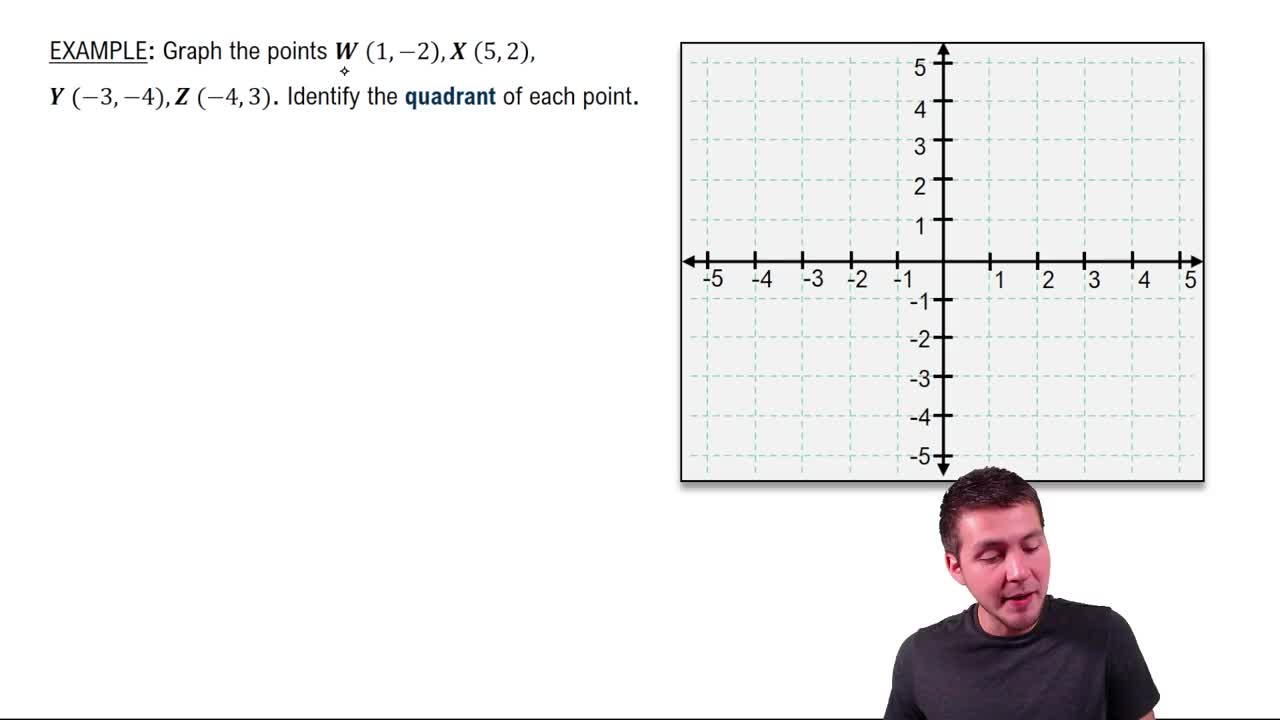
Graphing points involves plotting the coordinates of a function on a Cartesian plane. For the polynomial function f(x), once we calculate f(-2), we can determine the corresponding point on the graph, which will be represented as (-2, f(-2)). This visual representation helps in understanding the behavior of the polynomial and its roots.