Use synthetic division to determine whether the given number k is a zero of the polyno-mial function. If it is not, give the value of ƒ(k). ƒ(x) = x^2 + 3x + 4; k = 2+i
Verified step by step guidance
1
Write down the coefficients of the polynomial \( f(x) = x^2 + 3x + 4 \), which are \( 1, 3, \) and \( 4 \).
Set up the synthetic division using \( k = 2+i \). Place \( 2+i \) on the left and the coefficients \( 1, 3, 4 \) on the right.
Bring down the leading coefficient \( 1 \) to the bottom row.
Multiply \( 2+i \) by the number just written on the bottom row (initially \( 1 \)) and write the result under the next coefficient (\( 3 \)).
Add the numbers in the second column and write the result in the bottom row. Repeat the multiplication and addition process for the next column to determine if the remainder is zero or to find \( f(k) \).
Verified video answer for a similar problem:
This video solution was recommended by our tutors as helpful for the problem above
Video duration:
6m
Play a video:
Was this helpful?
Key Concepts
Here are the essential concepts you must grasp in order to answer the question correctly.
Synthetic Division
Synthetic division is a simplified method for dividing a polynomial by a linear binomial of the form (x - c). It allows for quicker calculations compared to long division, particularly when determining polynomial values at specific points or finding remainders. This technique is especially useful for evaluating polynomials at given values, such as checking if a number is a root.
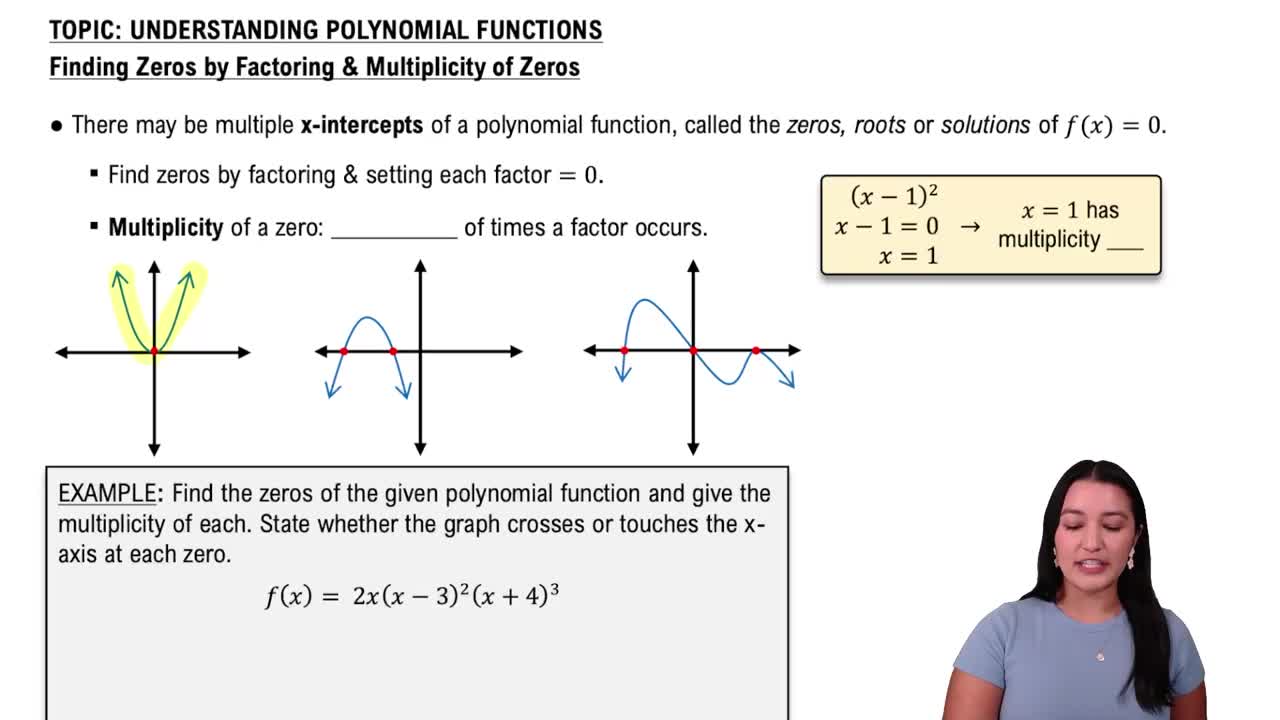
A polynomial function is a mathematical expression involving a sum of powers in one or more variables multiplied by coefficients. The general form is ƒ(x) = a_nx^n + a_(n-1)x^(n-1) + ... + a_1x + a_0, where 'n' is a non-negative integer. Understanding the structure of polynomial functions is crucial for analyzing their behavior, including finding roots and evaluating function values.
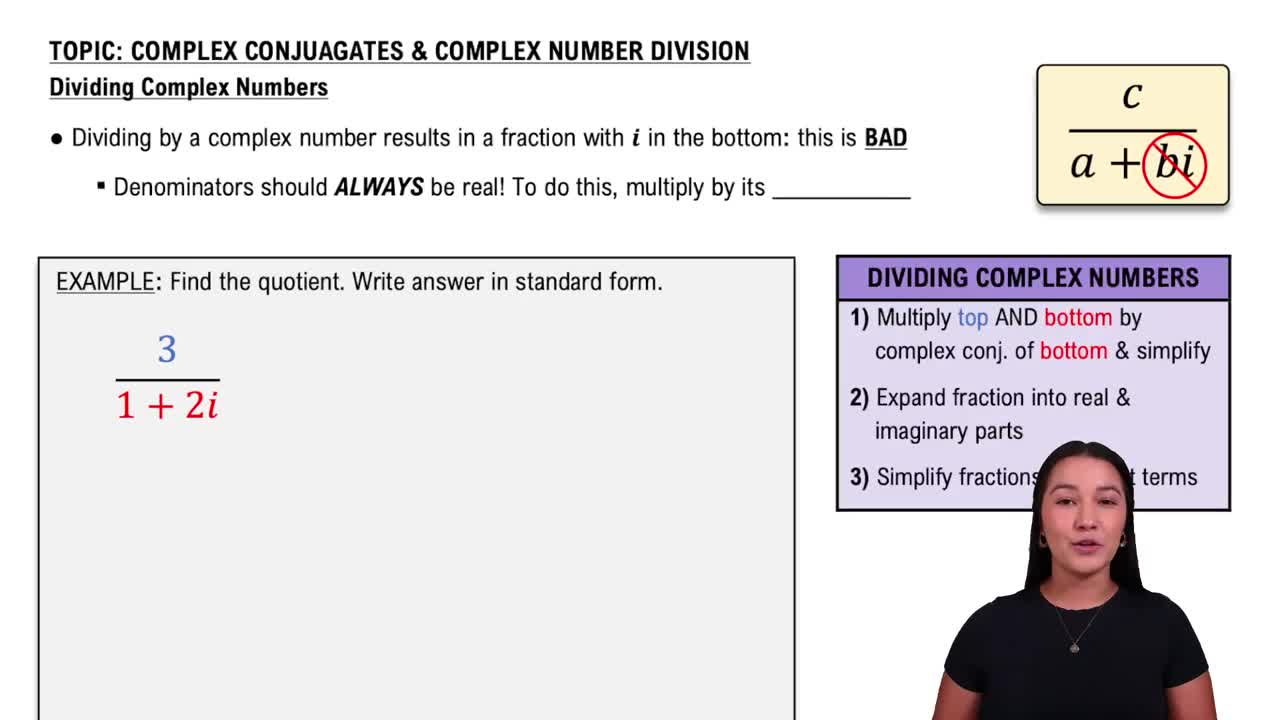
Complex numbers are numbers that have a real part and an imaginary part, expressed in the form a + bi, where 'a' is the real part and 'b' is the coefficient of the imaginary unit 'i' (where i^2 = -1). In this context, evaluating a polynomial at a complex number, such as k = 2 + i, requires understanding how to handle both the real and imaginary components to determine the function's value.