Solve each equation. See Example 7. (x2+24)1/4 = 3
Table of contents
- 0. Review of Algebra4h 18m
- 1. Equations & Inequalities3h 18m
- 2. Graphs of Equations1h 43m
- 3. Functions2h 17m
- 4. Polynomial Functions1h 44m
- 5. Rational Functions1h 23m
- 6. Exponential & Logarithmic Functions2h 28m
- 7. Systems of Equations & Matrices4h 5m
- 8. Conic Sections2h 23m
- 9. Sequences, Series, & Induction1h 22m
- 10. Combinatorics & Probability1h 45m
1. Equations & Inequalities
The Square Root Property
Problem 95
Textbook Question
Answer each question. Find the values of a, b, and c for which the quadratic equation. has the given numbers as solutions. (Hint: Use the zero-factor property in reverse.)
Verified step by step guidance1
Recall that if a quadratic equation \(ax^2 + bx + c = 0\) has solutions (roots) \(r_1\) and \(r_2\), then it can be factored as \(a(x - r_1)(x - r_2) = 0\).
Given the solutions \$4\( and \)5\(, write the factored form of the quadratic as \)a(x - 4)(x - 5) = 0$.
Expand the factored form by first multiplying the binomials: \((x - 4)(x - 5) = x^2 - 5x - 4x + 20 = x^2 - 9x + 20\).
Multiply the expanded expression by \(a\) to get \(a x^2 - 9a x + 20a = 0\), which matches the general form \(ax^2 + bx + c = 0\).
Identify the coefficients: \(a\) is the leading coefficient, \(b = -9a\), and \(c = 20a\). You can choose any nonzero value for \(a\) to get specific values for \(b\) and \(c\).
Verified video answer for a similar problem:This video solution was recommended by our tutors as helpful for the problem above
Video duration:
2mPlay a video:
Was this helpful?
Key Concepts
Here are the essential concepts you must grasp in order to answer the question correctly.
Quadratic Equations
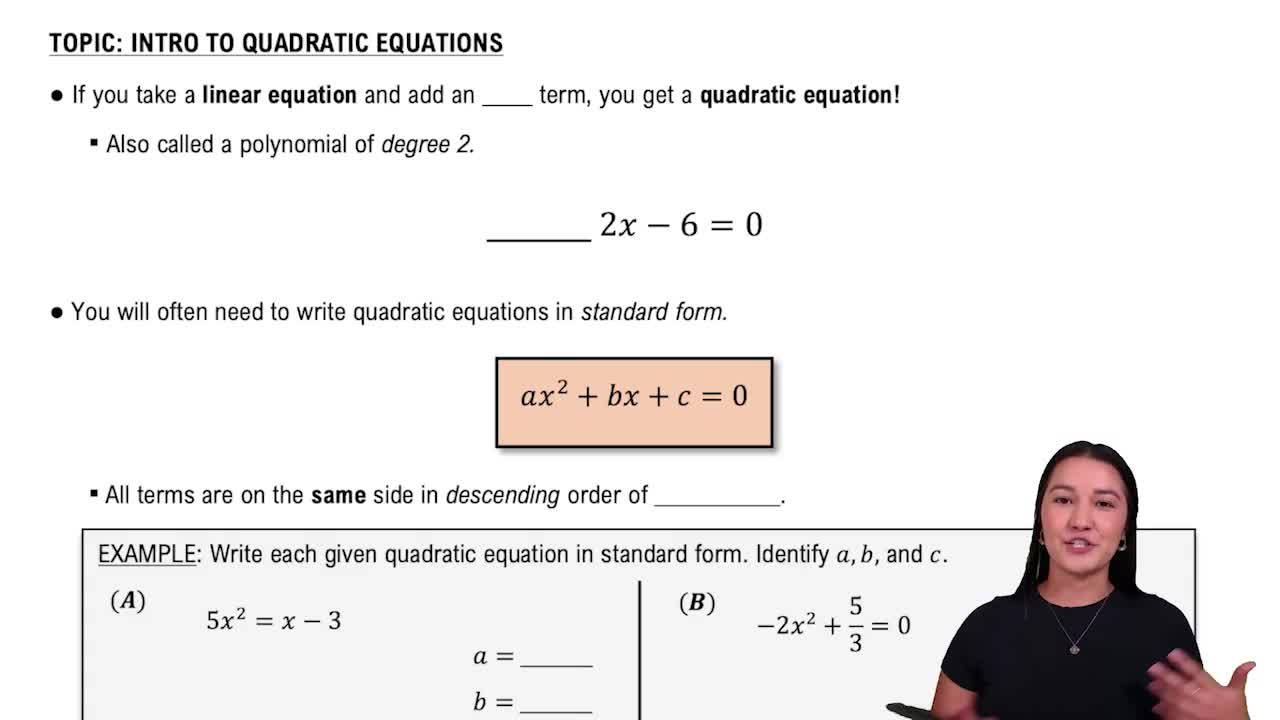
A quadratic equation is a second-degree polynomial equation of the form ax² + bx + c = 0, where a, b, and c are constants and a ≠ 0. The solutions (roots) of the equation are the values of x that satisfy it, often found using factoring, completing the square, or the quadratic formula.
Recommended video:
Introduction to Quadratic Equations
Zero-Factor Property
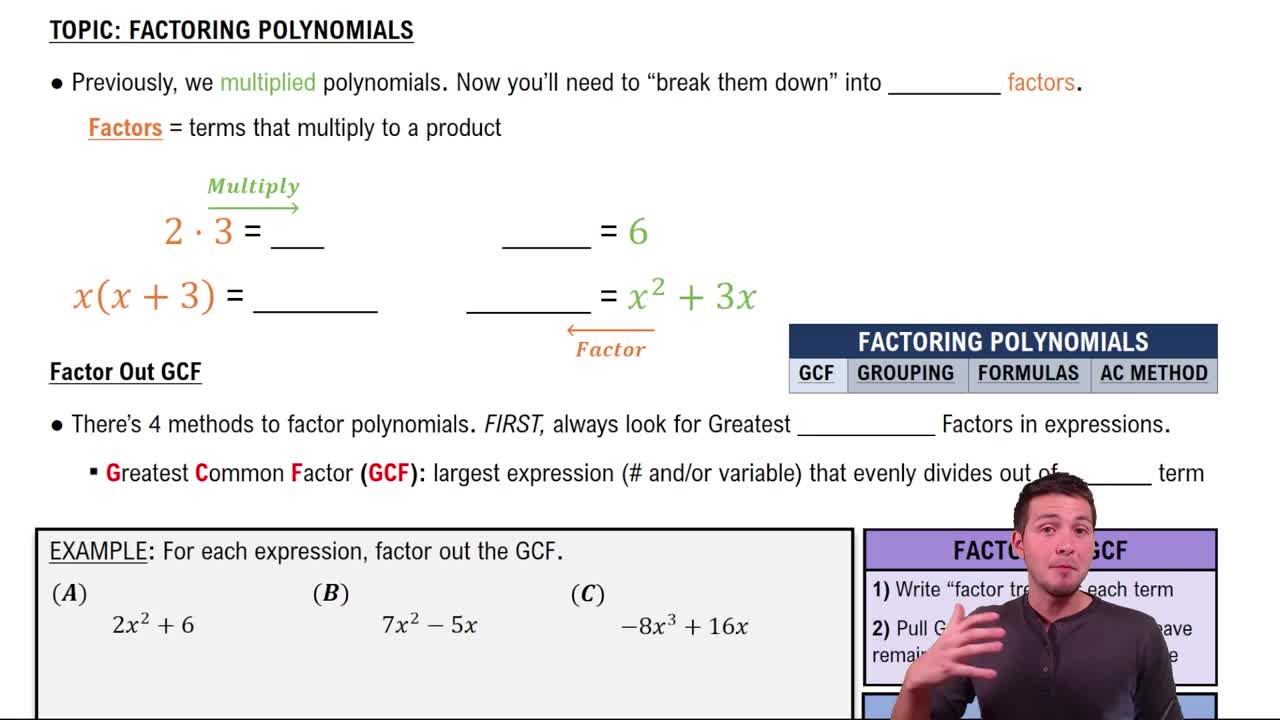
The zero-factor property states that if the product of two factors equals zero, then at least one of the factors must be zero. This property is used to solve quadratic equations by factoring them into two binomials and setting each equal to zero to find the roots.
Recommended video:
Guided course
Introduction to Factoring Polynomials
Forming Quadratic Equations from Roots
Given the roots of a quadratic equation, you can construct the equation by reversing the factoring process. If the roots are r₁ and r₂, the quadratic can be written as a(x - r₁)(x - r₂) = 0, which expands to ax² - a(r₁ + r₂)x + a(r₁r₂) = 0, allowing you to identify a, b, and c.
Recommended video:
Solving Quadratic Equations by the Square Root Property
Watch next
Master Solving Quadratic Equations by the Square Root Property with a bite sized video explanation from Patrick
Start learningRelated Videos
Related Practice
Textbook Question
432
views